Offline Feature Store via SageMaker Studio
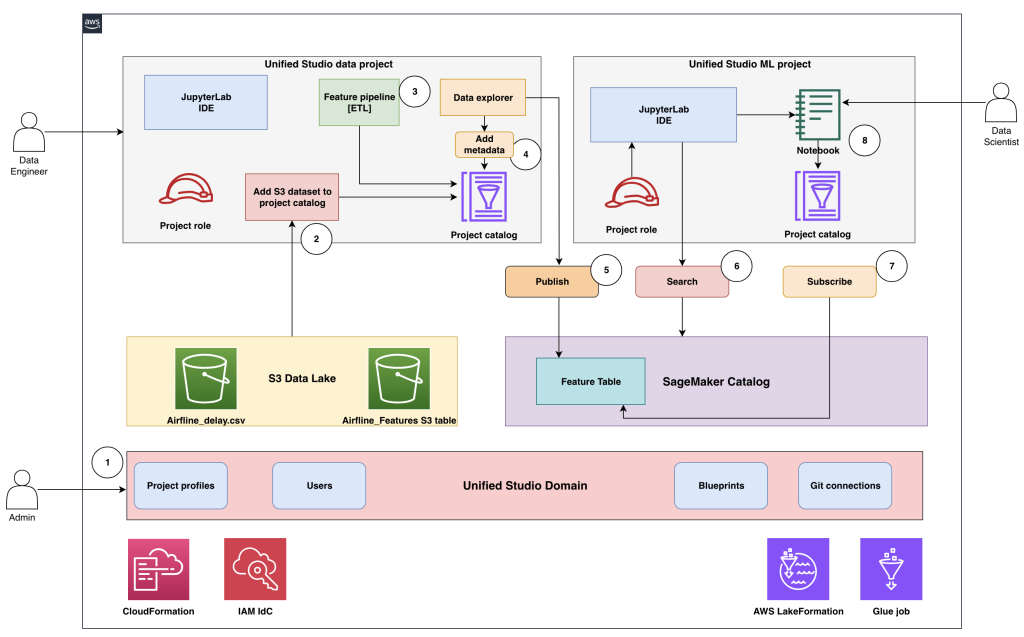
💡Build governed offline features in SageMaker—pub-sub pattern boosts ML efficiency
⚡ 30-Second TL;DR
What Changed
Step-by-step offline feature store build
Why It Matters
Streamlines ML pipelines by enabling reusable, governed features, accelerating model development across teams.
What To Do Next
Create a SageMaker domain and publish a test feature table using Catalog for offline ML reuse.
Key Points
- •Step-by-step offline feature store build
- •Uses SageMaker Unified Studio and Catalog
- •Publish-subscribe for versioned feature tables
- •Secure discovery and reuse for ML models
🧠 Deep Insight
Background and context from public sources — not the original article. 8 sources cited.
🔑 Enhanced Key Takeaways
- •SageMaker Feature Store maintains strict data consistency between online and offline stores to prevent training-serving skew, which is critical for model accuracy in production ML systems[5]
- •The offline store uses append-only Parquet file format with event-time-based partitioning (year/month/day/hour) in S3, enabling efficient historical data retrieval and point-in-time accuracy for model training[2][3]
- •SageMaker Feature Store supports batch ingestion from multiple enterprise data sources including Redshift, Snowflake, Databricks, and Lake Formation, with built-in feature transformation at ingestion time[5]
- •The offline store can be queried using the SageMaker Python SDK without writing SQL, supporting time travel, deduplication, and multi-feature-group joins for ML-ready dataset creation[6]
🛠️ Technical Deep Dive
- •Offline store data is stored in S3 using hierarchical partitioning:
s3://bucket/prefix/account-id/sagemaker/region/offline-store/feature-group-name-creation-time/data/year=YYYY/month=MM/day=DD/hour=HH/timestamp_16-alphanumeric.parquet[3] - •Feature groups require a record identifier name (unique key) and event time (timestamp) for all records; online store retains only the latest record per identifier, while offline store maintains complete history[1]
- •Supports two table format options: standard Parquet and Apache Iceberg (which registers tables with AWS Glue Data Catalog for modern data lake operations); Iceberg requires event time as String type[4]
- •Online store provides sub-millisecond latency reads via GetRecord API for real-time inference; offline store optimized for batch operations using Athena queries on S3-stored Parquet files[1][2]
- •When both online and offline stores are enabled, Feature Store automatically syncs data between them to maintain consistency, though InMemory online store type does not support offline replication[4]
🔮 Future ImplicationsAI analysis grounded in cited sources
⏳ Timeline
📎 Sources (8)
Factual claims are grounded in the sources below. Forward-looking analysis is AI-generated interpretation.
- docs.aws.amazon.com — Feature Store Concepts
- docs.aws.amazon.com — Feature Store
- docs.aws.amazon.com — Feature Store Offline
- docs.aws.amazon.com — Feature Store Storage Configurations Offline Store
- aws.amazon.com — Feature Store
- GitHub — Amazon Sagemaker Feature Store Offline Queries
- youtube.com — Watch
- dev.to — The Aws Aiml Landscape in 2026 Simplified 17i3
Weekly AI Recap
Read this week's curated digest of top AI events →
👉Related Updates
AI-curated news aggregator. All content rights belong to original publishers.
Original source: AWS Machine Learning Blog ↗
This is a summary, not the original. Read the source, or get the weekly briefing.
Weekly AI briefing
One email a week. Unsubscribe anytime.