NVIDIA’s AI Growth Keeps Surpassing Wall Street
💡NVIDIA’s record results reveal where AI compute demand, platforms, and infrastructure spending are heading next.
⚡ 30-Second TL;DR
What Changed
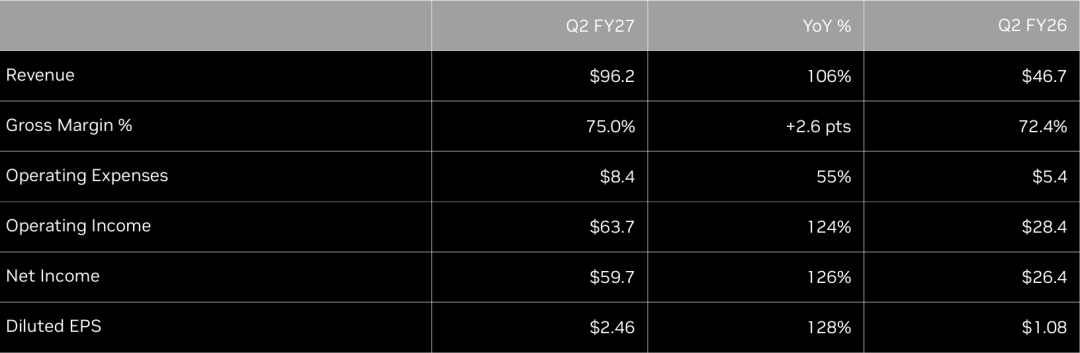
Second-quarter revenue reached $96.22 billion, net income $59.69 billion, and gross margin 75%.
Why It Matters
NVIDIA’s results reinforce the strength of enterprise demand for accelerated computing while raising questions about how long infrastructure spending can remain at this pace. Its shift into networking, software, system design, and project financing could reshape vendor relationships and increase platform lock-in for AI builders.
What To Do Next
Benchmark your inference stack on Blackwell-compatible infrastructure and evaluate NVIDIA DSX, Groq 3 LPX, and the Agent Toolkit before committing to your next production architecture.
Key Points
- •Second-quarter revenue reached $96.22 billion, net income $59.69 billion, and gross margin 75%.
- •Data-center revenue rose 117% year over year to $89.02 billion, led by large-scale AI infrastructure deployments.
- •AI cloud, industrial, and enterprise customers grew faster than hyperscalers, with ACIE revenue up 138% year over year.
- •Vera Rubin entered full production, while Groq 3 LPX, DSX, Agent Toolkit, and PhysicsNeMo expanded NVIDIA’s platform ecosystem.
- •NVIDIA disclosed $360 billion in future commitments and is targeting over $500 billion in third-party capital mobilization for AI infrastructure.
🧠 Deep Insight
Background and context from public sources — not the original article. 7 sources cited.
🔑 Enhanced Key Takeaways
- •NVIDIA reported non-GAAP earnings per diluted share of $2.22, exceeding the consensus analyst estimate of $2.09.
- •The company announced a significant expansion of its AWS partnership, involving the deployment of 2 million additional GPUs across Amazon's global infrastructure through 2028.
- •NVIDIA returned $26 billion to shareholders in Q2 via share repurchases and dividends, with $99 billion remaining in its current buyback authorization.
- •On August 25, 2026, NVIDIA launched the Jetson Orin Nano 2, targeting the integration of generative AI into entry-level edge robotics.
- •NVIDIA's market capitalization reached approximately $5 trillion as of late August 2026, reflecting its sustained dominance in the AI hardware sector.
📊 Competitor Analysis▸ Show
| Feature | NVIDIA (Rubin/Blackwell) | AMD (Instinct MI400 Series) | Intel (Gaudi 3) |
|---|---|---|---|
| Primary Focus | Full-stack AI Data Center | High-performance GPU Compute | Cost-effective AI Training |
| Architecture | Vera CPU + Rubin GPU | CDNA 4 Architecture | Tensor Processor Units |
| Ecosystem | CUDA / Omniverse / Agent Toolkit | ROCm / PyTorch optimization | OneAPI / OpenVINO |
🛠️ Technical Deep Dive
- Vera Rubin Platform: Integrates the Vera CPU with Rubin GPU architecture, specifically optimized for agentic and physical AI workloads.
- Jetson Orin Nano 2: Designed for edge-based generative AI, providing high-efficiency inference for robotics and autonomous systems.
- Agent Toolkit: Software framework enabling the deployment of autonomous AI agents capable of multi-step reasoning and task execution.
- PhysicsNeMo: A simulation framework designed to integrate physical laws into generative AI models for industrial digital twins.
🔮 Future ImplicationsAI analysis grounded in cited sources
⏳ Timeline
📎 Sources (7)
Factual claims are grounded in the sources below. Forward-looking analysis is AI-generated interpretation.
Weekly AI Recap
Read this week's curated digest of top AI events →
👉Related Updates


AI-curated news aggregator. All content rights belong to original publishers.
Original source: 虎嗅 ↗
This is a summary, not the original. Read the source, or get the weekly briefing.
Weekly AI briefing
One email a week. Unsubscribe anytime.