NVIDIA Turns AI Compute Into a $500B Asset
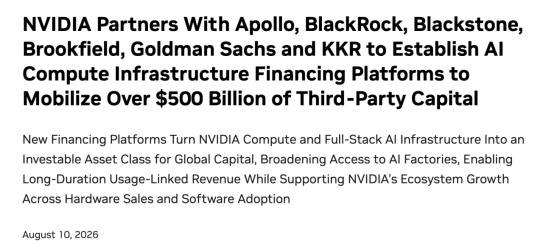
NVIDIA’s $500B platform could reshape how AI startups fund GPUs, data centers, and future compute demand.
30-Second TL;DR
What Changed
NVIDIA announced an AI compute infrastructure financing platform with Apollo, Blackstone, BlackRock, Brookfield, Goldman Sachs, and KKR.
Why It Matters
AI infrastructure may scale faster as compute demand becomes financeable collateral, but the model increases systemic exposure to uncertain future AI demand. If model usage or monetization falls short, GPU facilities, data centers, and lenders could face substantial losses.
What To Do Next
Recalculate your AI infrastructure roadmap under lower GPU utilization and higher financing costs before committing to long-term capacity contracts.
Key Points
- •NVIDIA announced an AI compute infrastructure financing platform with Apollo, Blackstone, BlackRock, Brookfield, Goldman Sachs, and KKR.
- •Volta Infrastructure secured a six-year, approximately $10 billion compute agreement with Anthropic before its first major data center became operational.
- •CoreWeave uses NVIDIA GPUs and long-term customer contracts to support infrastructure-backed financing, including an $8.5 billion loan.
- •Google is exploring TPU data-center financing backed by Anthropic’s future demand and Google’s credit support.
- •The model shifts AI infrastructure costs from technology-company balance sheets to banks, private credit, and infrastructure investors.
Deep Insight
AI-generated analysis for this event — not the original article.
Enhanced Key Takeaways
- •The financing model leverages 'compute-as-an-asset' securitization, where future GPU utilization is treated similarly to long-term power purchase agreements (PPAs) in the renewable energy sector.
- •NVIDIA's role has evolved from a hardware vendor to a 'compute orchestrator,' providing technical due diligence and demand-aggregation services to institutional lenders who lack internal AI expertise.
- •Regulatory bodies are closely monitoring this trend, specifically regarding the systemic risk posed by linking private credit markets to the highly volatile and rapidly depreciating lifecycle of AI hardware.
- •The shift toward infrastructure-backed financing is partially driven by the 'GPU-as-Collateral' standard, where NVIDIA’s secondary market liquidity for H100/B200 chips provides a floor for asset-backed security valuations.
- •This financial architecture enables smaller AI startups to bypass traditional venture capital dilution by funding massive compute clusters through debt instruments tied directly to their projected inference revenue.
Technical Deep Dive
- The financing structures rely on 'Compute-Backed Securities' (CBS), which utilize standardized metrics like TFLOPS-per-dollar and GPU-utilization-uptime guarantees as the primary collateral performance indicators.
- Implementation involves 'Virtual Data Center' partitioning, allowing lenders to track real-time GPU utilization and energy consumption via NVIDIA’s proprietary management software to verify asset health.
- Risk mitigation protocols include 'Hardware-Agnostic' clauses that allow for the migration of workloads to newer GPU architectures (e.g., Blackwell to Rubin) without triggering loan defaults, provided the compute capacity remains constant.
Future ImplicationsAI analysis grounded in cited sources
Timeline
- 2023-05NVIDIA reaches $1 trillion market cap, signaling the start of the massive AI infrastructure build-out phase.
- 2024-03NVIDIA introduces the Blackwell architecture, setting the new standard for high-performance compute assets.
- 2025-02NVIDIA begins formalizing partnerships with private credit firms to address the capital intensity of data center construction.
- 2026-01NVIDIA announces the expansion of its AI compute infrastructure financing platform to include major global financial institutions.
Weekly AI Recap
Read this week's curated digest of top AI events →
AI-curated news aggregator. All content rights belong to original publishers.
Original source: 虎嗅 ↗
This is a summary, not the original. Read the source, or get the weekly briefing.
The weekly digest
One email a week. Unsubscribe anytime.