Nvidia Pushes CPO Into AI Factories
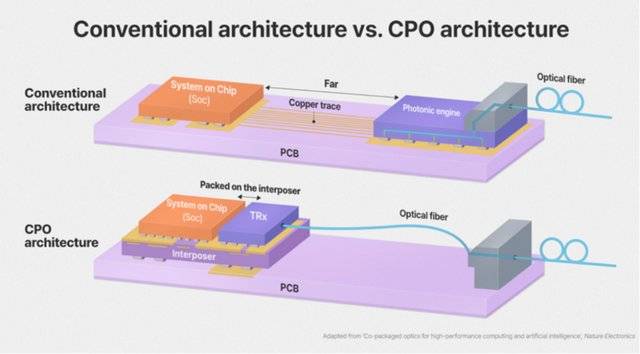
💡CPO is moving from lab roadmaps to production, potentially reshaping AI-cluster networking and its supplier base.
⚡ 30-Second TL;DR
What Changed
Nvidia’s Spectrum-X Ethernet Photonics is described as the first production 200G-per-lane CPO switch system.
Why It Matters
CPO could become a critical networking architecture for very large AI clusters as electrical reach, power, and cooling become bottlenecks. It may shift value from conventional front-panel optical-module assemblers toward silicon photonics, laser, advanced packaging, and system-integration suppliers.
What To Do Next
Benchmark your next AI-cluster network design against 200G-per-lane CPO options, focusing on power per bit, latency, thermal density, and serviceability versus 1.6T pluggable optics.
Key Points
- •Nvidia’s Spectrum-X Ethernet Photonics is described as the first production 200G-per-lane CPO switch system.
- •Nvidia claims fivefold better network power efficiency, fivefold longer AI application uptime, and 10 times higher MTBF than pluggable optics.
- •SK hynix’s roadmap covers the evolution from 2D/2.5D interposers to 3D heterogeneous stacking.
- •The reported supply chain includes TSMC, Siliconware Precision Industries, Lumentum, TFC, and Foxconn, but not major pluggable-module assemblers such as Innolight.
🧠 Deep Insight
Web-grounded analysis with 23 cited sources.
🔑 Enhanced Key Takeaways
- •Nvidia's Spectrum-X Ethernet Photonics CPO switch achieves a fourfold reduction in the number of lasers compared to traditional pluggable transceiver architectures.
- •The Spectrum-X system doubles the per-switch-chip bandwidth from 51.2 Tb/s (found in Blackwell-generation Spectrum-4) to 102.4 Tb/s.
- •Nvidia's CPO solution significantly reduces optical loss from approximately 22 dB to about 4 dB and improves signal integrity by a factor of 64.
- •Initial customers adopting Nvidia's Spectrum-X CPO include prominent cloud service providers such as CoreWeave, Lambda, and Oracle.
- •SK hynix's CPO technology roadmap, published in Nature Electronics in collaboration with several universities, proposes extending optical interconnects directly to the memory interface to address bandwidth bottlenecks.
🛠️ Technical Deep Dive
- Nvidia's Spectrum-X Ethernet Photonics integrates optical engines and switching ASICs directly within a single module, shortening signal transmission distances from 15-30 cm to mere millimeters.
- The system is built on Nvidia's next-generation Spectrum-6 switching chip.
- The flagship SN6800 configuration of Spectrum-X supports a total bandwidth of 409.6 Tb/s, configurable as 512 ports at 800Gb/s or 2,048 ports at 200Gb/s.
- Co-packaged optics (CPO) eliminates the need for Digital Signal Processor (DSP) retimers, which contributes to reduced network latency.
- SK hynix's CPO roadmap envisions an optics-centric architecture utilizing a photonic interposer to establish direct optical links between processor and memory resource pools.
- The CPO design uses 200Gb/s SerDes (serializer/deserializer) technology.
- Key technical challenges for CPO deployment include complex thermal management, difficulties with fiber attachment at scale, ensuring high manufacturing yield, comprehensive testing, and field serviceability.
🔮 Future ImplicationsAI analysis grounded in cited sources
⏳ Timeline
📎 Sources (23)
Factual claims are grounded in the sources below. Forward-looking analysis is AI-generated interpretation.
Weekly AI Recap
Read this week's curated digest of top AI events →
👉Related Updates


AI-curated news aggregator. All content rights belong to original publishers.
Original source: 虎嗅 ↗
Weekly AI briefing
One email a week. Unsubscribe anytime.