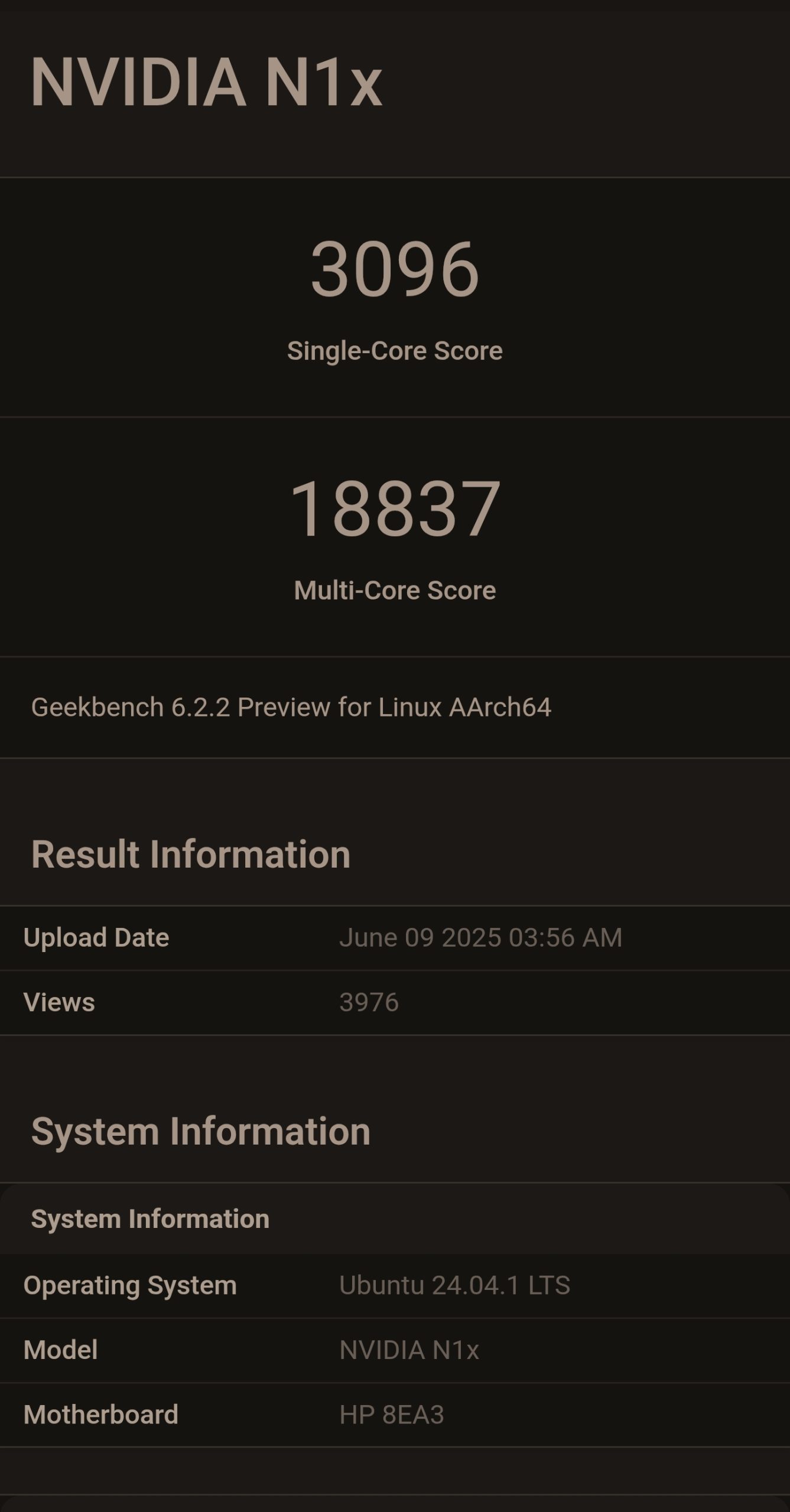
Nvidia N1x SoC benchmarks trail Apple M3 Max
💡Nvidia's challenge to Apple Silicon in the SoC market could reshape the hardware landscape for local AI inference.
⚡ 30-Second TL;DR
What Changed
Nvidia N1x SoC Geekbench 6 scores are lower than Apple M3 Max
Why It Matters
This suggests Nvidia's initial foray into high-performance consumer/laptop SoCs may face stiff competition from Apple Silicon's established efficiency and performance lead.
What To Do Next
Monitor the official Computex keynote to evaluate the N1x's power-to-performance ratio for potential edge AI deployment.
Key Points
- •Nvidia N1x SoC Geekbench 6 scores are lower than Apple M3 Max
- •Official announcement expected at upcoming Computex conference
- •Project involves strategic collaboration with Microsoft and ARM
🧠 Deep Insight
Background and context from public sources — not the original article. 27 sources cited.
🔑 Enhanced Key Takeaways
- •The Nvidia N1x SoC is fabricated on TSMC's 3nm process and integrates a Blackwell-architecture GPU with 6,144 CUDA cores, which is comparable to a desktop RTX 5070.
- •The N1x is specifically designed for Windows on ARM laptops and is a mobile adaptation of Nvidia's GB10 Superchip, previously seen in the DGX Spark mini-PC.
- •Nvidia's entry into the Windows on ARM market with the N1x aims to directly compete with Qualcomm's Snapdragon X Elite, leveraging Nvidia's extensive CUDA software ecosystem for AI and graphics acceleration on Windows laptops.
- •The N1x features a 20-core ARM CPU, configured with 10 performance and 10 efficiency cores based on Arm v9.2 architecture, and supports up to 128GB of LPDDR5X unified memory.
- •Major PC manufacturers including Dell, Lenovo, and ASUS are anticipated to launch laptops powered by the N1x SoC, indicating broad OEM support for Nvidia's new platform.
📊 Competitor Analysis▸ Show
| Feature/Spec | Nvidia N1x SoC (Top-end) | Apple M3 Max (16-core CPU/40-core GPU) | Qualcomm Snapdragon X Elite (X1E-84-100) |
|---|---|---|---|
| Manufacturing Process | TSMC 3nm | TSMC 3nm (N3B) | TSMC 4nm (likely) |
| CPU Cores | 20-core (10 Performance + 10 Efficiency) Arm v9.2 | 16-core (12 Performance + 4 Efficiency) | 12-core (8 Performance + 4 Efficiency) |
| GPU Cores | Blackwell architecture, 6,144 CUDA Cores (48 SMs), RTX 5070-class | 40-core GPU | Adreno GPU |
| Neural Engine/NPU | 180-200 TOPS AI computing power | 16-core Neural Engine, 18 TOPS | 45 TOPS NPU |
| Memory | Up to 128GB LPDDR5X unified memory | Up to 128GB unified memory (LPDDR5-6400) | Up to 64GB LPDDR5X unified memory |
| Memory Bandwidth | ~273 GB/s (GPU) / 300 GB/s (NVLink C2C) | 400 GB/s | 136 GB/s |
| TDP/Power | 45W-80W (N1X), 18W-45W (N1) | Not explicitly stated as TDP, designed for laptops | ~20-30W (typical for laptops) |
| Target OS | Windows on ARM | macOS | Windows on ARM |
| Key Differentiator | Full CUDA ecosystem, RTX-class integrated graphics | High performance-per-watt, integrated ecosystem | Strong battery life, Windows on ARM pioneer |
| Geekbench 6 CPU (Prototype) | Single-core: ~3096, Multi-core: ~18837 (N1x) | Single-core: ~3000-3200, Multi-core: ~21000-24000 | Single-core: ~2900-3000, Multi-core: ~15000-16000 |
| Geekbench OpenCL (GPU) | 46,361 (N1x prototype) | ~37,500 | N/A |
🛠️ Technical Deep Dive
- Architecture: The N1x SoC combines a CPU die designed by MediaTek with a GPU die built on Nvidia's Blackwell architecture in a 2.5D package.
- CPU: Features 20 Arm v9.2 cores, split into two clusters of 10 performance cores (Cortex-X925) and 10 efficiency cores (Cortex-A725), sharing 32 MB of L3 cache.
- GPU: Based on the Blackwell architecture, it includes 48 Streaming Multiprocessors (SMs) for a total of 6,144 CUDA cores, which is the same shader count as the desktop GeForce RTX 5070. It also features fifth-generation Tensor Cores with NVFP4 precision and dedicated ray tracing cores.
- Manufacturing Process: Built on TSMC's 3nm process.
- Memory: Supports up to 128GB of LPDDR5X unified memory across 16 channels, with a reported memory bandwidth for the GPU of approximately 273 GB/s.
- Interconnect: The CPU and GPU chiplets are connected via Nvidia's NVLink C2C interconnect, providing 300 GB/s bidirectional bandwidth.
- AI Performance: The N1x is expected to deliver 180-200 TOPS of AI computing power, exceeding Microsoft's Copilot+ certification requirement of 45+ TOPS.
- Power Envelope: The N1x models are designed to operate within a power range of 45W to 80W, while the standard N1 chips target a lower 18W to 45W range.
- PCIe Support: Both N1 and N1x processors feature PCIe 5.0 and 4.0 connectivity, with N1X offering 8x PCIe 5.0 lanes and 3x PCIe 4.0 lanes.
🔮 Future ImplicationsAI analysis grounded in cited sources
⏳ Timeline
📎 Sources (27)
Factual claims are grounded in the sources below. Forward-looking analysis is AI-generated interpretation.
- techtimes.com
- overclock3d.net
- 36kr.com
- videocardz.com
- pcworld.com
- aiweekly.co
- windowsforum.com
- notebookcheck.net
- techpowerup.com
- hothardware.com
- tweaktown.com
- notebookcheck.net
- lowendmac.com
- techable.com
- apple.com
- tomshardware.com
- invgate.com
- windowsforum.com
- techpowerup.com
- tomshardware.com
- overclocking.com
- forbes.com
- notebookcheck.net
- emulators.com
- pcmag.com
- pcmag.com
- tomshardware.com
Weekly AI Recap
Read this week's curated digest of top AI events →
👉Related Updates
AI-curated news aggregator. All content rights belong to original publishers.
Original source: cnBeta (Full RSS) ↗
This is a summary, not the original. Read the source, or get the weekly briefing.
The weekly digest
One email a week. Unsubscribe anytime.