Nvidia GTC Leaves AI Fans Disappointed
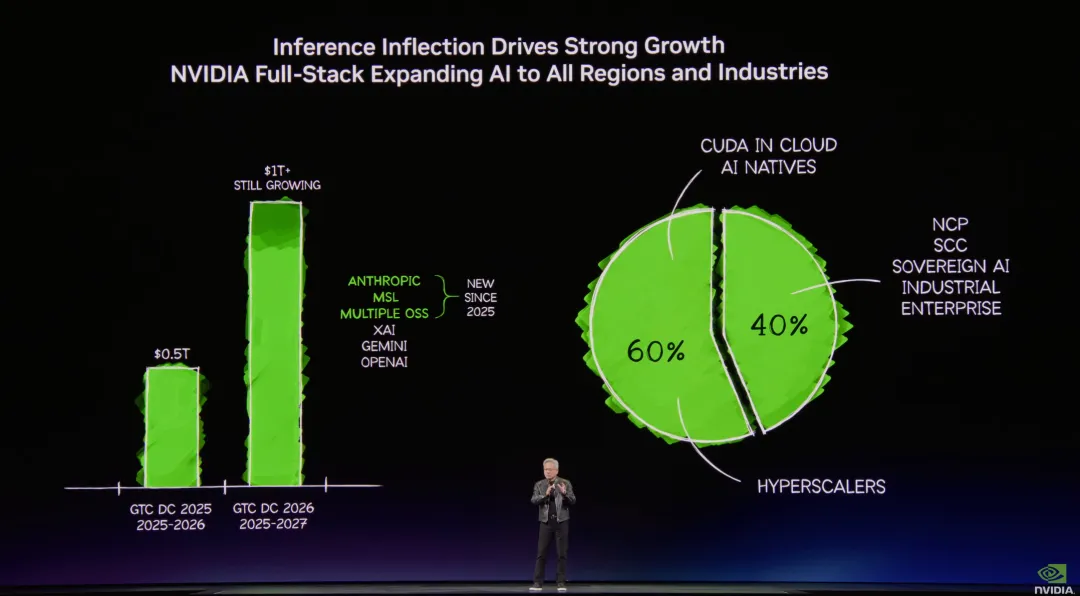
💡Nvidia GTC underdelivers—reveals cracks in AI growth story for devs & founders
⚡ 30-Second TL;DR
What Changed
High expectations for major AI announcements unmet
Why It Matters
Signals potential slowdown in Nvidia's AI hype cycle, prompting investors to seek alternative growth drivers. AI practitioners may see reduced short-term innovation momentum from Nvidia.
What To Do Next
Review GTC keynote transcripts for subtle Blackwell GPU roadmap hints.
Key Points
- •High expectations for major AI announcements unmet
- •Conference guidance described as flat and uninspiring
- •Urgent need for Nvidia's new AI growth narrative
🧠 Deep Insight
Background and context from public sources — not the original article. 10 sources cited.
🔑 Enhanced Key Takeaways
- •Nvidia announced Vera Rubin, a full-stack computing platform comprising seven chips, five rack-scale systems, and one supercomputer specifically optimized for agentic AI workloads, representing a major architectural shift beyond traditional GPU-centric designs[1][5]
- •DLSS 5 combines controllable 3D graphics with generative AI to create 'generative worlds,' demonstrating Nvidia's strategy to fuse structured data with generative AI across multiple industries beyond gaming[1]
- •Nvidia positioned 2026 as an 'inflection point for inference,' emphasizing that token throughput at iso power is now the critical metric for AI factories, with Vera Rubin delivering significantly higher throughput across all performance tiers[1]
- •The conference featured extensive Physical AI ecosystem expansion, with partnerships from semiconductor companies (Analog Devices, Infineon, NXP, STMicroelectronics, Texas Instruments) and industrial manufacturers integrating sensors and actuators into Nvidia's Isaac Sim framework and Holoscan Sensor Bridge[5]
- •Nvidia announced NemoClaw, an open-source enterprise AI agent platform designed to compete with OpenAI's offerings, positioning the company to capture the emerging agentic AI market segment[2]
🛠️ Technical Deep Dive
- •Vera Rubin platform architecture: Seven specialized chips, five rack-scale systems, one supercomputer; includes new Vera CPU and BlueField-4 STX storage architecture[5]
- •DLSS 5 technology: 3D-guided neural rendering enabling real-time, photoreal 4K performance on local hardware through fusion of structured data with generative AI[5]
- •Jetson Thor edge AI performance: MIC-742 delivers up to 2,070 TFLOPS (FP4) AI performance for humanoid robotics; MIC-743 enables real-time vision analytics and video summarization[3]
- •Nemotron 3 model family: Expanded lineup including Nemotron 3 Super with reasoning, speech, and vision capabilities[5]
- •Holoscan Sensor Bridge: Low-latency sensor-to-inference pipeline enabling transformer and vision-language-action models; Ethernet-based camera modules from Leopard Imaging, D3 Embedded, and e-con Systems stream sensor data directly to GPU[5]
🔮 Future ImplicationsAI analysis grounded in cited sources
⏳ Timeline
📎 Sources (10)
Factual claims are grounded in the sources below. Forward-looking analysis is AI-generated interpretation.
- Tom's Hardware — Nvidia Gtc 2026 Keynote Live Blog Jensen Huang
- TechCrunch — Nvidia Gtc How to Watch Jensen Huang 2026 Keynote
- prnewswire.com — Advantech to Showcase Edge AI and Physical AI Innovations at Nvidia Gtc 2026 302715417
- nvidianews.nvidia.com — Nvidia Vera Rubin Platform
- blogs.nvidia.com — Gtc 2026 News
- biztechmagazine.com — Nvidia Gtc 2026 What Expect Ais Biggest Event
- youtube.com — Watch
- NVIDIA — Gtc
- youtube.com — Watch
- NVIDIA — Advancing AI with Open Models
Weekly AI Recap
Read this week's curated digest of top AI events →
👉Related Updates


AI-curated news aggregator. All content rights belong to original publishers.
Original source: 钛媒体 ↗
This is a summary, not the original. Read the source, or get the weekly briefing.
Weekly AI briefing
One email a week. Unsubscribe anytime.