NVIDIA Doubles Down on China’s Robotics Market
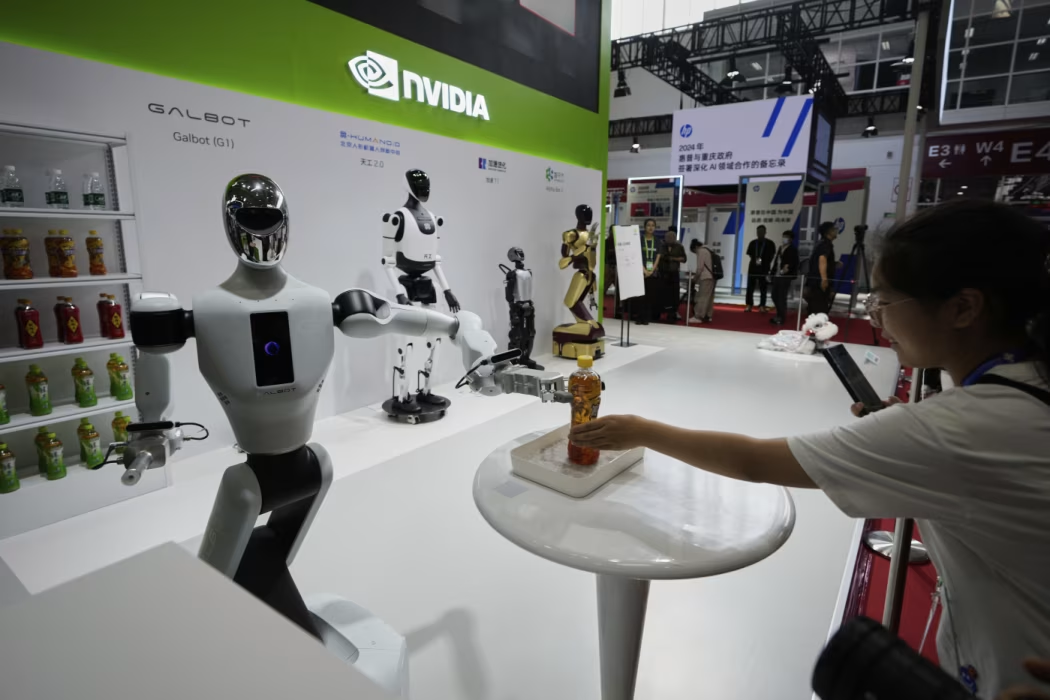
💡NVIDIA’s China robotics bet could determine which chips and platforms power the next wave of physical AI.
⚡ 30-Second TL;DR
What Changed
NVIDIA is expanding its physical AI strategy beyond data-center and generative AI workloads.
Why It Matters
NVIDIA’s strategy could accelerate competition for compute platforms, software stacks, and ecosystem partnerships in embodied AI. The differing trade treatment of robotics and automotive chips may also influence how Chinese developers design hardware and deployment architectures.
What To Do Next
Map your robotics stack against NVIDIA’s currently permitted automotive and robotics chips, then verify availability and export eligibility with an authorized distributor.
Key Points
- •NVIDIA is expanding its physical AI strategy beyond data-center and generative AI workloads.
- •Robotics and autonomous vehicles are identified as key application areas.
- •China remains strategically important despite US restrictions on advanced NVIDIA AI chip exports.
🧠 Deep Insight
Background and context from public sources — not the original article. 8 sources cited.
🔑 Enhanced Key Takeaways
- •NVIDIA's physical AI segment currently generates $10 billion in annual revenue, with projections for a tenfold increase over the next decade.
- •Chinese manufacturers dominated the global humanoid robot market in H1 2026, accounting for approximately 90% of total shipments.
- •Unitree Robotics, a major NVIDIA customer, achieved a 32.4% global market share in 2025 and completed a $900 million IPO on the Shanghai STAR Market in August 2026.
- •Chinese robotics firms are increasingly pivoting from NVIDIA's Jetson platform to domestic alternatives like Huawei's Ascend chips to ensure supply chain security.
- •The US FCC recently implemented a ban on new foreign-made humanoid and quadruped robot imports, creating a significant regulatory barrier for Chinese firms utilizing NVIDIA-powered hardware.
📊 Competitor Analysis▸ Show
| Feature | NVIDIA (Jetson/Orin) | Huawei (Ascend) | Custom In-House Silicon |
|---|---|---|---|
| Ecosystem | Mature (CUDA/Isaac) | Emerging (MindSpore) | Proprietary/Limited |
| Supply Chain | Subject to US Export Controls | Secure (Domestic) | Secure (Domestic) |
| Market Focus | Global/General Purpose | China/Industrial AI | Automotive/Specific OEM |
| Pricing | Premium | Competitive | High R&D/Low Unit Cost |
🛠️ Technical Deep Dive
- Jetson Platform: Utilizes NVIDIA's Ampere and Blackwell-derived architectures for edge inference in robotics.
- Orin/Thor SoCs: Integrated systems-on-chip designed for autonomous vehicle compute, featuring high-performance GPU cores and dedicated deep learning accelerators.
- Isaac SDK: Software stack providing simulation environments (Omniverse) and AI models for robot perception and navigation.
- Huawei Ascend: NPU-based architecture optimized for transformer-based models and edge inference, increasingly used as a replacement for Jetson modules in Chinese humanoid designs.
🔮 Future ImplicationsAI analysis grounded in cited sources
⏳ Timeline
📎 Sources (8)
Factual claims are grounded in the sources below. Forward-looking analysis is AI-generated interpretation.
Weekly AI Recap
Read this week's curated digest of top AI events →
👉Related Updates


AI-curated news aggregator. All content rights belong to original publishers.
Original source: cnBeta (Full RSS) ↗
This is a summary, not the original. Read the source, or get the weekly briefing.
Weekly AI briefing
One email a week. Unsubscribe anytime.