Nubia Debuts World's First Mass-Produced AI Agent Smartphone
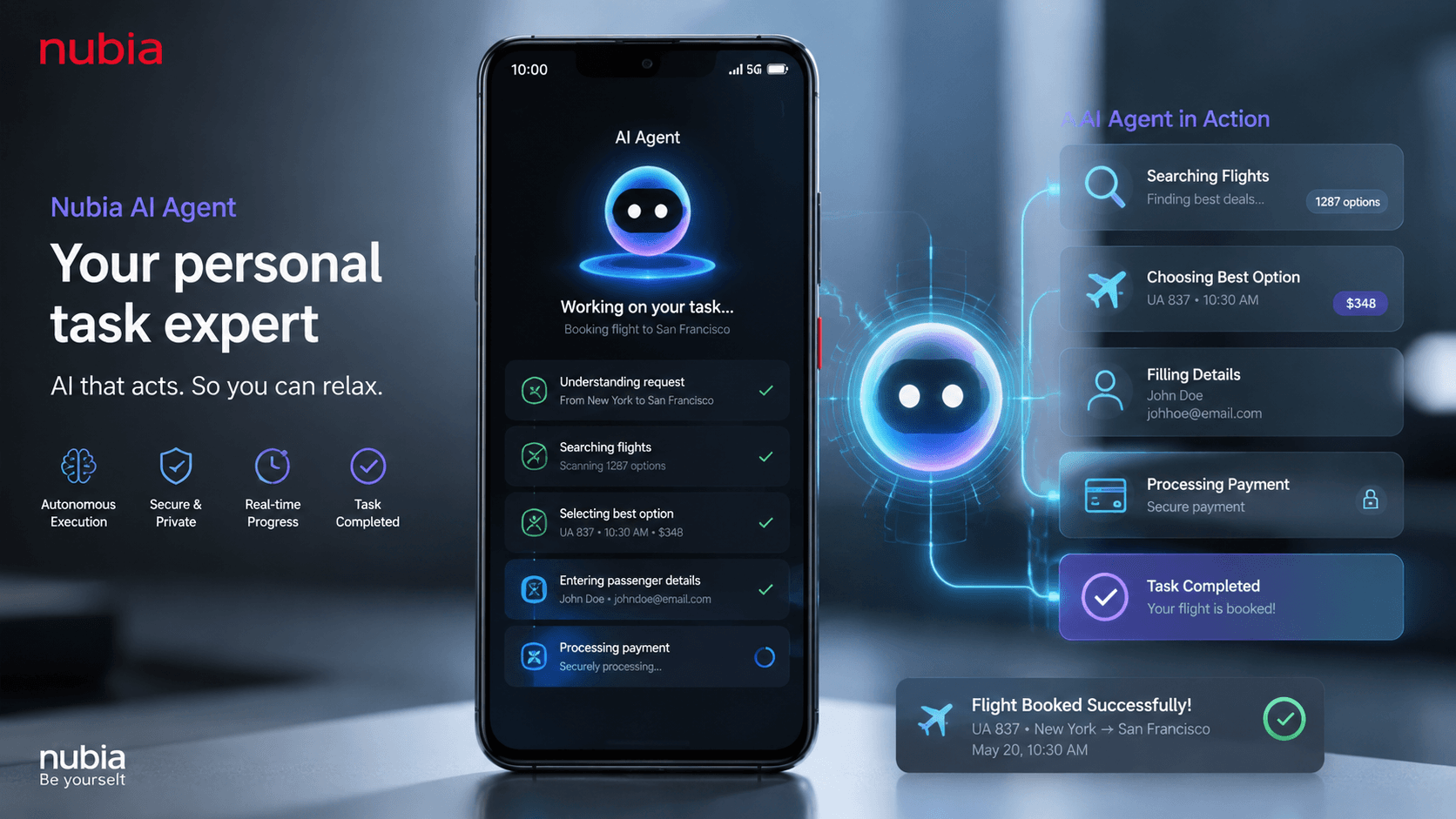
💡First look at a smartphone natively designed for autonomous GUI-based agent tasks.
⚡ 30-Second TL;DR
What Changed
First mass-produced smartphone featuring native AI agent capabilities
Why It Matters
This marks a shift from passive AI assistants to active agents capable of interacting with mobile UIs. It sets a new benchmark for mobile hardware-software integration in the agentic AI era.
What To Do Next
Research GUI agent frameworks like AppAgent to understand how to build cross-app automation workflows for mobile.
Key Points
- •First mass-produced smartphone featuring native AI agent capabilities
- •Deep integration with ByteDance Doubao large language model
- •Utilizes GUI agent technology for autonomous task execution
- •Official debut scheduled at the World Artificial Intelligence Conference (WAIC) in Shanghai
🧠 Deep Insight
AI-generated analysis for this event — not the original article.
🔑 Enhanced Key Takeaways
- •The device is identified as the Nubia Z70 Ultra, which serves as the hardware platform for this AI agent integration.
- •The GUI agent technology enables the phone to perform cross-app operations, such as automatically ordering food or booking rides by interacting with third-party application interfaces.
- •ByteDance's Doubao model integration includes a specialized 'AI Agent' mode that prioritizes low-latency intent recognition over standard chatbot interactions.
- •The launch at WAIC 2026 marks a strategic shift for Nubia, moving from gaming-centric hardware to AI-first mobile computing.
- •The smartphone utilizes a localized NPU-optimized architecture to handle agentic workflows, reducing reliance on cloud processing for sensitive user data.
📊 Competitor Analysis▸ Show
| Feature | Nubia Z70 Ultra (AI Agent) | Samsung Galaxy S26 Ultra | Apple iPhone 18 Pro |
|---|---|---|---|
| AI Agent Capability | Native GUI-based Autonomous | Cloud-Assisted Assistant | Siri-Integrated LLM |
| Primary Model | ByteDance Doubao | Google Gemini / Proprietary | Apple Intelligence |
| Task Execution | Cross-App Autonomous | App-Specific Intent | Limited App Control |
| Pricing (Est.) | ~$800 - $950 | ~$1,299 | ~$1,199 |
🛠️ Technical Deep Dive
- GUI Agent Framework: Employs a vision-language model (VLM) to interpret screen elements, allowing the agent to 'see' and click buttons within third-party apps just like a human user.
- Latency Optimization: Implements a hybrid compute model where intent parsing occurs on-device via a dedicated NPU, while complex reasoning is offloaded to Doubao's cloud infrastructure.
- Contextual Awareness: Uses a persistent memory layer that logs user habits to predict agentic triggers, reducing the need for manual activation.
- Integration Layer: Utilizes a system-level API hook that bypasses standard app sandboxing to allow the agent to input text and trigger UI events across the Android ecosystem.
🔮 Future ImplicationsAI analysis grounded in cited sources
⏳ Timeline
Weekly AI Recap
Read this week's curated digest of top AI events →
👉Related Updates


AI-curated news aggregator. All content rights belong to original publishers.
Original source: Pandaily ↗
This is a summary, not the original. Read the source, or get the weekly briefing.
The weekly digest
One email a week. Unsubscribe anytime.