NTT DATA AIVista Targets Enterprise AI’s Last Mile
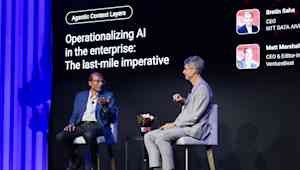
Learn why enterprise agents need workflow context and guardrails—not just a stronger frontier model.
30-Second TL;DR
What Changed
Enterprise AI requires a complete system around the foundation model, including proprietary context, workflows, governance, and security controls.
Why It Matters
The article reinforces that enterprise agent deployments are often constrained more by integration and governance than by raw model capability. AI teams may need to prioritize workflow orchestration, domain evaluation, and failure handling before investing in fine-tuning.
What To Do Next
Build a small insurance-claims benchmark that compares single-model inference against an ensemble plus validation-and-retry guardrails before choosing fine-tuning.
Key Points
- •Enterprise AI requires a complete system around the foundation model, including proprietary context, workflows, governance, and security controls.
- •Specialization focuses on customer data and undocumented tribal knowledge rather than fine-tuning the foundation model.
- •An ensemble of models and specialized guardrails can control inference costs, detect errors, and trigger retries in regulated workflows such as multinational insurance claims.
Deep Insight
AI-generated analysis for this event — not the original article.
Enhanced Key Takeaways
- •NTT DATA AIVista leverages the company's global 'Digital Engineering' practice, integrating legacy IT modernization services with generative AI deployment to bridge the gap between cloud infrastructure and model inference.
- •The platform utilizes a 'Model-Agnostic Orchestration' layer, allowing enterprises to swap underlying foundation models (e.g., GPT-4, Claude, or open-source variants) without re-engineering the surrounding governance and workflow logic.
- •AIVista incorporates specific 'Human-in-the-Loop' (HITL) feedback mechanisms designed to satisfy strict compliance requirements in the European Union and Japan, where NTT DATA maintains significant market share.
- •The architecture emphasizes 'Data Sovereignty' by deploying localized RAG (Retrieval-Augmented Generation) pipelines that ensure proprietary enterprise data never leaves the client's secure cloud environment during the inference process.
- •NTT DATA has integrated AIVista with its existing 'Cortex' automation platform, enabling the transition from simple chatbot interfaces to autonomous agentic workflows that execute multi-step business processes.
Competitor Analysis
- NTT DATA AIVista
- Regulated Industry Workflows
- Accenture AI Refinery
- Large-scale Digital Transformation
- Deloitte AI Factory
- Governance & Risk Management
- NTT DATA AIVista
- Model-Agnostic Orchestration
- Accenture AI Refinery
- Proprietary & Partner Ecosystem
- Deloitte AI Factory
- Advisory-led Implementation
- NTT DATA AIVista
- Consumption + Managed Services
- Accenture AI Refinery
- Project-based / Retainer
- Deloitte AI Factory
- Consulting-led / Licensing
| Feature | NTT DATA AIVista | Accenture AI Refinery | Deloitte AI Factory |
|---|---|---|---|
| Core Focus | Regulated Industry Workflows | Large-scale Digital Transformation | Governance & Risk Management |
| Model Strategy | Model-Agnostic Orchestration | Proprietary & Partner Ecosystem | Advisory-led Implementation |
| Pricing Model | Consumption + Managed Services | Project-based / Retainer | Consulting-led / Licensing |
Technical Deep Dive
- Architecture: Utilizes a multi-tier RAG pipeline that separates vector database indexing from real-time semantic search to reduce latency in high-volume environments.
- Guardrails: Implements a dual-layer validation system where a primary model generates output and a secondary, smaller 'Critic' model evaluates the response against predefined policy constraints before delivery.
- Integration: Supports native connectors for SAP, Salesforce, and ServiceNow to ingest unstructured enterprise data for context-aware generation.
- Orchestration: Employs a directed acyclic graph (DAG) approach to manage model ensembles, ensuring that complex tasks are decomposed into sub-tasks handled by specialized model instances.
Future ImplicationsAI analysis grounded in cited sources
Timeline
- 2023-07NTT DATA announces the launch of its Generative AI Center of Excellence to centralize AI research and development.
- 2024-04NTT DATA completes the integration of its global business units, positioning the company to scale unified AI solutions like AIVista.
- 2025-02NTT DATA unveils its 'AI-First' strategy, shifting focus toward agentic workflows and enterprise-grade model orchestration.
- 2026-05NTT DATA AIVista is officially launched as a commercial platform targeting regulated industries.
Weekly AI Recap
Read this week's curated digest of top AI events →
AI-curated news aggregator. All content rights belong to original publishers.
Original source: VentureBeat ↗
This is a summary, not the original. Read the source, or get the weekly briefing.
The weekly digest
One email a week. Unsubscribe anytime.