NPU Develops Electric-Activated Smart Adhesive with 400x Grip
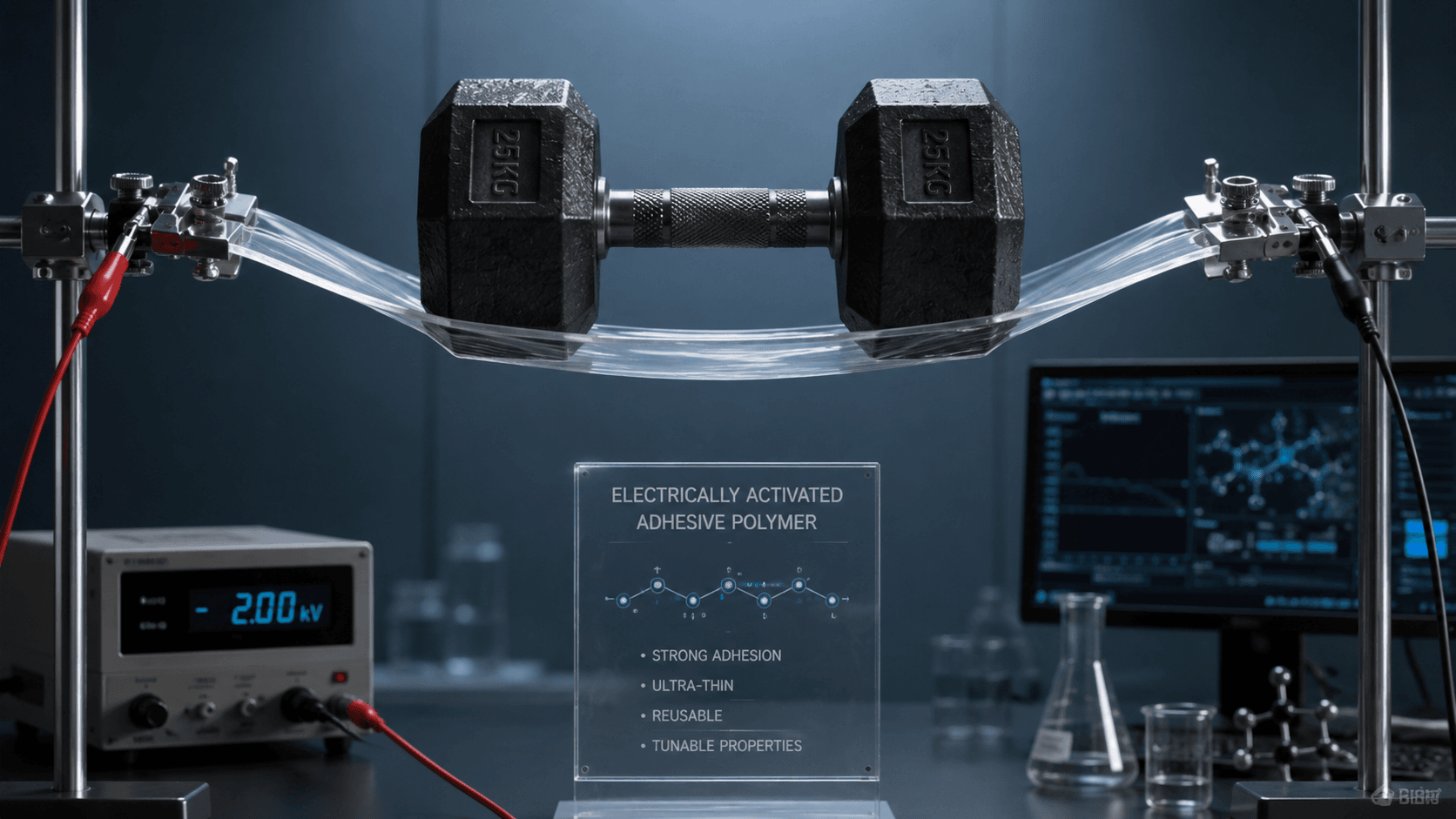
💡New smart material breakthrough with 400x grip strength could transform soft robotics and precision assembly.
⚡ 30-Second TL;DR
What Changed
Material adhesion increases 400x upon electrical activation.
Why It Matters
This material could revolutionize robotic handling of delicate components, reducing the complexity of end-effectors in automated assembly lines.
What To Do Next
Explore integrating this smart adhesive into your robotic end-effector prototypes to improve handling of fragile electronic components.
Key Points
- •Material adhesion increases 400x upon electrical activation.
- •Capable of holding 10-pound weights with thin-film application.
- •Key applications include soft robotics and precision chip manufacturing.
🧠 Deep Insight
AI-generated analysis for this event — not the original article.
🔑 Enhanced Key Takeaways
- •The adhesive utilizes an electro-responsive polymer composite that undergoes a reversible phase transition when subjected to a low-voltage electrical current.
- •Researchers at Northwestern Polytechnical University (NPU) integrated conductive nanomaterials into the polymer matrix to facilitate rapid electron transport and adhesion switching.
- •The material demonstrates high fatigue resistance, maintaining its 400x adhesion enhancement capability over thousands of activation cycles without significant degradation.
- •The activation mechanism is based on electrostatic attraction combined with surface energy modulation, allowing for 'instant' release when the power is cut.
- •The material is designed to be solvent-free and environmentally stable, addressing common limitations of traditional industrial adhesives in cleanroom environments.
🛠️ Technical Deep Dive
- Mechanism: Employs an electro-rheological or electro-adhesion principle where the application of an electric field induces polarization in the material interface.
- Response Time: The transition from low-adhesion to high-adhesion state occurs in milliseconds, enabling high-speed industrial automation.
- Power Requirements: Operates on low-voltage DC power, making it compatible with standard micro-controller and robotic control systems.
- Material Composition: Incorporates a proprietary blend of conductive fillers within a thermoplastic elastomer matrix to balance flexibility and structural integrity.
- Load Capacity: The 400x multiplier is achieved through a thin-film interface, specifically optimized for shear stress resistance in vertical lifting applications.
🔮 Future ImplicationsAI analysis grounded in cited sources
Weekly AI Recap
Read this week's curated digest of top AI events →
👉Related Updates

AI-curated news aggregator. All content rights belong to original publishers.
Original source: Pandaily ↗
This is a summary, not the original. Read the source, or get the weekly briefing.
The weekly digest
One email a week. Unsubscribe anytime.