Novo Nordisk Partners with OpenAI for Drug Discovery
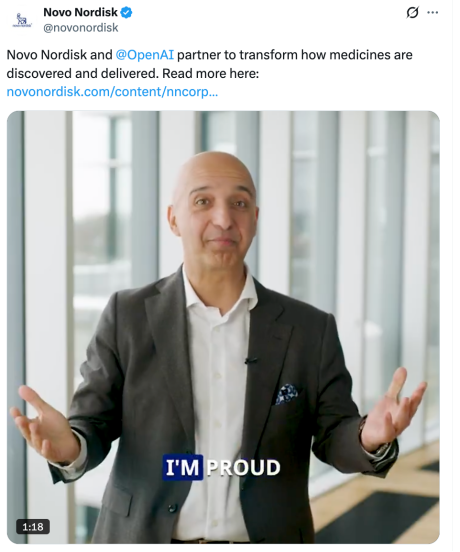
See how pharma giants are integrating OpenAI's models to solve complex biological R&D challenges.
30-Second TL;DR
What Changed
Novo Nordisk partners with OpenAI to enhance pharmaceutical R&D
Why It Matters
This partnership signals a major shift in the pharmaceutical industry toward AI-native drug discovery. It highlights the potential for LLMs to handle complex biological data, setting a new standard for biotech R&D.
What To Do Next
Explore how domain-specific fine-tuning of LLMs can be applied to your own industry's proprietary datasets for predictive modeling.
Key Points
- •Novo Nordisk partners with OpenAI to enhance pharmaceutical R&D
- •Focus on accelerating the discovery of next-generation weight-loss drugs
- •Strategic move to regain competitive edge in the GLP-1 market
Deep Insight
Background and context from public sources — not the original article. 16 sources cited.
Enhanced Key Takeaways
- •The partnership between Novo Nordisk and OpenAI extends beyond drug discovery to encompass manufacturing, supply chain operations, and commercial functions, with full integration anticipated by the end of 2026.
- •OpenAI will actively support Novo Nordisk in enhancing AI literacy and upskilling its global workforce, aiming to ensure the ethical and compliant application of AI technologies across the organization.
- •This collaboration signifies a broader industry shift among major pharmaceutical companies towards enterprise-wide AI integration, positioning artificial intelligence as a fundamental capability rather than a specialized research tool.
- •Following the Novo Nordisk partnership, OpenAI introduced GPT-Rosalind, a new domain-specific reasoning model specifically designed for research in biology, drug discovery, and translational medicine, available as a research preview.
- •Prior to this OpenAI collaboration, Novo Nordisk had established other AI initiatives, including internal tools like Found Data and Novoscribe, and formed partnerships in 2023 with Valo Health, Microsoft, and MIT to expand its AI capabilities, particularly in cardiometabolic diseases.
Competitor Analysis
- AI Partner/Focus
- OpenAI
- Key Application/Benefit
- Global AI integration from drug discovery to commercial operations, accelerating next-gen weight-loss drugs, workforce upskilling.
- AI Partner/Focus
- OpenAI, Nvidia, Chai Discovery
- Key Application/Benefit
- Discovering novel medicines for drug-resistant bacteria, supercomputing for pharmaceutical challenges, optimizing GLP-1 manufacturing to boost production.
- AI Partner/Focus
- OpenAI, Medidata
- Key Application/Benefit
- Clinical trial enrollment optimization.
- AI Partner/Focus
- OpenAI
- Key Application/Benefit
- Wide-ranging AI initiatives in drug development.
- AI Partner/Focus
- OpenAI
- Key Application/Benefit
- Accelerating drug development, enhancing clinical trial efficiency and resource allocation via Accelerator Drug Development platform.
- AI Partner/Focus
- Generative AI (internal)
- Key Application/Benefit
- AI-driven discovery of preclinical candidates for obesity (e.g., ISM0676 targeting GIPR).
- AI Partner/Focus
- LENSai™ platform, HYFT™ technology (internal)
- Key Application/Benefit
- AI-powered design of GLP-1 receptor agonist peptides with comparable or superior activation to Semaglutide.
- AI Partner/Focus
- Amazon (internal)
- Key Application/Benefit
- AI-powered drug discovery platform.
- AI Partner/Focus
- Internal AI
- Key Application/Benefit
- AI-powered drug discovery.
- AI Partner/Focus
- AWS, MongoDB (partnered with Novo Nordisk)
- Key Application/Benefit
- Generative AI for accelerating clinical study report generation, reducing timelines by over 90%.
- AI Partner/Focus
- OpenAI
- Key Application/Benefit
- Deploying ChatGPT across global workforce for R&D and commercial innovation.
| Company/Platform | AI Partner/Focus | Key Application/Benefit |
|---|---|---|
| Novo Nordisk | OpenAI | Global AI integration from drug discovery to commercial operations, accelerating next-gen weight-loss drugs, workforce upskilling. |
| Eli Lilly | OpenAI, Nvidia, Chai Discovery | Discovering novel medicines for drug-resistant bacteria, supercomputing for pharmaceutical challenges, optimizing GLP-1 manufacturing to boost production. |
| Sanofi | OpenAI, Medidata | Clinical trial enrollment optimization. |
| Moderna | OpenAI | Wide-ranging AI initiatives in drug development. |
| Thermo Fisher Scientific | OpenAI | Accelerating drug development, enhancing clinical trial efficiency and resource allocation via Accelerator Drug Development platform. |
| Insilico Medicine | Generative AI (internal) | AI-driven discovery of preclinical candidates for obesity (e.g., ISM0676 targeting GIPR). |
| ImmunoPrecise Antibodies (IPA) | LENSai™ platform, HYFT™ technology (internal) | AI-powered design of GLP-1 receptor agonist peptides with comparable or superior activation to Semaglutide. |
| Amazon Bio Discovery (ABD) | Amazon (internal) | AI-powered drug discovery platform. |
| Alphabet/Isomorphic Labs | Internal AI | AI-powered drug discovery. |
| Anthropic | AWS, MongoDB (partnered with Novo Nordisk) | Generative AI for accelerating clinical study report generation, reducing timelines by over 90%. |
| Lundbeck | OpenAI | Deploying ChatGPT across global workforce for R&D and commercial innovation. |
Technical Deep Dive
- The partnership leverages OpenAI's most advanced AI capabilities for large-scale analysis of complex biological and clinical datasets to identify patterns and therapeutic targets.
- OpenAI introduced GPT-Rosalind, a domain-specific frontier reasoning model optimized for biological reasoning, drug discovery, and translational medicine.
- GPT-Rosalind is available as a research preview in ChatGPT, Codex, and via API for partners, and includes a Life Sciences plugin for Codex that connects to over 50 scientific tools and data sources.
- AI is applied to tasks such as molecular modeling, biomarker discovery, patient stratification, and improving the efficiency of clinical trial design.
- In GLP-1 development, AI is crucial for predicting oral bioavailability, stability, and absorption patterns of peptide drugs, and for the computational design of delivery systems to protect fragile peptides.
- AI also supports multi-target optimization, enabling the design of dual or triple agonists (e.g., GLP-1/GIP combinations) for enhanced therapeutic benefits.
- Novo Nordisk previously utilized generative AI, in collaboration with Anthropic and AWS, to automate and accelerate the generation of clinical study reports, reducing the process from weeks to minutes.
Future ImplicationsAI analysis grounded in cited sources
Timeline
- 1923Nordisk Insulinlaboratorium founded.
- 1925Novo Terapeutisk Laboratorium founded.
- 1989Novo and Nordisk merge to form Novo Nordisk A/S.
- 2010Launch of Victoza (liraglutide), marking entry into GLP-1 therapy.
- 2017FDA approval of Ozempic (semaglutide).
- 2021FDA approval of Wegovy for chronic weight management.
- 2023Novo Nordisk partners with Valo Health, Microsoft, and MIT for AI capabilities.
- 2025-06Novo Nordisk partners with MongoDB, Anthropic, and AWS to accelerate clinical study report generation using generative AI.
- 2026-04-14Novo Nordisk announces strategic partnership with OpenAI for global AI integration across operations.
- 2026-04-17OpenAI introduces GPT-Rosalind, a new AI model for biology and drug discovery, following Novo Nordisk partnership.
Sources (16)
Factual claims are grounded in the sources below. Forward-looking analysis is AI-generated interpretation.
Weekly AI Recap
Read this week's curated digest of top AI events →
AI-curated news aggregator. All content rights belong to original publishers.
Original source: 钛媒体 ↗
This is a summary, not the original. Read the source, or get the weekly briefing.
The weekly digest
One email a week. Unsubscribe anytime.