Nova Reinforcement Fine-Tuning Explained
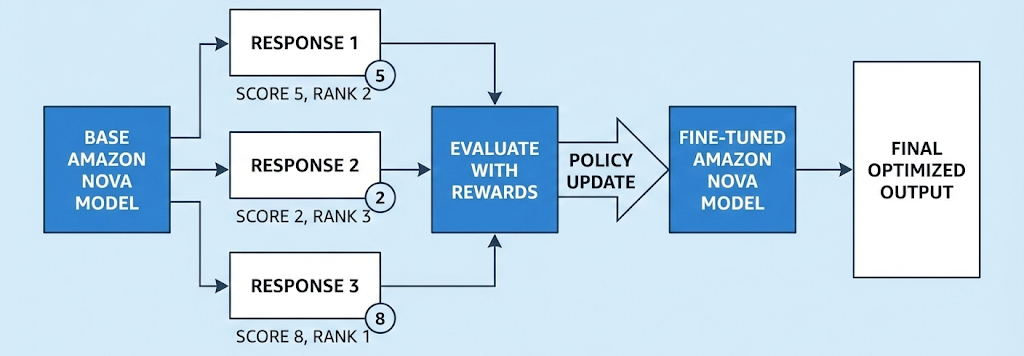
💡Master RFT to build feedback-driven Nova models outperforming imitation-based tuning
⚡ 30-Second TL;DR
What Changed
RFT learns via evaluation feedback, not imitation
Why It Matters
RFT empowers developers to create more adaptive AI models tailored to specific tasks, potentially reducing hallucination in agentic workflows. This boosts efficiency in production AI applications on AWS, giving users a competitive edge in customization.
What To Do Next
Test RFT on Amazon Bedrock with a sample preference dataset for your LLM tasks.
Key Points
- •RFT learns via evaluation feedback, not imitation
- •Ideal for code generation and customer service apps
- •Supports Amazon Bedrock managed service and Nova Forge workflows
- •Guidance on data prep and reward functions provided
- •Compares RFT vs. supervised fine-tuning use cases
🧠 Deep Insight
Background and context from public sources — not the original article. 9 sources cited.
🔑 Enhanced Key Takeaways
- •Amazon Bedrock RFT achieves up to 66% average accuracy improvement over base models by using Group Relative Policy Optimization (GRPO), a policy-based learning algorithm that trains on prompt-response pairs scored by reward functions[3][4][6].
- •RFT support has expanded beyond Amazon Nova to include open-weight models including OpenAI GPT-OSS, Qwen3 32B, and DeepSeek as of February 2026, with OpenAI-compatible fine-tuning APIs enabling broader developer adoption[7].
- •Nova Forge, a paid enterprise subscription service, extends RFT capabilities for advanced use cases including multi-turn conversations, reward functions exceeding 15-minute execution times, and custom training recipe modifications on SageMaker HyperPod[2].
- •RFT requires only a maximum of 20,000 prompts for training—significantly smaller than traditional supervised fine-tuning datasets—and can be deployed with one-click inference or Provisioned Throughput for mission-critical workloads[1][6].
- •Lambda-based reward functions must execute within seconds and minimize external API calls, with monitoring for overfitting patterns (validation reward decline) and reward plateauing below 0.15 as key optimization signals[2].
🛠️ Technical Deep Dive
- •Training Algorithm: Group Relative Policy Optimization (GRPO) — a policy-based learning method that trains on prompt-response pairs scored by reward functions rather than labeled datasets[6]
- •Reward Function Architecture: Custom Lambda functions or model-as-a-judge graders with built-in templates; must execute within seconds and handle error cases efficiently[2][6]
- •Data Requirements: Maximum 20,000 prompts per training job; can source from uploaded datasets or existing API invocation logs[1][6]
- •Monitoring Metrics: Average reward scores, reward distribution, validation vs. training reward divergence, reward variance trends, and checkpoint selection via intermediate model access[2]
- •Supported Models: Amazon Nova 2 Lite (us-east-1), OpenAI GPT-OSS 20B (us-west-2), Qwen3 32B (us-west-2) with regional availability constraints[6][7]
- •Lambda Configuration Requirements: Extended timeout up to 15 minutes (default 3 seconds insufficient), increased concurrency matching recipe configuration for parallel invocations during training[2]
- •Output Artifacts: Final model checkpoint saved to specified S3 location with path available in training logs and manifest.json file[2]
🔮 Future ImplicationsAI analysis grounded in cited sources
⏳ Timeline
📎 Sources (9)
Factual claims are grounded in the sources below. Forward-looking analysis is AI-generated interpretation.
- docs.aws.amazon.com — Rft Nova Models
- docs.aws.amazon.com — Nova Reinforcement Fine Tuning
- snaplogic.com — AI Success 2026 Lessons From Aws Reinvent
- constellationr.com — Aws Adds Doubles Down Customizing Fine Tuning AI Models Agents
- siliconangle.com — Aws Simplifies AI Agent Customization Automated Reinforcement Learning
- docs.aws.amazon.com — Reinforcement Fine Tuning
- aws.amazon.com — Amazon Bedrock Reinforcement Fine Tuning Openai
- aws.amazon.com — Announcing Amazon Sagemaker Inference for Custom Amazon Nova Models
- builder.aws.com — Reinforcement Fine Tuning Nova 2 Lite with Amazon Bedrock
Weekly AI Recap
Read this week's curated digest of top AI events →
👉Related Updates
AI-curated news aggregator. All content rights belong to original publishers.
Original source: AWS Machine Learning Blog ↗
This is a summary, not the original. Read the source, or get the weekly briefing.
Weekly AI briefing
One email a week. Unsubscribe anytime.