New monitoring dimensions for AI payment agents
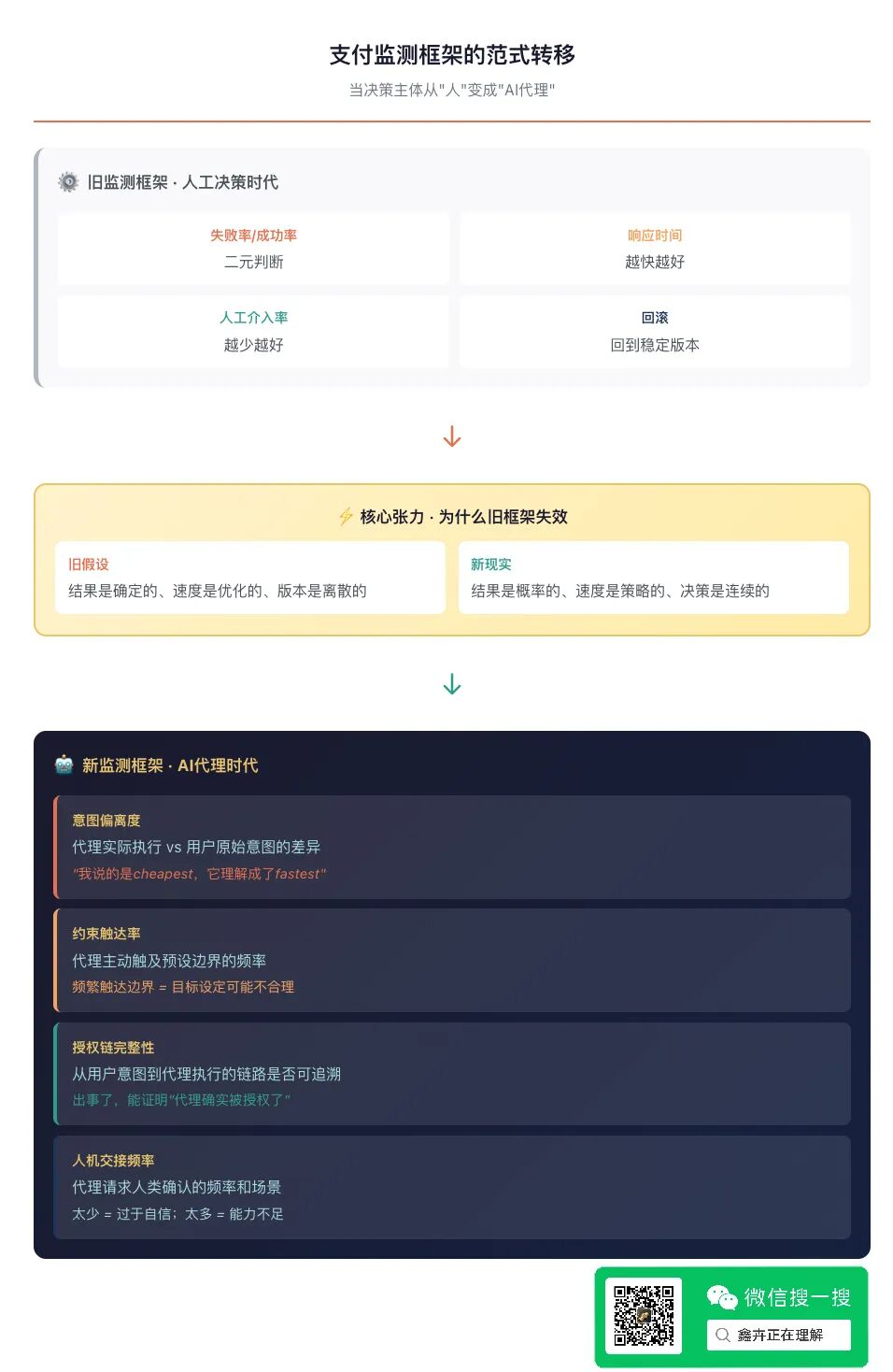
💡Learn how to secure autonomous AI agents against 'authorization failures' and financial logic errors.
⚡ 30-Second TL;DR
What Changed
Authorization traceability failures are a critical risk in autonomous AI payment agents.
Why It Matters
Essential for developers building autonomous agents to ensure financial safety and compliance in agentic workflows.
What To Do Next
Implement an 'Authorization Traceability' log for all AI agent payment calls to ensure every transaction is linked to a verified intent.
Key Points
- •Authorization traceability failures are a critical risk in autonomous AI payment agents.
- •New monitoring dimensions include 'Intent Layer' (target alignment), 'Authorization Layer' (safety constraints), and 'Execution Layer' (transaction accuracy).
- •Monitoring must shift from just 'transaction results' to 'agent reasoning and decision-making processes'.
🧠 Deep Insight
AI-generated analysis for this event — not the original article.
🔑 Enhanced Key Takeaways
- •Regulatory bodies in major financial hubs are increasingly mandating 'Human-in-the-loop' (HITL) protocols for AI agents handling transactions exceeding specific monetary thresholds.
- •The integration of Zero-Knowledge Proofs (ZKPs) is emerging as a standard for verifying agent authorization without exposing sensitive underlying user credentials.
- •Financial institutions are adopting 'Agentic Guardrails' that utilize real-time anomaly detection models to intercept transactions where the agent's reasoning path deviates from established risk profiles.
- •Standardization efforts, such as the IEEE P3119 working group, are actively defining metrics for AI agent accountability and transparency in autonomous financial operations.
- •The shift toward 'Explainable AI' (XAI) in payments is being driven by the need for audit trails that can be interpreted by both automated compliance systems and human regulators.
🛠️ Technical Deep Dive
- Implementation of Chain-of-Thought (CoT) monitoring allows systems to log the intermediate reasoning steps of an agent before the final API call to a payment gateway is triggered.
- Utilization of Vector Databases to store historical 'intent-to-action' mappings, enabling real-time cosine similarity checks to detect malicious or erroneous agent behavior.
- Deployment of sandboxed execution environments where AI agents must sign transactions using ephemeral keys that expire immediately upon verification.
- Integration of Multi-Agent Orchestration layers where a 'Supervisor Agent' independently validates the 'Worker Agent's' proposed transaction parameters against predefined policy constraints.
🔮 Future ImplicationsAI analysis grounded in cited sources
Weekly AI Recap
Read this week's curated digest of top AI events →
👉Related Updates


AI-curated news aggregator. All content rights belong to original publishers.
Original source: 虎嗅 ↗
This is a summary, not the original. Read the source, or get the weekly briefing.
The weekly digest
One email a week. Unsubscribe anytime.