Netflix uses generative AI to improve content discovery
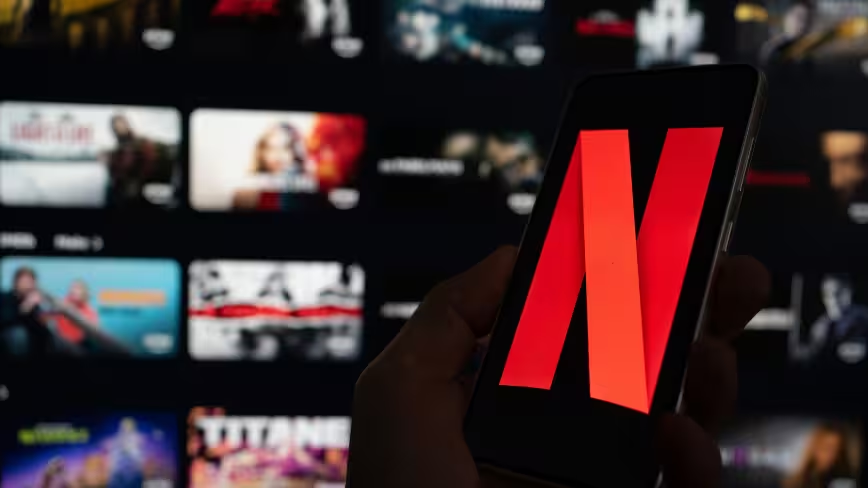
💡See how Netflix is using generative AI to solve the 'paradox of choice' in massive streaming content libraries.
⚡ 30-Second TL;DR
What Changed
Netflix is integrating generative AI to solve the 'endless scroll' problem.
Why It Matters
This shift suggests a move toward more intelligent, intent-based recommendation engines rather than traditional collaborative filtering. It highlights how major platforms are pivoting to AI to improve user retention in saturated markets.
What To Do Next
Analyze how your recommendation system handles long-tail content and consider implementing LLM-based reranking to improve user engagement metrics.
Key Points
- •Netflix is integrating generative AI to solve the 'endless scroll' problem.
- •The feature aims to help users find relevant content within a massive library.
- •Elizabeth Stone, Chief Product and Technology Officer, confirmed the deployment at Bloomberg Tech.
🧠 Deep Insight
Background and context from public sources — not the original article. 12 sources cited.
🔑 Enhanced Key Takeaways
- •Netflix is actively testing a voice user interface and other generative AI features to provide more personalized and interactive content recommendations, aiming to better reflect a viewer's current mood and preferences.
- •The current generative AI deployment builds upon Netflix's long-standing and sophisticated recommendation system, which historically leverages viewing history, user ratings, similar user behavior, and extensive title metadata.
- •This initiative follows earlier tests of a conversational search tool, which was rolled out in a limited, opt-in beta for iPhone and iPad users.
- •The company's move into advanced AI for content discovery comes amidst broader industry scrutiny, with US Federal Trade Commission staff having criticized algorithmic profiling and data retention practices in streaming services, though Netflix was not specifically named.
- •Netflix has partnered with OpenAI to develop a conversational content discovery tool that can interpret natural language queries, indicating a collaboration with a leading AI research entity.
📊 Competitor Analysis▸ Show
| Streaming Service | Generative AI for Content Discovery | Other AI/ML Features (Content Discovery) |
|---|---|---|
| Netflix | Testing voice user interface, conversational search (iOS/iPadOS beta), natural language processing for mood-based recommendations. | Personalized Video Ranker (PVR), Top N Video Ranker, uses viewing history, ratings, similar user behavior, title metadata, Deep Learning for image/audio analysis. |
| YouTube (Alphabet Inc.) | Not explicitly detailed for generative AI content discovery, but has surpassed Netflix in average daily viewing in 2025, suggesting strong existing recommendation systems. | Advanced recommendation algorithms based on viewing habits, engagement, and trending content. |
| Disney Plus (Disney) | Plans to implement Generative AI. | Existing recommendation systems, likely leveraging user data and content metadata. |
| Amazon Prime Video | Launched AI-dubbed anime (faced backlash), making AI-animated shows. | Existing recommendation systems, likely leveraging user data and content metadata. |
| Cineverse | Launched 'CineSearch', an AI-based content discovery tool for intuitive, personalized searches across streaming services. | AI video analysis. |
| Reelgood | Launched an AI assistant to help users find content. | Streaming analytics platform. |
🛠️ Technical Deep Dive
- Netflix integrates generative AI with natural language processing (NLP) to understand viewer intent and mood.
- The system combines a user's viewing preferences and history with other factors, such as trending content, to generate highly tailored recommendations.
- The foundation of Netflix's recommendation system, which these new generative AI features build upon, includes analyzing viewing history, explicit ratings, behavior of similar users, and extensive title metadata.
- Historically, Netflix's recommendation engine evolved from 'Cinematch,' a collaborative filtering algorithm introduced in 2000.
- Modern Netflix content discovery is a 'system of systems,' including algorithms like the Personalized Video Ranker (PVR) for ranking the entire catalog and the Top N Video Ranker for specific 'Top Picks' rows.
- Deep Learning algorithms are employed to analyze visual elements and audio within content, aiding in more accurate categorization and tagging.
- Netflix utilizes 'Axion,' a specialized fact store, as a core component of its Machine Learning platform to ensure high-quality data is fed into recommendation models.
- Apache Flink, an open-source platform, is used for real-time data processing and validation, ensuring the quality and correctness of data before it is used by ML models.
🔮 Future ImplicationsAI analysis grounded in cited sources
⏳ Timeline
📎 Sources (12)
Factual claims are grounded in the sources below. Forward-looking analysis is AI-generated interpretation.
Weekly AI Recap
Read this week's curated digest of top AI events →
👉Related Updates


AI-curated news aggregator. All content rights belong to original publishers.
Original source: The Next Web (TNW) ↗
This is a summary, not the original. Read the source, or get the weekly briefing.
The weekly digest
One email a week. Unsubscribe anytime.