Natural Language Autoencoders show poor robustness to initialization
💡Critical research showing NLAs may produce convincing but false explanations, questioning current interpretability.
⚡ 30-Second TL;DR
What Changed
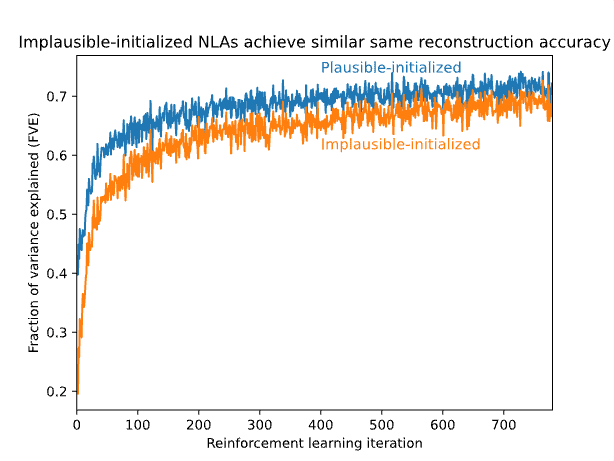
NLAs can achieve high reconstruction accuracy despite being initialized with 99.3% implausible statements.
Why It Matters
This research challenges the validity of current interpretability tools that rely on plain-text bottlenecks. It suggests that reconstruction accuracy is a poor proxy for the semantic truthfulness of model explanations.
What To Do Next
If you are using NLAs for model interpretability, perform a robustness check by initializing your verbalizer with randomized or nonsensical prompts to verify if your explanations remain grounded.
Key Points
- •NLAs can achieve high reconstruction accuracy despite being initialized with 99.3% implausible statements.
- •Training with RL only marginally improves the plausibility of implausible-initialized NLAs.
- •Plausibility of initially plausible NLAs significantly degrades during the training process.
- •Results cast doubt on the reliability of using NLAs for mechanistic interpretability.
🧠 Deep Insight
AI-generated analysis for this event — not the original article.
🔑 Enhanced Key Takeaways
- •The phenomenon is linked to the 'superposition hypothesis,' where autoencoders struggle to disentangle features when the dictionary size is insufficient or the sparsity penalty is misaligned.
- •Researchers have identified that NLAs often exhibit 'feature drift,' where the semantic meaning of latent directions shifts significantly during training, even if reconstruction loss remains low.
- •Studies suggest that the 'reconstruction accuracy' metric is a poor proxy for interpretability because autoencoders can learn to map activations to arbitrary, non-interpretable latent spaces that still minimize loss.
- •The failure of RL-based fine-tuning to correct implausible initializations is attributed to the 'reward hacking' of the autoencoder, which optimizes for reconstruction fidelity over semantic coherence.
- •Recent experiments indicate that using 'sparse autoencoders' (SAEs) with higher sparsity constraints and L1 regularization can mitigate some, but not all, of the initialization sensitivity issues observed in standard NLAs.
🛠️ Technical Deep Dive
- Architecture: Typically utilizes a standard bottleneck autoencoder structure where the encoder maps LLM activations to a latent space and the decoder attempts to reconstruct the original activation vector.
- Training Objective: Minimizes Mean Squared Error (MSE) between the original activation and the reconstructed output, often augmented with an L1 penalty on the latent activations to enforce sparsity.
- Initialization Sensitivity: The problem arises because the loss landscape is highly non-convex, allowing the model to settle into 'dead' or 'semantically meaningless' local minima that satisfy the reconstruction objective.
- RL Integration: Attempts to use Reinforcement Learning involve rewarding the decoder for generating 'plausible' natural language explanations, but this often conflicts with the primary reconstruction loss, leading to unstable training dynamics.
🔮 Future ImplicationsAI analysis grounded in cited sources
⏳ Timeline
Weekly AI Recap
Read this week's curated digest of top AI events →
👉Related Updates
AI-curated news aggregator. All content rights belong to original publishers.
Original source: AI Alignment Forum ↗
This is a summary, not the original. Read the source, or get the weekly briefing.
The weekly digest
One email a week. Unsubscribe anytime.