Native Multimodality Defines China’s Next AI Frontier
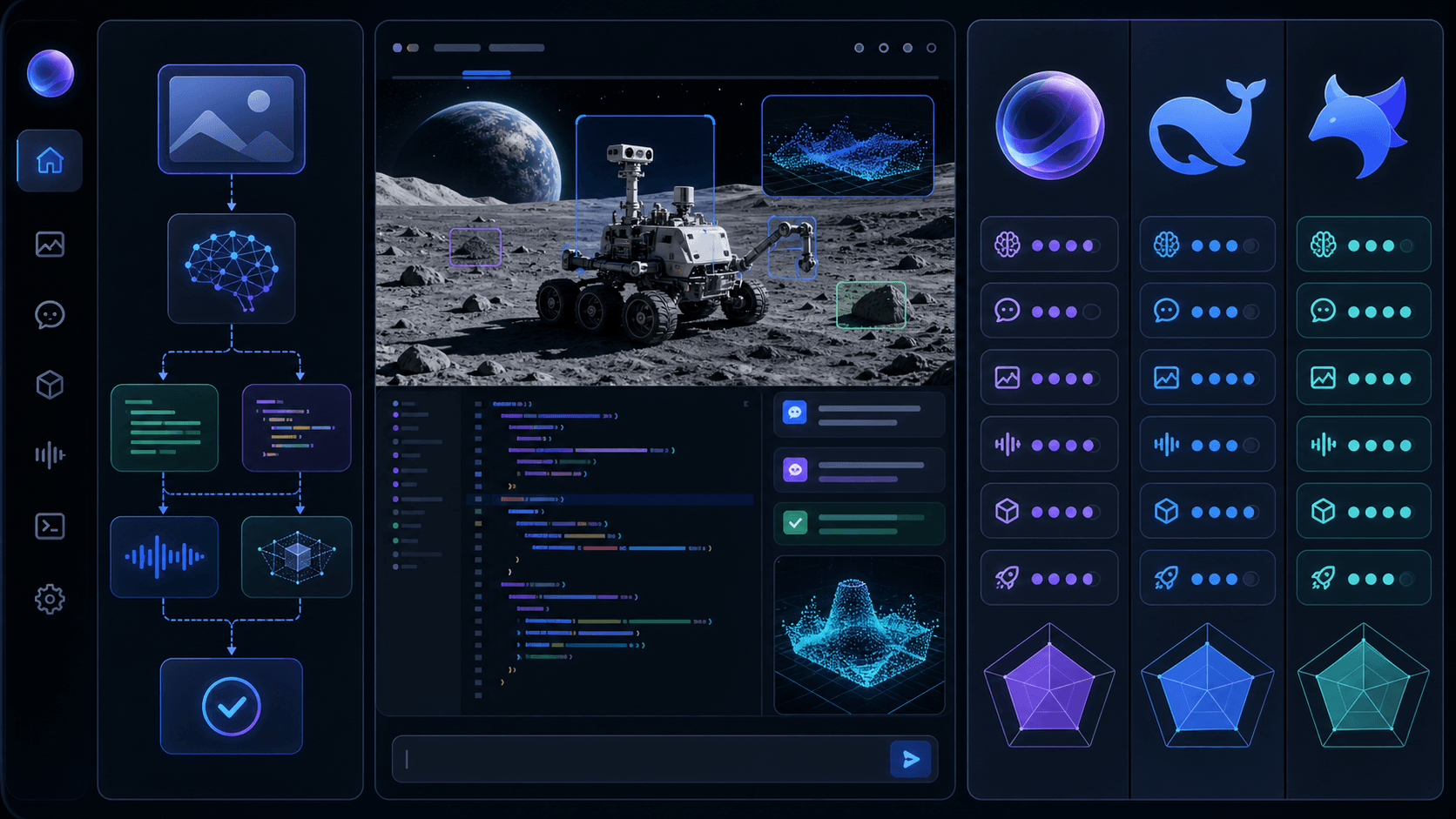
Native vision may decide which Chinese models can power reliable long-running agents.
30-Second TL;DR
What Changed
Kimi K3, Qwen3.8-Max, and Doubao-Seed-2.1 are described as pursuing native multimodal training.
Why It Matters
If native multimodality improves agent reliability over long tasks, text-only models may face growing pressure in workflows involving documents, screens, images, and real-world context. Developers may need to evaluate models on end-to-end multimodal tasks rather than text benchmarks alone.
What To Do Next
Benchmark Kimi K3, Qwen3.8-Max, and Doubao-Seed-2.1 on a long-horizon workflow combining screenshots, documents, and tool calls before selecting an agent model.
Key Points
- •Kimi K3, Qwen3.8-Max, and Doubao-Seed-2.1 are described as pursuing native multimodal training.
- •Native vision capabilities may improve performance in long-running agent workflows.
- •DeepSeek, Zhipu, and Tencent Hunyuan are characterized as text-only models.
- •The comparison frames multimodality as a strategic dividing line among Chinese frontier models.
Deep Insight
AI-generated analysis for this event — not the original article.
Enhanced Key Takeaways
- •The shift toward native multimodality is driven by the need to reduce latency in agentic workflows, as traditional 'adapter-based' vision encoders often introduce bottlenecks in real-time reasoning.
- •Industry data suggests that native multimodal models in China are increasingly adopting unified tokenization strategies, treating image patches as visual tokens within the same embedding space as text.
- •While DeepSeek and Zhipu are labeled as text-only in the article, they have been aggressively developing separate, specialized vision-language models (VLMs) rather than integrating vision into their core foundation models.
- •The Chinese government's recent 'AI+ Action' initiative has prioritized the development of multimodal agents capable of industrial automation, directly influencing the R&D roadmaps of companies like Alibaba and ByteDance.
- •Compute efficiency remains a major hurdle; native multimodal training requires significantly higher VRAM allocation during the pre-training phase compared to text-only models, leading to a surge in demand for high-bandwidth memory (HBM) chips among Chinese labs.
Competitor Analysis
- Kimi K3 (Moonshot)
- Native Multimodal
- Qwen3.8-Max (Alibaba)
- Native Multimodal
- Doubao-Seed-2.1 (ByteDance)
- Native Multimodal
- DeepSeek (V3/R1 Series)
- Text-Only (MoE)
- Kimi K3 (Moonshot)
- Long-context Agents
- Qwen3.8-Max (Alibaba)
- Enterprise/Cloud API
- Doubao-Seed-2.1 (ByteDance)
- Consumer/Mobile Apps
- DeepSeek (V3/R1 Series)
- Reasoning/Coding
- Kimi K3 (Moonshot)
- Deeply Integrated
- Qwen3.8-Max (Alibaba)
- Unified Tokenization
- Doubao-Seed-2.1 (ByteDance)
- Real-time Video/Audio
- DeepSeek (V3/R1 Series)
- External VLM Modules
- Kimi K3 (Moonshot)
- Needle-in-a-Haystack
- Qwen3.8-Max (Alibaba)
- MMLU-Pro/Math
- Doubao-Seed-2.1 (ByteDance)
- Multimodal Interaction
- DeepSeek (V3/R1 Series)
- HumanEval/GPQA
| Feature | Kimi K3 (Moonshot) | Qwen3.8-Max (Alibaba) | Doubao-Seed-2.1 (ByteDance) | DeepSeek (V3/R1 Series) |
|---|---|---|---|---|
| Architecture | Native Multimodal | Native Multimodal | Native Multimodal | Text-Only (MoE) |
| Primary Focus | Long-context Agents | Enterprise/Cloud API | Consumer/Mobile Apps | Reasoning/Coding |
| Vision Integration | Deeply Integrated | Unified Tokenization | Real-time Video/Audio | External VLM Modules |
| Benchmark Focus | Needle-in-a-Haystack | MMLU-Pro/Math | Multimodal Interaction | HumanEval/GPQA |
Technical Deep Dive
- Native multimodal models mentioned utilize a unified transformer architecture where visual inputs are processed through a vision encoder (often ViT-based) and projected into the LLM's latent space as discrete tokens.
- These models employ cross-modal attention mechanisms that allow the model to attend to visual and textual tokens simultaneously, rather than relying on sequential processing.
- Training pipelines for these models incorporate large-scale interleaved image-text datasets, moving away from the traditional two-stage pre-training (pre-train text, then fine-tune vision).
- The models utilize dynamic resolution processing, allowing them to handle varying aspect ratios and image sizes without significant information loss during the tokenization phase.
Future ImplicationsAI analysis grounded in cited sources
Timeline
- 2023-10Moonshot AI launches Kimi, focusing on long-context window capabilities.
- 2024-04Alibaba releases Qwen-VL, marking the company's first major pivot toward integrated vision-language models.
- 2024-08ByteDance introduces Doubao, rapidly scaling its multimodal capabilities for the domestic market.
- 2025-05Moonshot AI initiates the development of native multimodal architectures for the K3 series.
- 2026-02Alibaba announces the Qwen3 series, emphasizing native multimodal training as a core architectural pillar.
Weekly AI Recap
Read this week's curated digest of top AI events →
Related Updates


AI-curated news aggregator. All content rights belong to original publishers.
Original source: Pandaily ↗
This is a summary, not the original. Read the source, or get the weekly briefing.
The weekly digest
One email a week. Unsubscribe anytime.