NASA's Roman Space Telescope set for August 30 launch
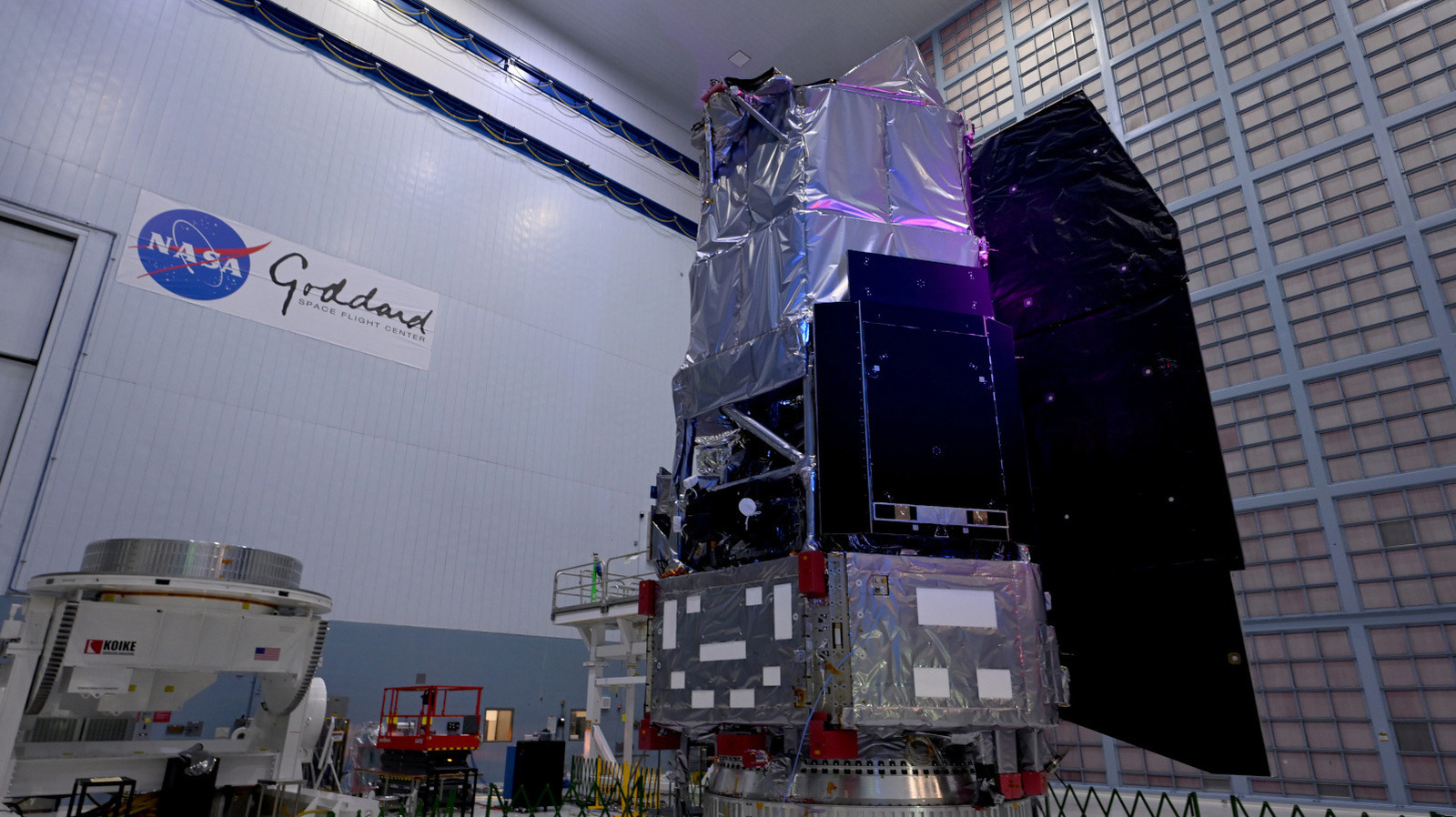
💡Massive astronomical datasets are coming; prepare your pipelines for high-volume image processing.
⚡ 30-Second TL;DR
What Changed
Launch date confirmed for August 30
Why It Matters
The telescope will generate massive datasets that will drive new advancements in computer vision and automated astronomical data processing.
What To Do Next
Monitor NASA's open data portal for upcoming datasets to test your large-scale image processing pipelines.
Key Points
- •Launch date confirmed for August 30
- •Field of view is 100x larger than Hubble
- •Designed for wide-field infrared astronomy
🧠 Deep Insight
Background and context from public sources — not the original article. 18 sources cited.
🔑 Enhanced Key Takeaways
- •The Nancy Grace Roman Space Telescope's 2.4-meter primary mirror was originally donated by the National Reconnaissance Office.
- •Roman's mission extends beyond general wide-field infrared astronomy to include specific objectives such as probing the chronology of the universe, measuring the effects of dark energy using three independent techniques (baryon acoustic oscillations, supernovae, and weak gravitational lensing), and conducting a comprehensive census of exoplanets via gravitational microlensing.
- •The telescope is equipped with two primary instruments: the Wide-Field Instrument (WFI), a 300.8-megapixel camera, and a Coronagraph Instrument (CGI), which is designed to directly image exoplanets by actively suppressing the light from their host stars.
- •The launch of the Roman Space Telescope on August 30, 2026, represents an acceleration of the schedule, occurring eight months earlier than previously targeted.
- •Roman will operate from a quasi-halo orbit around the Sun-Earth L2 Lagrange point, a gravitationally stable location approximately four times farther from Earth than the Moon, for a planned primary mission duration of five years.
📊 Competitor Analysis▸ Show
| Feature | Nancy Grace Roman Space Telescope | Hubble Space Telescope | James Webb Space Telescope |
|---|---|---|---|
| Primary Mirror | 2.4 meters (7.9 ft) | 2.4 meters (7.9 ft) | 6.5 meters (21.3 ft) |
| Field of View | 100x larger than Hubble's infrared instrument (0.28 sq deg) | Narrow (e.g., WFC3 IR Channel) | Narrow, optimized for deep views |
| Wavelength Range | 0.48–2.30 μm (visible to near-infrared) | Ultraviolet, visible, and near-infrared (0.2–1.7 μm) | Mid-infrared to orange visible (0.6–28.5 μm) |
| Primary Objectives | Dark energy, exoplanet census (microlensing), wide-field infrared surveys, exoplanet direct imaging (coronagraph) | High-resolution imaging, galaxy evolution, stellar life cycles | Early universe, star/planet formation, exoplanet atmospheres |
| Role | Wide-field survey instrument, technology demonstrator | General-purpose observatory, high-resolution imaging | Deep-field, high-resolution infrared observatory |
🛠️ Technical Deep Dive
- Primary Mirror: 2.4 meters (7.9 ft) in diameter, three-mirror anastigmat design.
- Instruments:
- Wide-Field Instrument (WFI): A 300.8-megapixel multi-band visible and near-infrared camera. It contains 18 mercury cadmium telluride (HgCdTe) detectors, each capturing 16 million pixels. It provides imaging and spectroscopy from 0.48 to 2.30 μm and offers a resolution of 0.1 arcsec/pixel over a 0.28 square degree field of view.
- Coronagraph Instrument (CGI): A high-contrast coronagraph operating in shorter visible wavelengths (575 nm to 825 nm). It utilizes dual deformable mirrors with 3,000 actuators each and specialized masks to achieve part-per-billion starlight suppression, enabling direct imaging and spectroscopy of exoplanets.
- Orbit: Quasi-halo orbit around the Sun-Earth L2 Lagrange point.
- Mission Duration: 5 years (planned primary mission).
- Launch Vehicle: SpaceX Falcon Heavy.
- Launch Mass: 10,500 kg (23,100 lb).
- Power: 4.5 kW.
🔮 Future ImplicationsAI analysis grounded in cited sources
⏳ Timeline
📎 Sources (18)
Factual claims are grounded in the sources below. Forward-looking analysis is AI-generated interpretation.
Weekly AI Recap
Read this week's curated digest of top AI events →
👉Related Updates

AI-curated news aggregator. All content rights belong to original publishers.
Original source: Engadget ↗
This is a summary, not the original. Read the source, or get the weekly briefing.
The weekly digest
One email a week. Unsubscribe anytime.