NASA's Psyche spacecraft captures rare Mars imagery
See how deep-space imaging hardware performs in real-world conditions, relevant for autonomous robotics and vision AI.
30-Second TL;DR
What Changed
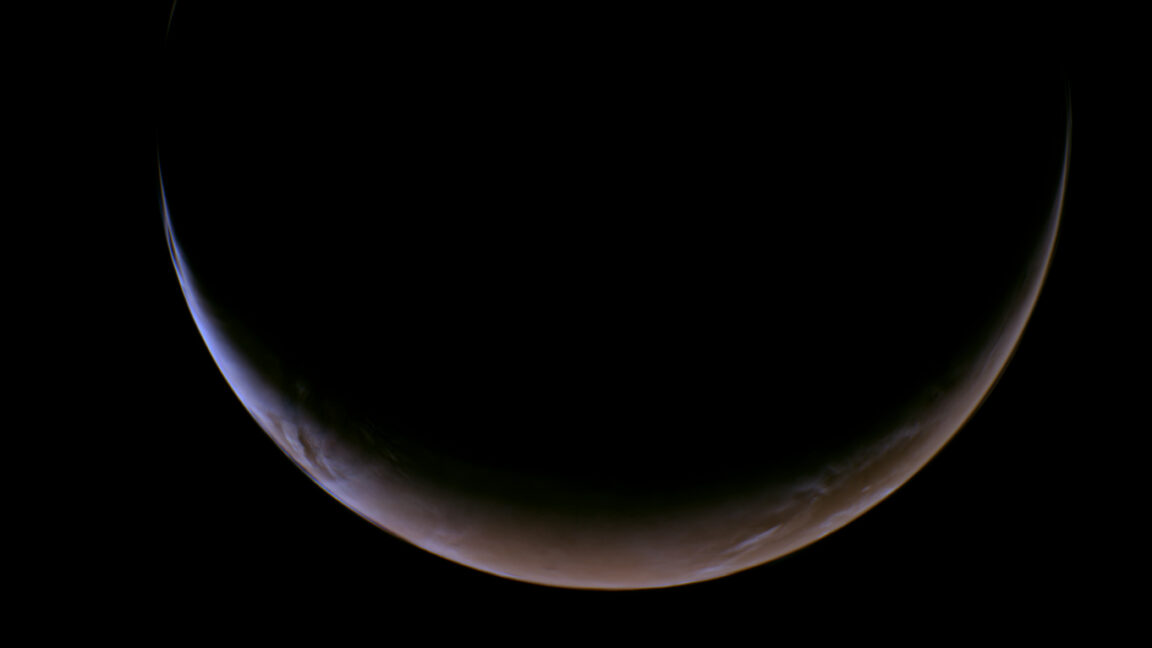
Psyche spacecraft successfully captured images of Mars from a rare deep-space perspective.
Why It Matters
This mission highlights advancements in long-range autonomous imaging and data transmission, which are critical for future deep-space AI-driven navigation and observation systems.
What To Do Next
Review NASA's open data portals for the latest telemetry and image datasets to test computer vision models for planetary feature recognition.
Key Points
- •Psyche spacecraft successfully captured images of Mars from a rare deep-space perspective.
- •The mission demonstrates the operational readiness of the spacecraft's imaging hardware.
- •Data collected provides new visual insights into planetary observation from long distances.
Deep Insight
Background and context from public sources — not the original article. 17 sources cited.
Enhanced Key Takeaways
- •The images were captured during a critical gravity-assist maneuver at Mars on May 15, 2026, which provided a 1,000 mile-per-hour boost and adjusted the spacecraft's orbital plane by about 1 degree, setting its course for asteroid Psyche.
- •The primary mission of the Psyche spacecraft is to explore the metal-rich asteroid 16 Psyche, located in the main asteroid belt, which is believed to be the exposed core of an early planetesimal, offering unique insights into planetary formation.
- •The Mars flyby served as a crucial practice run for the spacecraft's imaging and navigation systems, preparing them for the eventual approach and orbital operations around asteroid Psyche, scheduled to begin in August 2029.
- •The spacecraft's multispectral imager captured Mars from a "high phase angle," resulting in a crescent view, and observations indicated atmospheric dust scattering light, making the crescent appear brighter and more extended than if Mars had no atmosphere.
- •Beyond imaging, the Psyche mission is also testing the Deep Space Optical Communications (DSOC) experiment, a laser-based system designed to transmit data at significantly higher bandwidths (10 to 100 times) than traditional radio systems.
Technical Deep Dive
- Imaging System: Psyche's multispectral imager consists of a pair of identical cameras equipped with filters and telescopic lenses to photograph surfaces in different wavelengths of light, providing high-resolution images for geologic, compositional, and topographic data.
- Scientific Instruments: In addition to the imager, the spacecraft carries a gamma-ray and neutron spectrometer to determine elemental composition, and a magnetometer to detect evidence of an ancient magnetic field.
- Propulsion: The spacecraft utilizes solar-powered Hall-effect thrusters for propulsion and orbital maneuvering, marking it as the first interplanetary spacecraft to employ this technology.
- Communications: It features an X-band high-gain antenna for telecommunications and gravity science, and is also testing the Deep Space Optical Communications (DSOC) experiment, which uses invisible near-infrared lasers for high-bandwidth data transmission.
- Size: The main body of the Psyche spacecraft is approximately the size of a small van.
Future ImplicationsAI analysis grounded in cited sources
Timeline
- 2015-09Psyche mission shortlisted as one of five finalists for NASA's Discovery Program.
- 2017-01Psyche selected as the 14th mission in NASA's Discovery Program.
- 2019-03Preliminary Design Review for the project and flight system completed.
- 2023-10-13Psyche spacecraft launched on a SpaceX Falcon Heavy rocket from Kennedy Space Center.
- 2023-12-04First "first light" images acquired by both of Psyche's cameras.
- 2026-05-15Psyche successfully performed a gravity-assist maneuver at Mars, passing 4,609 km from the planet's surface.
Sources (17)
Factual claims are grounded in the sources below. Forward-looking analysis is AI-generated interpretation.
Weekly AI Recap
Read this week's curated digest of top AI events →
AI-curated news aggregator. All content rights belong to original publishers.
Original source: Ars Technica ↗
This is a summary, not the original. Read the source, or get the weekly briefing.
The weekly digest
One email a week. Unsubscribe anytime.