NASA's Deep Space Network performance during Artemis II
💡Learn how critical infrastructure manages extreme workloads—essential for scaling distributed AI systems.
⚡ 30-Second TL;DR
What Changed
Deep Space Network handled Artemis II communication requirements successfully
Why It Matters
Highlights the critical need for scalable infrastructure in high-stakes remote operations. AI practitioners managing edge or distributed systems should note the risks of operating near capacity.
What To Do Next
Audit your distributed system's headroom to ensure it can handle 20% over-capacity spikes without degradation.
Key Points
- •Deep Space Network handled Artemis II communication requirements successfully
- •Current mission demands are exceeding original paperwork specifications
- •Infrastructure is operating near its maximum capacity threshold
🧠 Deep Insight
Background and context from public sources — not the original article. 17 sources cited.
🔑 Enhanced Key Takeaways
- •The Deep Space Network's origins predate NASA's official establishment, with its forerunner created by JPL in January 1958 to track the Explorer 1 satellite.
- •The DSN is a global network comprising three complexes in Goldstone (California), Madrid (Spain), and Canberra (Australia), strategically positioned approximately 120 degrees apart in longitude to ensure continuous communication with spacecraft as the Earth rotates.
- •Future demand for DSN support is projected to increase dramatically, with average data rates expected to be six times higher and data volume 37 times greater by the early 2030s compared to 2021 levels.
- •Artemis II is testing the Orion Artemis II Optical Communications System, a laser communications terminal capable of transmitting data at significantly higher rates (e.g., 260 Megabits per second) than traditional radio frequencies, paving the way for future high-bandwidth deep space communication.
- •Human spaceflight missions like Artemis take priority for DSN resources, potentially leading to scheduling conflicts and reduced tracking hours for uncrewed scientific missions such as the James Webb Space Telescope.
🛠️ Technical Deep Dive
- The DSN consists of three Deep Space Communications Complexes (DSCCs) located in Goldstone, California (USA); Robledo de Chavela, Spain; and Canberra, Australia.
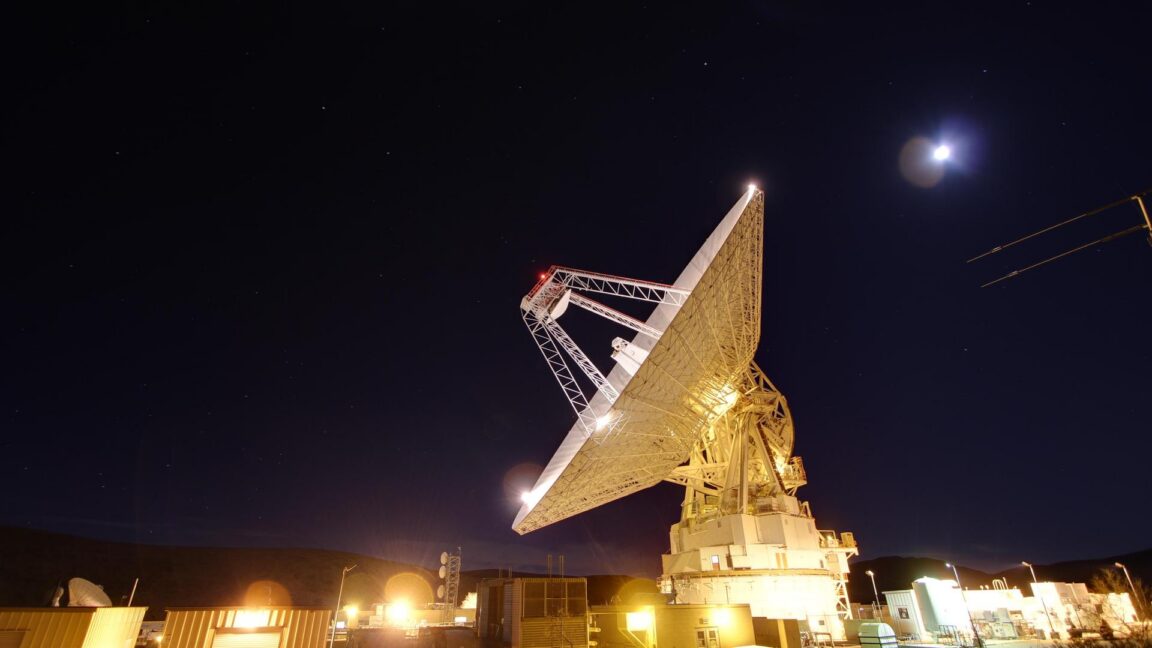
- Each complex operates multiple antennas, including massive 70-meter (230-foot) diameter dishes, several 34-meter (112-foot) diameter antennas (both high-efficiency and beam waveguide types), and some smaller 26-meter antennas.
- The 70-meter antennas are the largest and most sensitive, capable of tracking faint signals from billions of miles away, with a surface precision maintained to within half an inch.
- DSN primarily uses S-band (2-3 GHz for legacy/emergency), X-band (7-8 GHz for primary operations), and Ka-band (32-34 GHz for high data rates) for communication.
- Beam waveguide antennas house sensitive electronics in climate-controlled rooms below the antenna structure, using mirrors to reflect signals, which simplifies maintenance and upgrades.
- The network utilizes advanced low-noise receivers, with some operating at extremely low physical temperatures of 1.2 Kelvin to enhance signal detection.
- Antenna arraying allows multiple 34-meter dishes to be combined to achieve or exceed the performance of a single 70-meter antenna, providing redundancy and increased signal gain.
- Artemis II communications utilize both S-band for command, voice, and low-rate telemetry, and Ka-band for higher-rate data and video.
🔮 Future ImplicationsAI analysis grounded in cited sources
⏳ Timeline
📎 Sources (17)
Factual claims are grounded in the sources below. Forward-looking analysis is AI-generated interpretation.
Weekly AI Recap
Read this week's curated digest of top AI events →
👉Related Updates
AI-curated news aggregator. All content rights belong to original publishers.
Original source: Ars Technica ↗
This is a summary, not the original. Read the source, or get the weekly briefing.
The weekly digest
One email a week. Unsubscribe anytime.