NASA officially ends Mars MAVEN mission
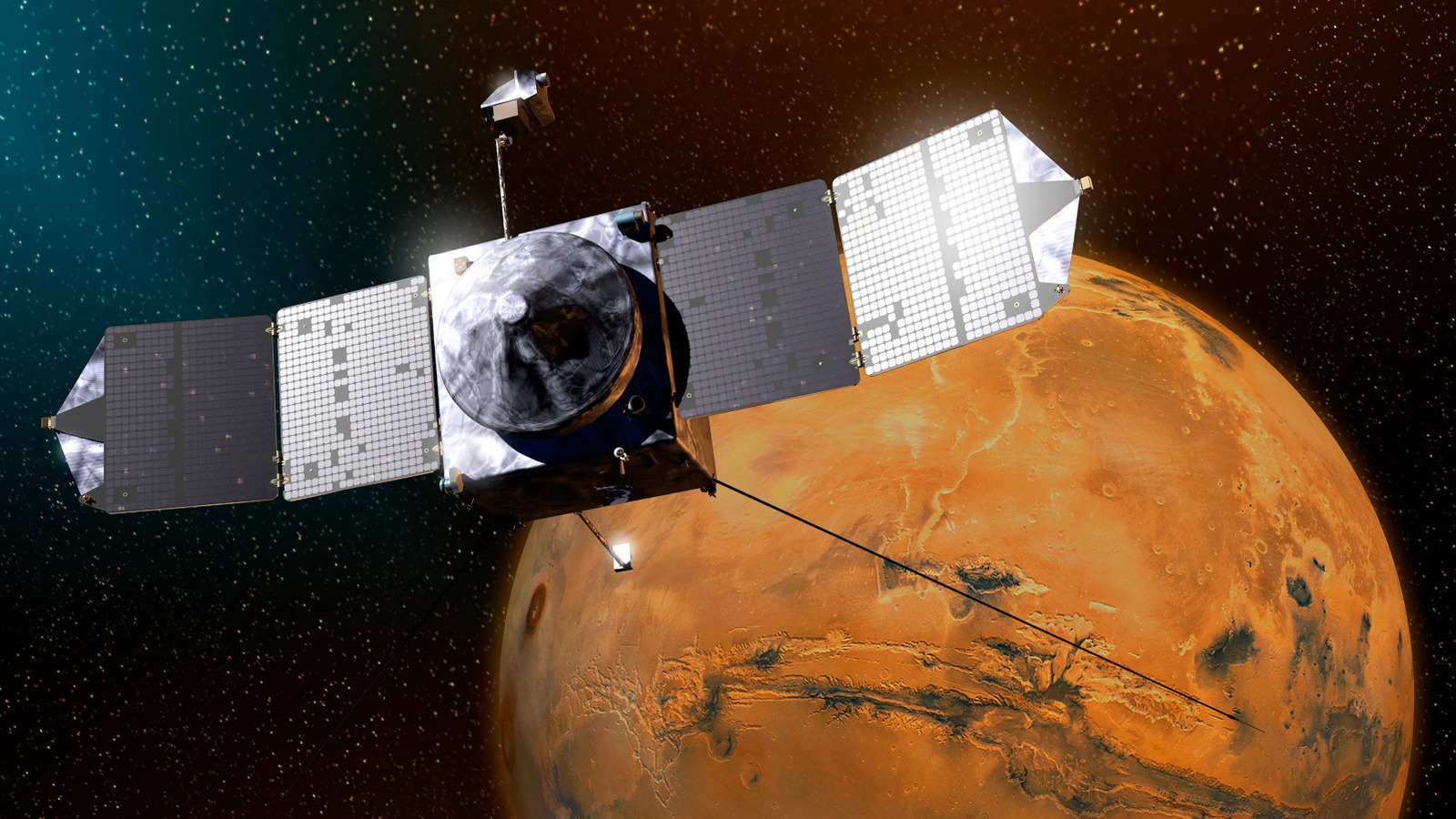
💡Lessons from MAVEN's communication failure are critical for engineers building autonomous remote-sensing AI systems.
⚡ 30-Second TL;DR
What Changed
MAVEN mission officially terminated
Why It Matters
The loss of MAVEN impacts ongoing atmospheric research data collection for Mars. It highlights the challenges of long-term autonomous remote sensing.
What To Do Next
Review NASA's public post-mortem reports on MAVEN's communication failure to improve edge-case recovery logic in your own autonomous systems.
Key Points
- •MAVEN mission officially terminated
- •Communication lost for six months prior to closure
- •NASA confirms the end of the probe's operational life
🧠 Deep Insight
Background and context from public sources — not the original article. 17 sources cited.
🔑 Enhanced Key Takeaways
- •The MAVEN mission, an acronym for Mars Atmosphere and Volatile Evolution, was the first NASA mission specifically dedicated to studying the Martian upper atmosphere and its interaction with the solar wind to understand atmospheric loss.
- •Originally designed for a one-Earth-year primary mission, MAVEN operated for over 11 years, significantly extending its scientific observations and becoming one of NASA's longest-running Mars orbiters.
- •Key scientific achievements include observing how solar storms accelerate atmospheric erosion, discovering new types of auroras on Mars, and being the first spacecraft to directly measure atmospheric sputtering at any planet.
- •The loss of communication in December 2025 was determined by an anomaly review board to be caused by the spacecraft entering safe mode and rotating at an unusually high rate, which subsequently drained its batteries and rendered it unrecoverable.
- •Beyond its scientific role, MAVEN served as a critical communications relay for NASA's Curiosity and Perseverance rovers on the Martian surface, transmitting data back to Earth.
📊 Competitor Analysis▸ Show
| Orbiter Name | Operator | Launch Year | Primary Objectives (relevant to MAVEN) | Data Relay Capability |
|---|---|---|---|---|
| MAVEN | NASA | 2013 | Martian atmospheric loss, climate evolution, solar wind interaction | Yes |
| Mars Odyssey | NASA | 2001 | Global mapping, mineralogy, radiation environment, data relay | Yes |
| MRO (Mars Reconnaissance Orbiter) | NASA | 2005 | High-resolution imaging, mineralogy, subsurface ice, data relay | Yes |
| Mars Express | ESA | 2003 | Surface, subsurface, atmosphere, ionosphere, data relay | Yes |
| TGO (ExoMars Trace Gas Orbiter) | ESA/Roscosmos | 2016 | Trace gases in atmosphere, surface features, data relay | Yes |
| Hope (Al Amal) | UAE | 2020 | Global Martian atmosphere dynamics and weather | No specific mention of relay |
| Tianwen-1 Orbiter | China | 2020 | Global mapping, surface morphology, atmospheric and ionospheric characteristics | Yes (for its own lander/rover) |
| ESCAPADE | NASA | 2025 | Solar wind interaction with Martian atmosphere (using twin spacecraft) | No (dedicated science) |
🛠️ Technical Deep Dive
- Manufacturer: Lockheed Martin Space Systems
- Design Heritage: Based on the Mars Reconnaissance Orbiter and 2001 Mars Odyssey designs
- Dimensions: Approximately 2.3 m × 2.3 m × 2 m (cubical bus), with a total length of 11.4 m including deployed solar arrays
- Mass: Launch mass of 2,454 kg; dry mass of 809 kg; payload mass of 65 kg
- Power: 1,135 watts
- Orbital Parameters: Highly elliptical orbit ranging from approximately 180 km (periareon) to 4,500 km (apoareon) altitude, with a 75° inclination and a period of 3.6 hours. It performed occasional "deep dips" down to 125 km into the upper atmosphere.
- Scientific Instruments (8 instruments, 9 sensors):
- Solar Wind Electron Analyzer (SWEA): Measures solar wind and ionosphere electrons.
- Solar Wind Ion Analyzer (SWIA): Measures solar wind and magnetosheath ion density and velocity.
- Suprathermal and Thermal Ion Composition (STATIC): Measures ion composition and distribution, operating over an energy range of 0.1 eV to 30 keV.
- Neutral Gas and Ion Mass Spectrometer (NGIMS): Measures the composition and isotopes of neutral gases and ions.
- Imaging Ultraviolet Spectrometer (IUVS): Measures atmospheric composition and structure.
- Langmuir Probe and Waves (LPW): Measures ionosphere properties and wave activity.
- Solar Energetic Particle (SEP): Measures solar energetic particles.
- Magnetometer (MAG): Measures the interplanetary and Martian magnetic fields.
- Communications Relay: Equipped with an Electra ultra high frequency (UHF) relay radio payload capable of data return rates up to 2048 kbit/s.
🔮 Future ImplicationsAI analysis grounded in cited sources
⏳ Timeline
📎 Sources (17)
Factual claims are grounded in the sources below. Forward-looking analysis is AI-generated interpretation.
Weekly AI Recap
Read this week's curated digest of top AI events →
👉Related Updates

AI-curated news aggregator. All content rights belong to original publishers.
Original source: Engadget ↗
This is a summary, not the original. Read the source, or get the weekly briefing.
The weekly digest
One email a week. Unsubscribe anytime.