Musk Praises Kimi's Attention Residuals
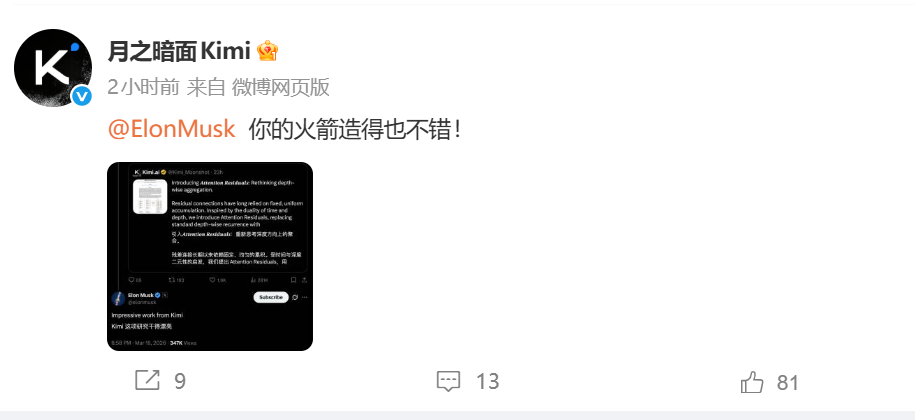
💡Musk-backed breakthrough reshapes attention residuals for deeper LLMs
⚡ 30-Second TL;DR
What Changed
Musk endorses Kimi's latest deep learning research
Why It Matters
Boosts visibility of Chinese AI innovations globally. May inspire new architectures in transformer models used by practitioners.
What To Do Next
Download Kimi's technical report to implement Attention Residuals in your transformer models.
Key Points
- •Musk endorses Kimi's latest deep learning research
- •Attention Residuals reimagines traditional residual connections
- •Kimi team releases technical report gaining global attention
- •Humorous exchange between Musk and Kimi official account
🧠 Deep Insight
Background and context from public sources — not the original article. 5 sources cited.
🔑 Enhanced Key Takeaways
- •Attention Residuals (AttnRes) achieves 1.25x compute efficiency advantage, matching baseline model performance with 25% less computational resources during training[1][3][4]
- •Moonshot AI integrated AttnRes into Kimi Linear, a 48-billion parameter Mixture-of-Experts architecture pre-trained on 1.4 trillion tokens, demonstrating scalability to production-grade models[1][2]
- •AttnRes solves PreNorm dilution by using learned softmax attention over network depth, allowing each layer to selectively retrieve information from previous layers rather than fixed additive accumulation[2][3]
- •Block AttnRes variant reduces memory footprints and communication costs through layer grouping, enabling seamless integration with less than 2% inference overhead[3][4]
- •Benchmark improvements span reasoning (GPQA-Diamond +7.5 points), mathematics (Minerva Math +3.6 points), and code generation (HumanEval significant gains), with consistent gains across MMLU, BBH, and other evaluation tasks[1][2]
🛠️ Technical Deep Dive
Architecture & Mechanism:
- Replaces fixed residual connections (h = h_l + F(h_l)) with depth-wise attention: V = [b₀; b₁; …; bₙ] (stacked blocks), K = RMSNorm(V) (normalized keys), α = softmax(K · w_l) (learned attention weights), h = Σ αᵢ · Vᵢ (weighted combination)[4]
- Two AttnRes operations per layer: one before self-attention, one before MLP, each with independent learned pseudo-query weights (w_l)[4]
- Pseudo-query vectors initialized to zero, ensuring uniform 1/N attention weights at training start and avoiding early instability[1]
- RMSNorm applied to keys to prevent blocks with large accumulated magnitudes from dominating attention logits[3][4]
Scaling Properties:
- Block AttnRes matches baseline validation loss at 1.25x compute efficiency[3][4]
- Mitigates gradient flow issues by distributing gradient norms uniformly across layers[1][2]
- Keeps output magnitudes bounded across network depth, addressing hidden-state growth problems in standard residuals[2]
Implementation Details:
- Softmax attention operates over depth dimension (dim=0), not sequence dimension—this is attention over layers, not tokens[4]
- Rust implementation available on burn framework, supporting CPU, CUDA, Metal, and wgpu backends[4]
- Inference overhead less than 2% with optimized system designs including cross-stage caching and two-phase computation strategy[3]
🔮 Future ImplicationsAI analysis grounded in cited sources
⏳ Timeline
📎 Sources (5)
Factual claims are grounded in the sources below. Forward-looking analysis is AI-generated interpretation.
- marktechpost.com — Moonshot AI Releases %f0%9d%91%a8%f0%9d%92%95%f0%9d%92%95%f0%9d%92%86%f0%9d%92%8f%f0%9d%92%95%f0%9d%92%8a%f0%9d%92%90%f0%9d%92%8f %f0%9d%91%b9%f0%9d%92%86%f0%9d%92%94%f0%9d%92%8a%f0%9d%92%85
- lifeinthesingularity.com — How Attention Residuals Are Rewiring
- youtube.com — Watch
- lib.rs — Attnres
- GitHub — Attention Residuals
Weekly AI Recap
Read this week's curated digest of top AI events →
👉Related Updates




AI-curated news aggregator. All content rights belong to original publishers.
Original source: cnBeta (Full RSS) ↗
This is a summary, not the original. Read the source, or get the weekly briefing.
Weekly AI briefing
One email a week. Unsubscribe anytime.