Mozilla Launches Open-Source Thunderbolt AI Client
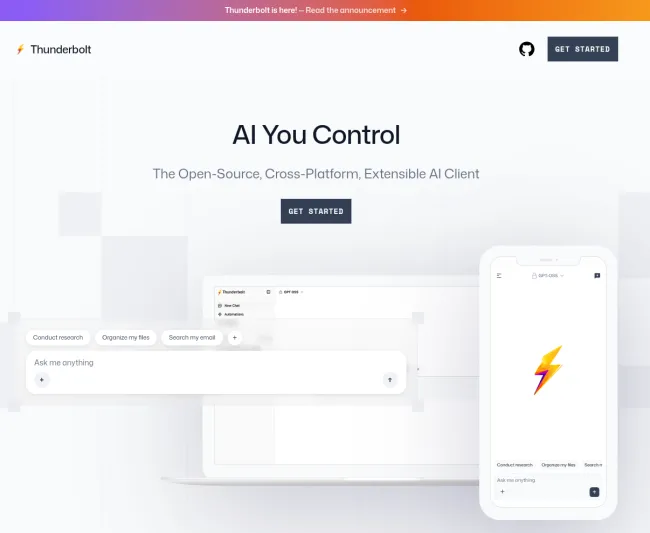
💡Open-source sovereign AI client for enterprise self-hosting—no vendor lock-in.
⚡ 30-Second TL;DR
What Changed
Open-source AI client for enterprise use
Why It Matters
This launch enables enterprises to deploy customizable, self-hosted AI without proprietary dependencies, accelerating open AI adoption and reducing cloud vendor lock-in. It positions Mozilla as a key player in sovereign AI solutions.
What To Do Next
Download Thunderbolt from Mozilla's repository and test connecting it to your enterprise data with Llama models.
Key Points
- •Open-source AI client for enterprise use
- •Sovereign AI with full controllability and independence
- •Integrates enterprise data, custom models, and tools
- •Supports chat, search, and research workspaces
🧠 Deep Insight
Background and context from public sources — not the original article. 10 sources cited.
🔑 Enhanced Key Takeaways
- •Mozilla's Thunderbolt client is developed by MZLA Technologies Corporation, the same entity responsible for the Thunderbird email client, and is explicitly positioned as a sovereign AI solution to challenge the dominance of closed-source enterprise AI platforms.
- •The platform features deep integration with open-source AI infrastructure, specifically partnering with deepset to utilize the Haystack agent framework, and supports standardized protocols like the Model Context Protocol (MCP) and Agent Client Protocol (ACP).
- •Thunderbolt offers flexible deployment options including self-hosted infrastructure, optional end-to-end encryption, and device-level access controls, allowing organizations to mix commercial, open-source, and local AI models.
📊 Competitor Analysis▸ Show
| Feature | Mozilla Thunderbolt | Enterprise AI Platforms (e.g., Microsoft Copilot, Google Gemini) | Local/Open-Source Frameworks (e.g., Ollama, LangChain) |
|---|---|---|---|
| Deployment | Self-hosted / Hybrid | Primarily Cloud-SaaS | Primarily Local / Self-hosted |
| Model Choice | Agnostic (Commercial/Open/Local) | Restricted to Provider Models | Fully Agnostic |
| Data Sovereignty | High (Self-hosted) | Low (Cloud-managed) | High (Self-hosted) |
| Pricing | Open-source / Enterprise Licensing | Subscription / Per-user | Open-source (Free) / Infrastructure costs |
🛠️ Technical Deep Dive
- •Architecture: Designed as a sovereign AI client with an extensible workspace for chat, search, and research.
- •Integration Protocols: Supports Model Context Protocol (MCP) servers and Agent Client Protocol (ACP) for interoperability with external systems.
- •Framework Partnership: Built with integration support for deepset's Haystack platform for agentic workflows.
- •Cross-Platform Support: Native applications available for Windows, macOS, Linux, iOS, and Android, alongside a web application.
- •Security: Features self-hosted deployment capabilities, optional end-to-end encryption, and granular device-level access controls.
- •Licensing: Codebase is open-source under the Mozilla Public License (MPL) 2.0, with additional enterprise licensing options provided by MZLA Technologies Corporation.
🔮 Future ImplicationsAI analysis grounded in cited sources
⏳ Timeline
📎 Sources (10)
Factual claims are grounded in the sources below. Forward-looking analysis is AI-generated interpretation.
Weekly AI Recap
Read this week's curated digest of top AI events →
👉Related Updates
AI-curated news aggregator. All content rights belong to original publishers.
Original source: cnBeta (Full RSS) ↗
This is a summary, not the original. Read the source, or get the weekly briefing.
The weekly digest
One email a week. Unsubscribe anytime.