Moonshot AI releases open-source Kimi K2.7 Code model
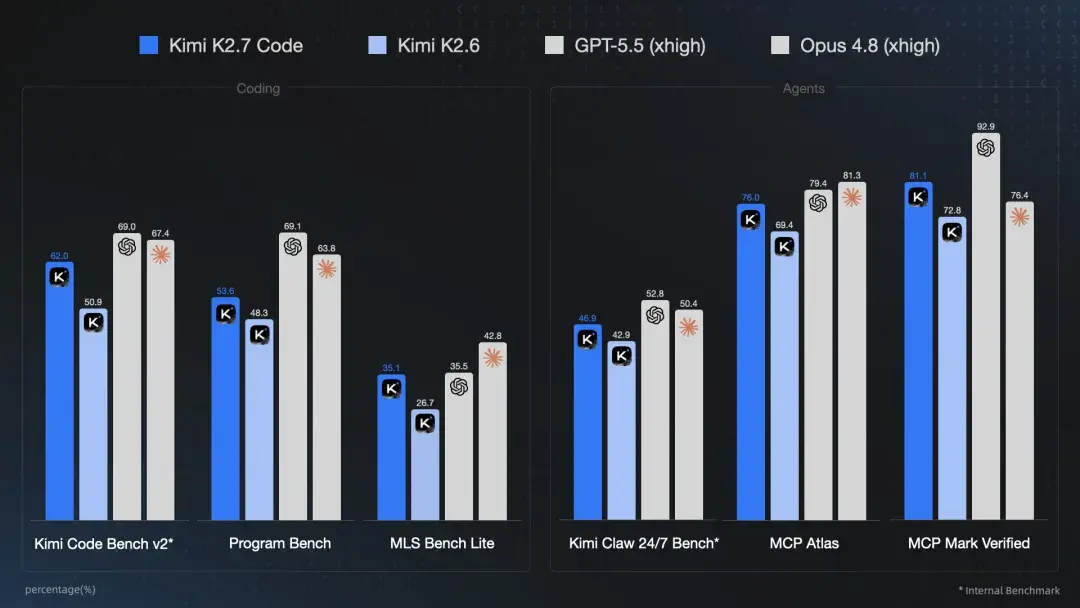
💡New open-source coding model with 30% better token efficiency for long-context tasks.
⚡ 30-Second TL;DR
What Changed
Kimi K2.7 Code is now open-source for developers.
Why It Matters
The reduction in token consumption offers a more cost-effective solution for developers handling large-scale codebases. This release strengthens the open-source ecosystem for specialized coding models.
What To Do Next
Integrate Kimi K2.7 Code into your IDE or CI/CD pipeline to evaluate its efficiency gains in your specific coding tasks.
Key Points
- •Kimi K2.7 Code is now open-source for developers.
- •Achieves 30% reduction in average token consumption.
- •Improved performance in long-context programming and instruction following.
🧠 Deep Insight
Background and context from public sources — not the original article. 20 sources cited.
🔑 Enhanced Key Takeaways
- •Kimi K2.7 Code is released under a Modified MIT license, with its weights available on HuggingFace, allowing for commercial use with attribution in large-scale deployments.
- •The model is built upon the same trillion-parameter Mixture-of-Experts (MoE) architecture as its predecessor, K2.6, activating 32 billion parameters per forward pass.
- •K2.7 Code specifically targets 'overthinking' in agentic workflows, achieving a 30% reduction in 'thinking-token' usage compared to K2.6, which directly translates to lower inference costs and improved latency.
- •Moonshot AI reports substantial performance improvements for K2.7 Code over K2.6 on its proprietary benchmarks, including a 21.8% gain on Kimi Code Bench v2, an 11% increase on Program Bench, and a 31.5% jump on MLS Bench Lite, which evaluates multi-language support across Rust, Go, and Python.
- •A key architectural change in K2.7 Code is its ability to directly author low-level code implementations, rather than merely wrapping existing libraries as K2.6 did, leading to more robust generalization across various programming languages and task domains like frontend development and DevOps.
📊 Competitor Analysis▸ Show
| Feature/Model | Moonshot AI Kimi K2.7 Code | Moonshot AI Kimi K2.6 | DeepSeek V4 Pro / R1 | Qwen 3.7 Max / 235B | GLM-4.7 / GLM-5 |
|---|---|---|---|---|---|
| Developer | Moonshot AI | Moonshot AI | DeepSeek AI | Alibaba Cloud | Zhipu AI |
| Architecture | MoE (1T total, 32B active) | MoE (1T total, 32B active) | MoE (V3) | Hybrid MoE | MoE |
| Context Window | 256K tokens | 256K tokens | N/A (R1 is reasoning-focused) | 1M tokens (Qwen 3.6 Plus) | 200K tokens (GLM-5) |
| License | Modified MIT | Modified MIT | MIT (V4) / Apache 2.0 (many variants) | Open-weight (Max tier gateway-served, smaller siblings permissive) | Apache 2.0 (open releases) |
| Key Strengths | Coding-focused, agentic, multimodal, 30% thinking-token reduction | Agentic coding, multimodal, ties GPT-5.5 on SWE-Bench Pro | Code, math (V4 Pro); Deep reasoning (R1) | Broad reasoning, multilingual, agentic coding, long context | Agentic coding (GLM-4.7: 94.2% HumanEval, 73.8% SWE-bench) |
| SWE-Bench Pro | N/A (K2.7 Code uses proprietary benchmarks) | 58.6% (tied GPT-5.5) | N/A | N/A | N/A (GLM-4.7: 73.8% SWE-bench) |
| API Pricing (per 1M tokens) | N/A (open-source, but API available) | $0.95 input / $4.00 output | N/A (open-source) | N/A (open-source) | N/A (open-source) |
🛠️ Technical Deep Dive
- Architecture: Kimi K2.7 Code is built on a 1 trillion-parameter Mixture-of-Experts (MoE) architecture, with 32 billion active parameters per forward pass.
- Context Window: It supports an ultra-long context window of 256,000 tokens, inherited from its predecessor K2.6.
- Code Generation Method: A core technical advancement is that K2.7 Code directly authors low-level code implementations, a departure from K2.6 which primarily wrapped existing libraries.
- Operating Mode: The model operates exclusively in a 'thinking mode' and has its temperature fixed at 1.0, which means developers cannot adjust output determinism. It also forces
preserve_thinkingmode to retain full reasoning content across multi-turn interactions. - Multimodal Capabilities: K2.7 Code supports native multimodal input, including text, image, and video, facilitated by the MoonViT vision encoder.
- Efficiency: It includes native INT4 quantization support, designed to reduce VRAM usage, accelerate inference, and lower deployment costs.
- Deployment: The model is deployable via vLLM or SGLang and offers an OpenAI-compatible API for integration.
🔮 Future ImplicationsAI analysis grounded in cited sources
⏳ Timeline
📎 Sources (20)
Factual claims are grounded in the sources below. Forward-looking analysis is AI-generated interpretation.
Weekly AI Recap
Read this week's curated digest of top AI events →
👉Related Updates
AI-curated news aggregator. All content rights belong to original publishers.
Original source: cnBeta (Full RSS) ↗
This is a summary, not the original. Read the source, or get the weekly briefing.
The weekly digest
One email a week. Unsubscribe anytime.