Monarch API Unlocks Supercomputer Training
💡Easier supercomputer access for distributed training – vital for scaling RL models.
⚡ 30-Second TL;DR
What Changed
New API for easy distributed training on supercomputers
Why It Matters
This lowers barriers for scaling ML models on supercomputers, enabling faster experimentation for researchers and builders handling massive datasets.
What To Do Next
Test Monarch API by submitting a sample distributed RL job via PyTorch Blog guide.
Key Points
- •New API for easy distributed training on supercomputers
- •Supports complex setups like distributed RL
- •Simplifies debugging on huge clusters
🧠 Deep Insight
Background and context from public sources — not the original article. 5 sources cited.
🔑 Enhanced Key Takeaways
- •Monarch shifts from the traditional multi-controller (SPMD) model to a single-controller architecture, allowing a single Python script to orchestrate distributed resources across an entire cluster as if they were local objects.
- •The framework utilizes 'process meshes' and 'actor meshes' to organize compute resources, enabling developers to slice, broadcast, and manipulate distributed nodes using intuitive Pythonic constructs like loops and futures.
- •To optimize performance, Monarch separates the control plane (messaging) from the data plane, utilizing RDMA (Remote Direct Memory Access) for high-throughput, zero-copy GPU-to-GPU data transfers.
📊 Competitor Analysis▸ Show
| Feature | Monarch | Ray | Dask |
|---|---|---|---|
| Primary Model | Single-controller (Orchestration) | Distributed Task/Actor | Distributed Task/Dataframe |
| PyTorch Native | Yes (Deep integration) | Via libraries | Via libraries |
| Data Transfer | RDMA-optimized | Plasma Store / Arrow | Pickle / Cloudpickle |
| Best For | Large-scale PyTorch training/RL | General purpose distributed Python | Data science/parallel computing |
🛠️ Technical Deep Dive
- •Architecture: Single-controller model where one script manages process/actor meshes; backend implemented in Rust.
- •Communication: Separates control plane (messaging) from data plane (RDMA transfers using libibverbs).
- •Fault Tolerance: Implements supervision trees where failures propagate up, enabling fine-grained, user-defined recovery logic.
- •Distributed Tensors: Provides sharded tensors that integrate with PyTorch, supporting direct GPU-to-GPU memory transfers.
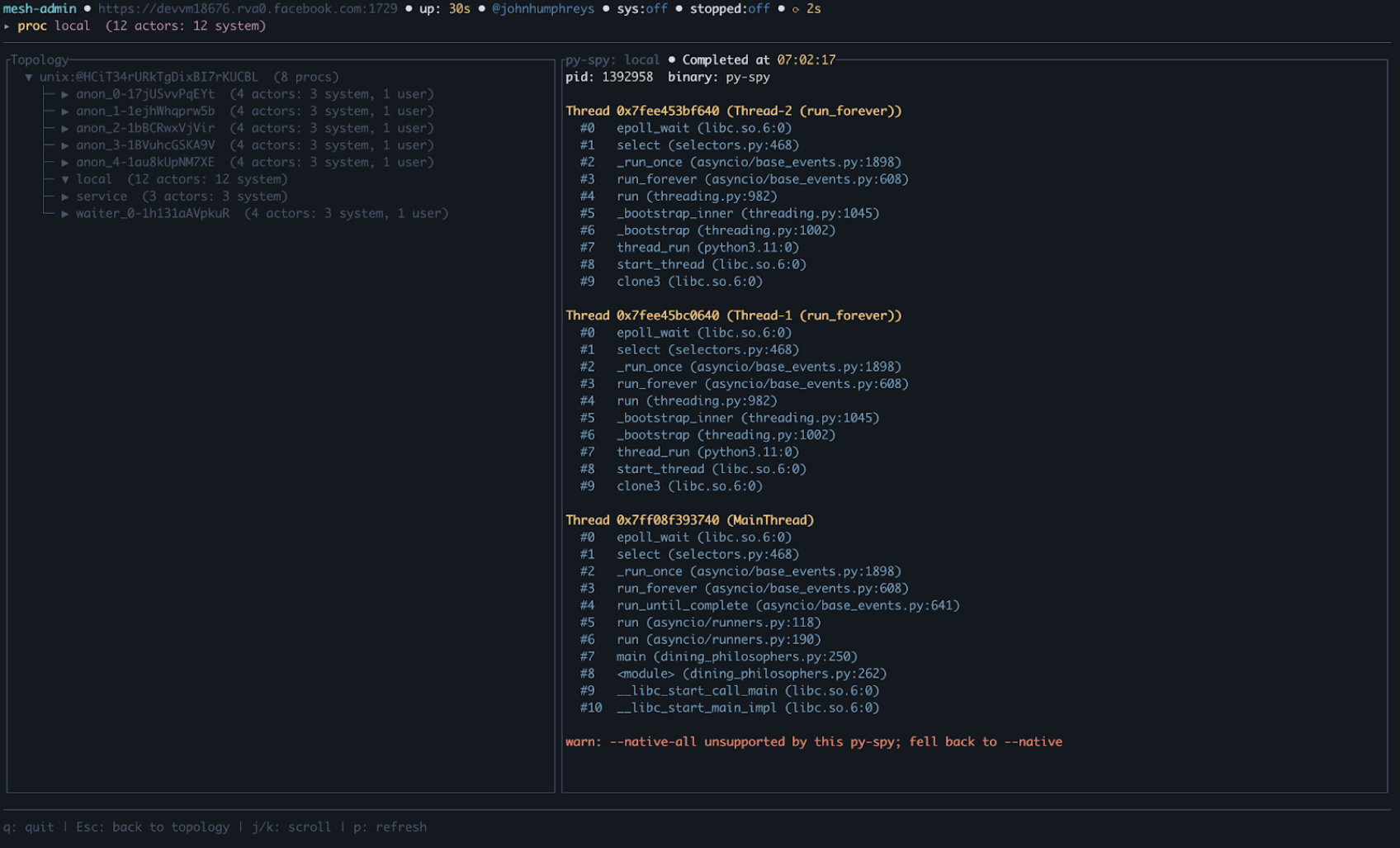
- •Debugging: Supports standard Python pdb breakpoints within remote actor meshes, with a TUI (Terminal User Interface) for mesh administration.
🔮 Future ImplicationsAI analysis grounded in cited sources
⏳ Timeline
📎 Sources (5)
Factual claims are grounded in the sources below. Forward-looking analysis is AI-generated interpretation.
Weekly AI Recap
Read this week's curated digest of top AI events →
👉Related Updates
AI-curated news aggregator. All content rights belong to original publishers.
Original source: PyTorch Blog ↗
This is a summary, not the original. Read the source, or get the weekly briefing.
The weekly digest
One email a week. Unsubscribe anytime.