Mistral launches OCR 4 for multilingual document extraction
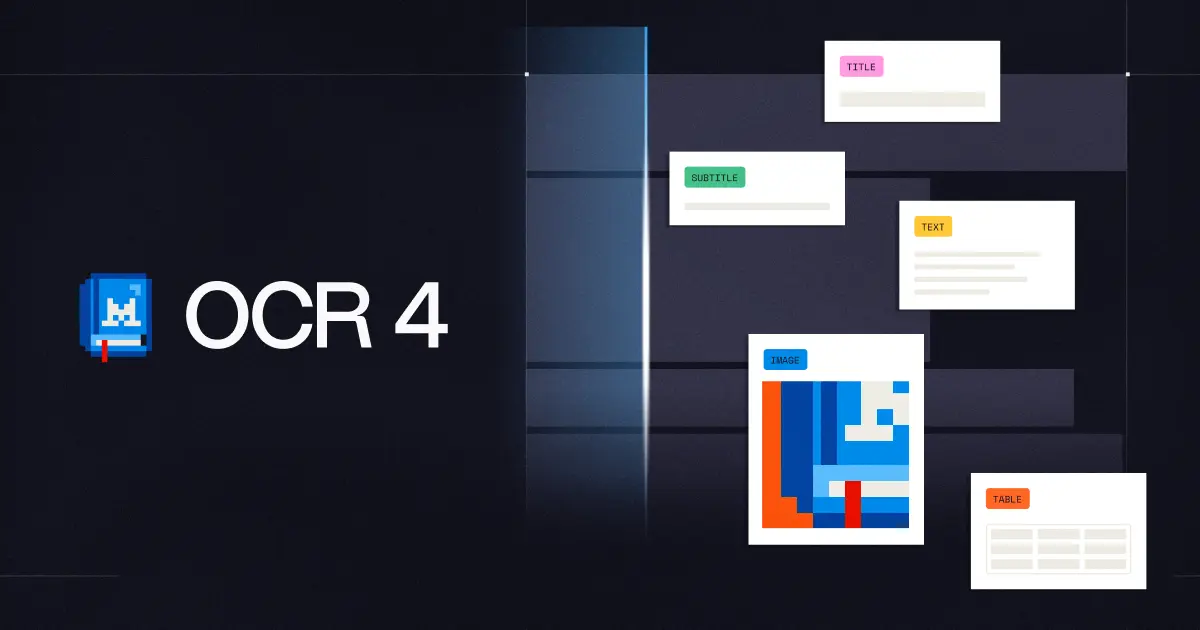
Mistral's new OCR 4 offers multilingual extraction with spatial metadata, ideal for complex document automation tasks.
30-Second TL;DR
What Changed
Supports document extraction in 170 different languages
Why It Matters
This release strengthens Mistral's position in the document processing market by offering a robust, multilingual alternative to existing OCR solutions. It enables developers to build more accurate automated data entry and document analysis pipelines.
What To Do Next
Integrate the Mistral OCR 4 API into your document processing pipeline to evaluate its accuracy on your specific multilingual datasets.
Key Points
- •Supports document extraction in 170 different languages
- •Outputs structured data including bounding boxes and region scores
- •Available via API and as a self-hosted container for flexible deployment
Deep Insight
AI-generated analysis for this event — not the original article.
Enhanced Key Takeaways
- •Mistral OCR 4 is built upon the Pixtral architecture, leveraging its multimodal capabilities to interpret visual document layouts alongside text content.
- •The model is specifically optimized for complex document structures, including tables, handwritten notes, and multi-column layouts that traditional OCR often struggles to parse.
- •Mistral has integrated this OCR capability directly into its platform's API, allowing developers to chain document extraction with their existing LLM workflows for automated data processing.
- •The model demonstrates significant improvements in latency and token efficiency compared to previous vision-language models when processing high-resolution document images.
- •Mistral offers a specific 'OCR-only' mode that reduces computational overhead by disabling unnecessary generative features, focusing strictly on extraction accuracy.
Competitor Analysis
- Mistral OCR 4
- Multimodal (Pixtral-based)
- Google Cloud Document AI
- Specialized CNN/Transformer
- AWS Textract
- Specialized Deep Learning
- Mistral OCR 4
- API / Self-hosted Container
- Google Cloud Document AI
- Managed Cloud Service
- AWS Textract
- Managed Cloud Service
- Mistral OCR 4
- 170+ Languages
- Google Cloud Document AI
- 200+ Languages
- AWS Textract
- 100+ Languages
- Mistral OCR 4
- Usage-based / Enterprise
- Google Cloud Document AI
- Usage-based
- AWS Textract
- Usage-based
| Feature | Mistral OCR 4 | Google Cloud Document AI | AWS Textract |
|---|---|---|---|
| Architecture | Multimodal (Pixtral-based) | Specialized CNN/Transformer | Specialized Deep Learning |
| Deployment | API / Self-hosted Container | Managed Cloud Service | Managed Cloud Service |
| Multilingual | 170+ Languages | 200+ Languages | 100+ Languages |
| Pricing Model | Usage-based / Enterprise | Usage-based | Usage-based |
Technical Deep Dive
- Architecture: Utilizes a vision-encoder-decoder framework derived from the Pixtral family, allowing for spatial awareness of document elements.
- Output Format: Generates structured JSON output containing hierarchical block definitions (pages, blocks, lines, words) and normalized bounding box coordinates (0-1000 scale).
- Integration: Supports standard REST API endpoints and Docker-based deployment for on-premise or VPC-isolated environments.
- Performance: Optimized for high-density text extraction, maintaining context retention across long-form documents through a sliding window attention mechanism.
Future ImplicationsAI analysis grounded in cited sources
Timeline
- 2023-04Mistral AI is founded in Paris, France.
- 2024-02Mistral releases Mistral Large, marking its entry into high-end enterprise LLMs.
- 2024-09Mistral introduces Pixtral 12B, its first multimodal model capable of processing images.
- 2026-06Mistral launches OCR 4, specialized for document extraction and structured data output.
Weekly AI Recap
Read this week's curated digest of top AI events →
AI-curated news aggregator. All content rights belong to original publishers.
Original source: TestingCatalog ↗
This is a summary, not the original. Read the source, or get the weekly briefing.
The weekly digest
One email a week. Unsubscribe anytime.