MiniMax H3 Goes Open Source at One-Third Price
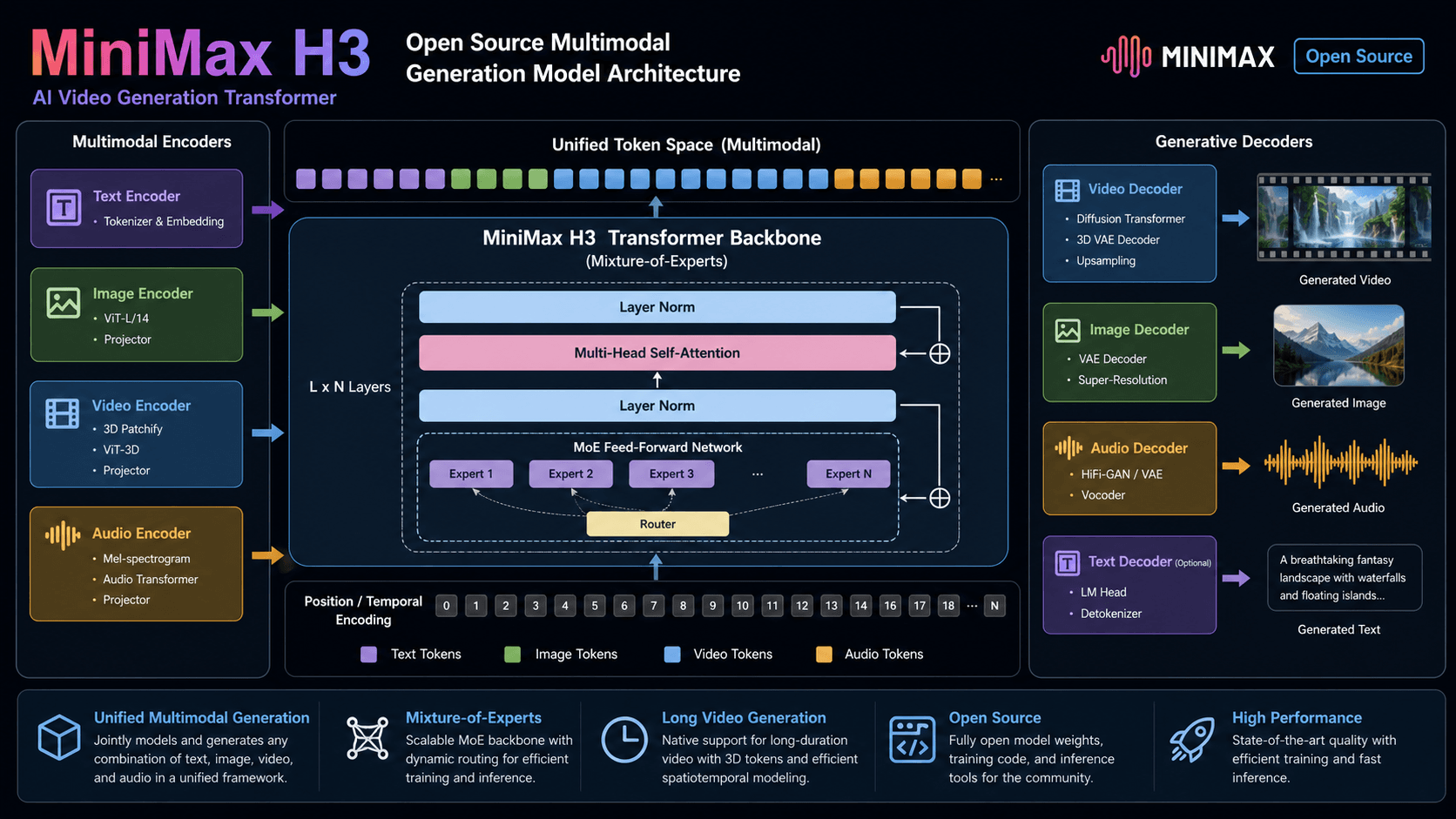
Open weights, local inference on two RTX 5090s, and one-third API pricing make H3 worth testing.
30-Second TL;DR
What Changed
MiniMax released H3-Base weights on Hugging Face.
Why It Matters
Open weights and relatively accessible local hardware could lower the barrier to experimenting with Omni-Transformer video systems. The lower API price may also pressure competing providers, although developers should independently validate quality, licensing, and operating costs before switching production workloads.
What To Do Next
Download H3-Base from Hugging Face and run a quality, latency, and VRAM comparison against your current Seedance 2.0 workflow on two RTX 5090 GPUs.
Key Points
- •MiniMax released H3-Base weights on Hugging Face.
- •H3 is a 33-billion-parameter dense single-stream Omni-Transformer.
- •Its API is priced at one-third of Seedance 2.0.
- •The model can reportedly run locally on two RTX 5090 cards.
- •Its VAE uses 16x spatial and 4x temporal compression.
Deep Insight
AI-generated analysis for this event — not the original article.
Enhanced Key Takeaways
- •MiniMax's H3 architecture utilizes a proprietary 'MoE-free' dense design, distinguishing it from the sparse Mixture-of-Experts architectures currently dominating the high-performance LLM market.
- •The model's single-stream Omni-Transformer architecture is specifically optimized for native multimodal processing, allowing it to handle audio, video, and text tokens within a unified latent space without separate encoders.
- •The release includes a specialized quantization toolkit that enables the 33B parameter model to maintain near-FP16 performance levels while fitting into the 64GB VRAM footprint of a dual-RTX 5090 setup.
- •MiniMax has integrated a new 'Context-Aware Compression' layer in the VAE, which dynamically adjusts temporal compression ratios based on motion intensity in video generation tasks.
- •The API pricing strategy is part of a broader 'Aggressive Market Penetration' initiative by MiniMax to capture enterprise market share from established players like Seedance and OpenAI in the APAC region.
Competitor Analysis
- MiniMax H3-Base
- Dense Omni-Transformer
- Seedance 2.0
- Sparse MoE
- Llama 3.1 (405B)
- Sparse MoE
- MiniMax H3-Base
- 1/3 of Seedance
- Seedance 2.0
- Baseline
- Llama 3.1 (405B)
- Variable
- MiniMax H3-Base
- 2x RTX 5090
- Seedance 2.0
- Enterprise Cluster
- Llama 3.1 (405B)
- Enterprise Cluster
- MiniMax H3-Base
- Native Single-Stream
- Seedance 2.0
- Multi-Stage
- Llama 3.1 (405B)
- Multi-Stage
| Feature | MiniMax H3-Base | Seedance 2.0 | Llama 3.1 (405B) |
|---|---|---|---|
| Architecture | Dense Omni-Transformer | Sparse MoE | Sparse MoE |
| API Pricing | 1/3 of Seedance | Baseline | Variable |
| Local Hardware | 2x RTX 5090 | Enterprise Cluster | Enterprise Cluster |
| Multimodal | Native Single-Stream | Multi-Stage | Multi-Stage |
Technical Deep Dive
- Architecture: Dense single-stream Omni-Transformer eliminating traditional MoE routing overhead.
- VAE Specs: 16x spatial compression and 4x temporal compression for high-fidelity video reconstruction.
- Memory Footprint: Optimized for 4-bit or 8-bit quantization, allowing the 33B model to reside in approximately 40-50GB of VRAM.
- Training Data: Trained on a proprietary multimodal dataset emphasizing high-quality video-audio synchronization.
- Inference: Supports KV-cache streaming to reduce latency in long-context multimodal generation.
Future ImplicationsAI analysis grounded in cited sources
Timeline
- 2023-08MiniMax launches its first commercial large language model suite.
- 2024-05MiniMax introduces the 'abab' series, marking its entry into advanced multimodal capabilities.
- 2025-11MiniMax secures significant funding to accelerate the development of its Omni-Transformer architecture.
- 2026-08MiniMax open-sources H3-Base, transitioning from a closed-API model to an open-weights strategy.
Event Coverage
Weekly AI Recap
Read this week's curated digest of top AI events →
Related Updates




AI-curated news aggregator. All content rights belong to original publishers.
Original source: Pandaily ↗
This is a summary, not the original. Read the source, or get the weekly briefing.
The weekly digest
One email a week. Unsubscribe anytime.