Migrate legacy Topics to semantic datasets in QuickSight
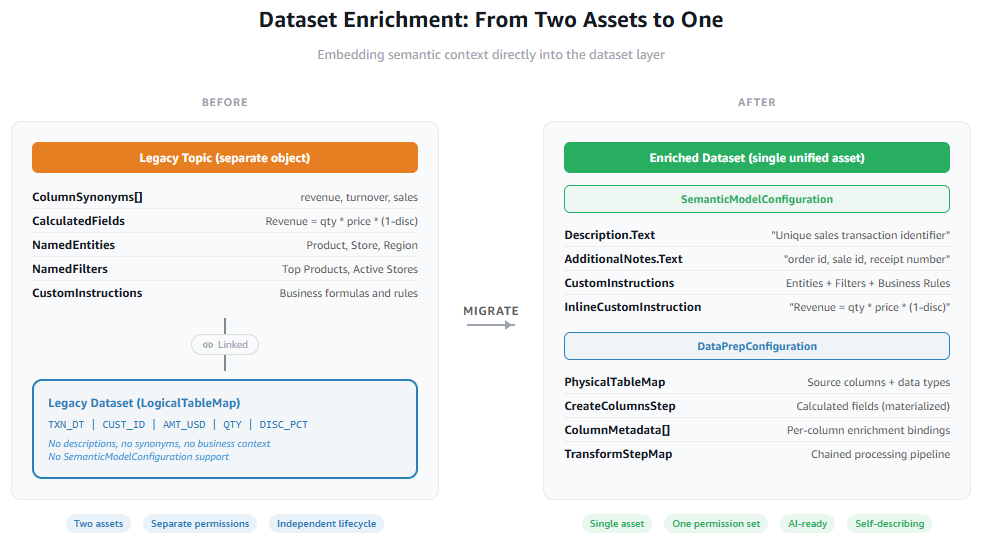
💡Learn how to centralize your business logic for more robust and maintainable data analytics.
⚡ 30-Second TL;DR
What Changed
Understand Dataset Enrichment concepts
Why It Matters
Improves data governance and consistency by centralizing business logic within the dataset layer rather than the presentation layer.
What To Do Next
Review your existing QuickSight Topics and identify which business logic can be moved to the semantic dataset layer.
Key Points
- •Understand Dataset Enrichment concepts
- •Compare legacy Topics vs semantic datasets
- •Follow three specific migration scenarios
🧠 Deep Insight
AI-generated analysis for this event — not the original article.
🔑 Enhanced Key Takeaways
- •Semantic datasets in QuickSight leverage a centralized metadata layer that persists business logic, such as calculated fields and row-level security, directly within the dataset rather than the Topic object.
- •The migration process is necessitated by the deprecation of legacy Topics, which lacked the unified governance and reusability features now provided by the semantic layer.
- •Semantic datasets enable 'Natural Language Query' (NLQ) capabilities by automatically inheriting the enriched metadata, reducing the need for manual synonym mapping required in legacy Topics.
- •AWS provides a specific migration utility or API-based approach to map existing Topic configurations to the new semantic dataset structure, ensuring continuity for Q&A dashboards.
- •By moving business context to the dataset layer, organizations can achieve a 'single source of truth' that propagates changes across all connected analyses and dashboards simultaneously.
📊 Competitor Analysis▸ Show
| Feature | AWS QuickSight (Semantic Datasets) | Microsoft Power BI (Semantic Models) | Tableau (Data Sources) |
|---|---|---|---|
| Governance | Centralized, AWS-native | Enterprise-grade, Fabric integrated | Project-based, Server/Cloud |
| NLQ Integration | Native Q&A via Semantic Layer | Copilot/Q&A via Datasets | Ask Data via Data Sources |
| Pricing Model | Pay-per-session/Capacity | Per-user/Capacity (Fabric) | Per-user/Creator/Explorer |
🛠️ Technical Deep Dive
- Semantic datasets utilize a JSON-based definition structure that encapsulates column metadata, semantic types (e.g., geography, currency), and aggregation rules.
- The migration architecture involves re-binding existing Q&A visuals from the legacy Topic ID to the new Semantic Dataset ID within the QuickSight API.
- Semantic layers support 'Synonym Groups' and 'Excluded Columns' configurations that are now stored as properties of the dataset object rather than the Topic object.
- The underlying engine uses an optimized indexing strategy for natural language processing that prioritizes semantic relationships defined in the dataset schema over raw table joins.
🔮 Future ImplicationsAI analysis grounded in cited sources
⏳ Timeline
Weekly AI Recap
Read this week's curated digest of top AI events →
👉Related Updates
AI-curated news aggregator. All content rights belong to original publishers.
Original source: AWS Machine Learning Blog ↗
This is a summary, not the original. Read the source, or get the weekly briefing.
Weekly AI briefing
One email a week. Unsubscribe anytime.