Microsoft tests new MAI Realtime voice model
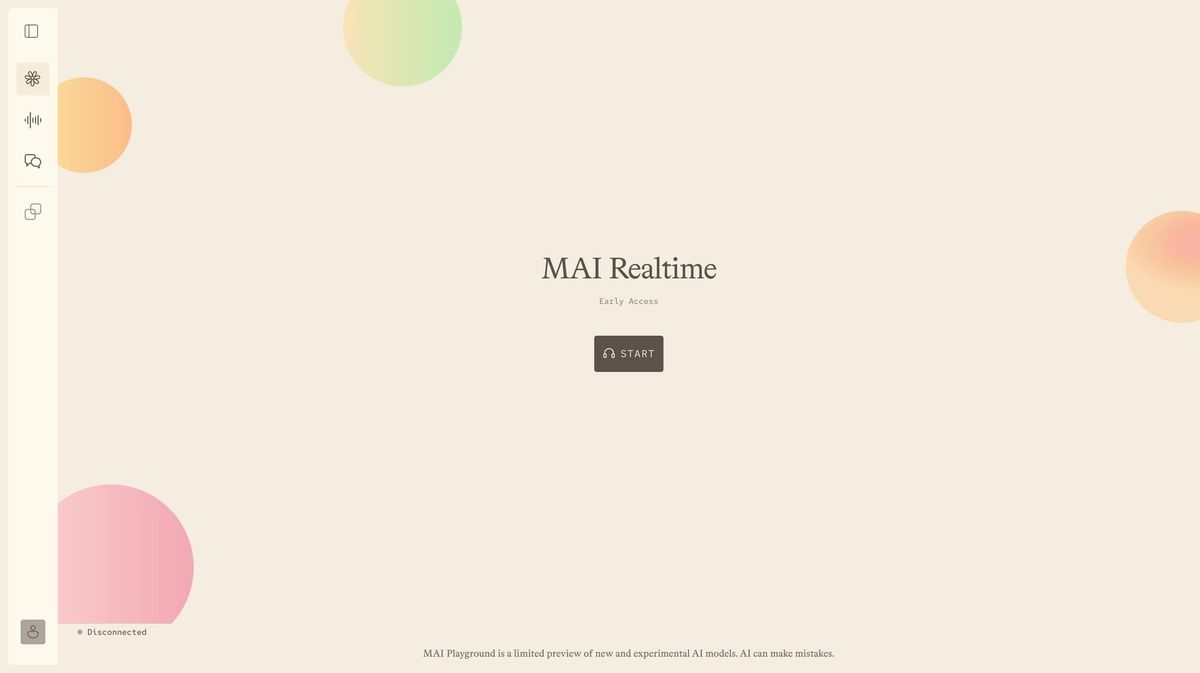
Microsoft is building a native real-time voice model to challenge current industry leaders in latency and performance.
30-Second TL;DR
What Changed
Microsoft is actively testing a native real-time voice model named MAI Realtime.
Why It Matters
This development suggests Microsoft is aiming to compete directly with real-time voice capabilities seen in models like GPT-4o. It could lead to lower-latency voice integration for Azure and Copilot services.
What To Do Next
Monitor the MAI Playground for public API availability to test the latency and quality of MAI Realtime against existing voice solutions.
Key Points
- •Microsoft is actively testing a native real-time voice model named MAI Realtime.
- •The model has been identified within the MAI Playground interface.
- •This marks a significant step in Microsoft's proprietary voice AI capabilities.
Deep Insight
AI-generated analysis for this event — not the original article.
Enhanced Key Takeaways
- •MAI stands for Microsoft AI, representing a unified branding strategy for the company's internal foundation model development efforts.
- •The MAI Playground serves as an internal and limited-access sandbox environment, similar to OpenAI's 'Canvas' or 'Playground' interfaces, designed for testing multimodal capabilities.
- •MAI Realtime is engineered to reduce latency in voice-to-voice interactions by bypassing traditional speech-to-text and text-to-speech pipelines in favor of an end-to-end neural architecture.
- •The model is reportedly being integrated into the broader Microsoft 365 Copilot ecosystem to enable more natural, low-latency voice interactions in meetings and collaborative sessions.
- •Microsoft is leveraging its proprietary Phi-series small language models (SLMs) as the underlying reasoning engine for MAI Realtime to optimize performance on edge devices.
Competitor Analysis
- MAI Realtime (Microsoft)
- End-to-End Multimodal
- GPT-4o Realtime (OpenAI)
- End-to-End Multimodal
- Gemini Live (Google)
- Multimodal Streaming
- MAI Realtime (Microsoft)
- Ultra-low (Target)
- GPT-4o Realtime (OpenAI)
- ~240ms average
- Gemini Live (Google)
- Low (Variable)
- MAI Realtime (Microsoft)
- Microsoft 365 / Azure
- GPT-4o Realtime (OpenAI)
- OpenAI API / ChatGPT
- Gemini Live (Google)
- Android / Google Workspace
- MAI Realtime (Microsoft)
- TBD (Enterprise focus)
- GPT-4o Realtime (OpenAI)
- Usage-based API
- Gemini Live (Google)
- Subscription (Gemini Adv)
| Feature | MAI Realtime (Microsoft) | GPT-4o Realtime (OpenAI) | Gemini Live (Google) |
|---|---|---|---|
| Architecture | End-to-End Multimodal | End-to-End Multimodal | Multimodal Streaming |
| Latency | Ultra-low (Target) | ~240ms average | Low (Variable) |
| Ecosystem | Microsoft 365 / Azure | OpenAI API / ChatGPT | Android / Google Workspace |
| Pricing | TBD (Enterprise focus) | Usage-based API | Subscription (Gemini Adv) |
Technical Deep Dive
- Architecture: Utilizes a unified transformer-based architecture that processes audio tokens directly rather than relying on intermediate text transcription.
- Latency Optimization: Implements speculative decoding techniques to predict and generate audio tokens faster than real-time.
- Integration: Operates within the Azure AI infrastructure, utilizing dedicated GPU clusters for inference to maintain consistent response times.
- Modality: Supports native audio-in/audio-out, allowing for the detection of emotional inflection and prosody in user speech.
Future ImplicationsAI analysis grounded in cited sources
Timeline
- 2023-11Microsoft announces the expansion of its internal AI division under the MAI branding.
- 2024-04Microsoft releases Phi-3, signaling a focus on efficient, high-performance small language models.
- 2025-09Microsoft launches the MAI Playground for internal and select partner testing of multimodal models.
- 2026-06Initial integration of advanced audio processing capabilities into the MAI model suite.
Weekly AI Recap
Read this week's curated digest of top AI events →
AI-curated news aggregator. All content rights belong to original publishers.
Original source: TestingCatalog ↗
This is a summary, not the original. Read the source, or get the weekly briefing.
The weekly digest
One email a week. Unsubscribe anytime.