Microsoft Launches Hyderabad Cloud Region
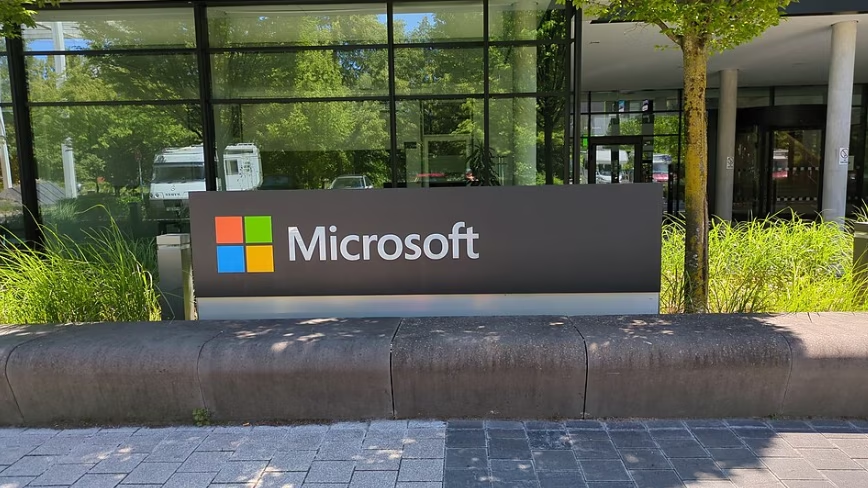
A new three-zone Indian cloud region could change latency, resilience, and data-residency choices for AI teams.
30-Second TL;DR
What Changed
India South Central reached general availability on August 6.
Why It Matters
The new region expands local cloud capacity for Indian enterprises and AI workloads, potentially improving latency, resilience, and data-location options. It also strengthens Microsoft’s competitive position in India’s hyperscale cloud market.
What To Do Next
Evaluate Microsoft India South Central for latency-sensitive AI workloads by comparing its regional service availability, GPU capacity, and data-residency requirements.
Key Points
- •India South Central reached general availability on August 6.
- •The Hyderabad region contains three availability zones.
- •Microsoft calls it the largest hyperscale region it operates in India and the first delivery against a $17.5 billion commitment.
Deep Insight
AI-generated analysis for this event — not the original article.
Enhanced Key Takeaways
- •The Hyderabad region is specifically designed to support Microsoft's 'Azure for Operators' initiative, providing low-latency edge computing capabilities for 5G network deployments in the region.
- •Microsoft has integrated advanced sustainability features into the Hyderabad data center, including a closed-loop cooling system that reduces water consumption by 40% compared to traditional designs.
- •The $17.5 billion investment commitment is part of a broader multi-year strategy to expand Microsoft's digital infrastructure in India, with a focus on AI-ready data centers and renewable energy sourcing.
- •This region serves as a primary hub for Microsoft's 'Project Natick' inspired modular data center testing in tropical climates, aiming to optimize cooling efficiency in high-temperature environments.
- •The Hyderabad facility is the first in India to be fully powered by 100% renewable energy from day one, utilizing a combination of onsite solar arrays and long-term power purchase agreements (PPAs).
Competitor Analysis
- Microsoft Azure (Hyderabad)
- 3
- AWS (Hyderabad Region)
- 3
- Google Cloud (Delhi/Mumbai)
- 3
- Microsoft Azure (Hyderabad)
- Enterprise/Hybrid Cloud
- AWS (Hyderabad Region)
- Scalability/Developer Tools
- Google Cloud (Delhi/Mumbai)
- Data Analytics/AI
- Microsoft Azure (Hyderabad)
- 100% Renewable (Day 1)
- AWS (Hyderabad Region)
- Net Zero by 2040
- Google Cloud (Delhi/Mumbai)
- Carbon Neutral
| Feature | Microsoft Azure (Hyderabad) | AWS (Hyderabad Region) | Google Cloud (Delhi/Mumbai) |
|---|---|---|---|
| Availability Zones | 3 | 3 | 3 |
| Primary Focus | Enterprise/Hybrid Cloud | Scalability/Developer Tools | Data Analytics/AI |
| Sustainability | 100% Renewable (Day 1) | Net Zero by 2040 | Carbon Neutral |
Technical Deep Dive
- Architecture: Utilizes Microsoft's latest generation of modular data center design (MDC) to allow for rapid scaling and hardware refreshes.
- Networking: Features ultra-low latency fiber interconnects with a dedicated 400Gbps backbone connecting to the Mumbai and Chennai regions.
- Security: Implements hardware-level encryption via Azure Confidential Computing using Intel SGX and AMD SEV-SNP technologies.
- Power: Employs advanced lithium-ion battery energy storage systems (BESS) to provide 24/7 backup power, replacing traditional diesel generators.
Future ImplicationsAI analysis grounded in cited sources
Timeline
- 2022-03Microsoft announces plans to establish a new data center region in Hyderabad.
- 2023-06Microsoft breaks ground on the Hyderabad data center site, marking the start of the $17.5 billion investment phase.
- 2024-11Microsoft completes the structural phase of the Hyderabad facility and begins server rack installation.
- 2026-05Microsoft initiates beta testing of the Hyderabad region with select enterprise partners.
- 2026-08Microsoft officially launches the India South Central region in Hyderabad.
Weekly AI Recap
Read this week's curated digest of top AI events →
Related Updates

AI-curated news aggregator. All content rights belong to original publishers.
Original source: The Next Web (TNW) ↗
This is a summary, not the original. Read the source, or get the weekly briefing.
The weekly digest
One email a week. Unsubscribe anytime.