๐จ๐ณcnBeta (Full RSS)โขStalecollected in 4m
Microsoft Launches AI Trio for 2027 Independence
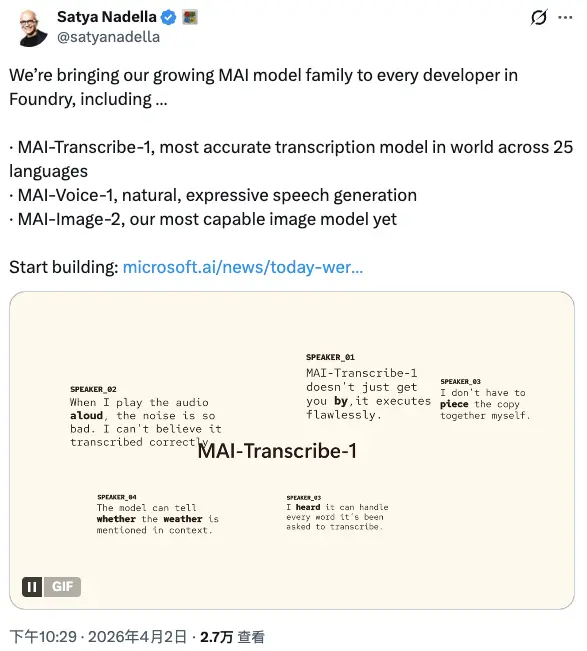
๐กMSFT's new MAI models rival OpenAI โ test for your voice/image apps now!
โก 30-Second TL;DR
What Changed
MAI-Transcribe-1 enables speech-to-text transcription
Why It Matters
Provides Microsoft customers with native AI tools, fostering alternatives to third-party APIs. Accelerates competition in multimodal enterprise AI, potentially lowering costs long-term.
What To Do Next
Integrate MAI-Image-2 into your image generation pipelines and benchmark against DALL-E.
Who should care:Developers & AI Engineers
๐ง Deep Insight
AI-generated analysis for this event.
๐ Enhanced Key Takeaways
- โขThe MAI series models leverage Microsoft's proprietary 'MAI-1' architecture, a foundational framework designed to optimize inference costs specifically for Azure-hosted enterprise workloads.
- โขInternal documentation suggests these models utilize a distilled training approach, allowing them to achieve performance parity with larger frontier models while requiring significantly less compute during deployment.
- โขThe release marks a shift in Microsoft's infrastructure strategy, moving away from exclusive reliance on OpenAI's API endpoints toward a hybrid model that prioritizes internal IP for core productivity features.
๐ Competitor Analysisโธ Show
| Feature | MAI-Transcribe-1 | OpenAI Whisper-v4 | Google Gemini 1.5 Pro (Audio) |
|---|---|---|---|
| Primary Focus | Enterprise/Azure Native | General Purpose | Multimodal/Cloud |
| Pricing | Azure Consumption-based | API per-minute | Tiered/Token-based |
| Benchmarks | High accuracy in noisy environments | Industry standard | High reasoning capability |
๐ฎ Future ImplicationsAI analysis grounded in cited sources
Microsoft will reduce its annual capital expenditure on OpenAI API credits by at least 15% by Q4 2027.
The deployment of internal MAI models allows Microsoft to shift high-volume enterprise traffic from external API dependencies to owned, lower-cost infrastructure.
Azure will introduce exclusive 'MAI-native' service tiers for enterprise customers by early 2027.
Integrating these models directly into the Azure stack provides a competitive moat by offering performance optimizations unavailable to users of third-party models.
โณ Timeline
2024-05
Microsoft announces the development of the MAI-1 model, a smaller, high-performance language model.
2025-02
Microsoft reorganizes its AI division to centralize 'superintelligence' research under a unified internal team.
2026-04
Official release of the MAI-Transcribe-1, MAI-Voice-1, and MAI-Image-2 suite.
๐ฐ Event Coverage
๐ฐ
Weekly AI Recap
Read this week's curated digest of top AI events โ
๐Related Updates
AI-curated news aggregator. All content rights belong to original publishers.
Original source: cnBeta (Full RSS) โ


