Microsoft Launches Web IQ for AI Agents
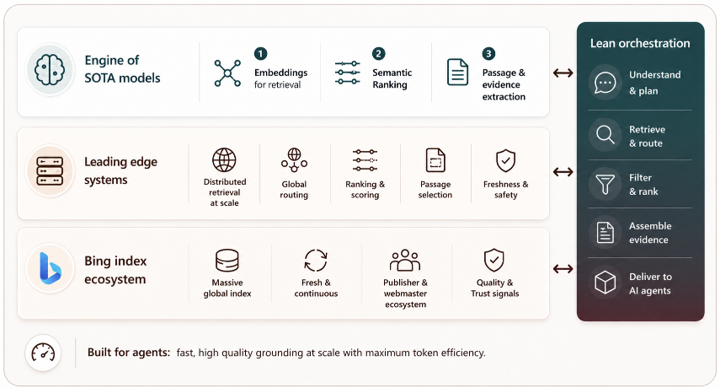
💡A new grounding API from Microsoft that lets your AI agents access real-time Bing search data.
⚡ 30-Second TL;DR
What Changed
Web IQ acts as a grounding API for AI agents to access real-time web data.
Why It Matters
This tool significantly lowers the barrier for developers to build agents that are grounded in current, real-world data, reducing hallucinations in AI responses.
What To Do Next
Explore the Web IQ API documentation to integrate real-time Bing search data into your current AI agent architecture.
Key Points
- •Web IQ acts as a grounding API for AI agents to access real-time web data.
- •Leverages Bing's search index and understanding capabilities.
- •Supports diverse content types including news, images, and videos.
🧠 Deep Insight
Background and context from public sources — not the original article. 11 sources cited.
🔑 Enhanced Key Takeaways
- •Web IQ is a component of the broader 'Microsoft IQ' intelligence layer, which also integrates Work IQ, Fabric IQ, and Foundry IQ to provide comprehensive grounding for AI agents using both external web data and internal enterprise context.
- •Unlike traditional search engines designed for human users, Web IQ has been specifically re-architected and rebuilt from the ground up to optimize search results for AI agents, focusing on token efficiency and rapid parsing.
- •The API boasts industry-leading performance, achieving responses in less than 165 milliseconds 95% of the time, making it approximately 2.5 times faster than other products on the market, alongside superior search result quality and token efficiency.
- •Prior to its public announcement, Web IQ APIs were already powering Microsoft's own Copilot AI offering and OpenAI's ChatGPT for a significant period.
- •Microsoft anticipates a significant shift in online search behavior, predicting that AI agents will perform the majority of web searches by the end of 2026.
📊 Competitor Analysis▸ Show
| Feature/Category | Microsoft Web IQ | Firecrawl | Exa | Tavily | You.com | Brave Search API |
|---|---|---|---|---|---|---|
| Primary Function | AI-native grounding API for real-time web data | Curated search index for AI agents, integrated extraction | Neural search trained on link prediction, ideal for RAG | Source-first discovery, citation-ready results | Web-scale search platform, AI-ready Search, Content, Research APIs | Official web search service, independent search index |
| Optimization for AI | Re-architected for AI agents, token efficiency, condensed results | AI-native, semantic understanding, LLM-optimized outputs | AI-native, semantic understanding, LLM-optimized outputs | AI-native, semantic understanding, LLM-optimized outputs | AI-ready, multi-step agentic research, structured snippets | Focuses on traditional keyword search, less AI-native |
| Speed/Latency | <165ms (95% of time), ~2.5x faster than competitors | Not specified in search results | Not specified in search results | Not specified in search results | Not specified in search results | Not specified in search results |
| Content Types | Web documents, news, images, videos | Fresh, full-content results from authoritative sources | Not specified, but for RAG | Not specified, but for citation-ready results | Web, Content, Research | Structured web results, LLM-optimized "Answers" and "AI Context" |
| Integration | Powers Copilot, ChatGPT, GitHub Copilot, Microsoft Foundry, Copilot Studio | LangChain/LlamaIndex integration | OpenClaw, LangChain, CrewAI, and others | Vercel AI SDK, LlamaIndex, Google ADK, and others | LangChain, LlamaIndex, Vercel AI SDK, n8n, Zapier, and others | LangChain, LlamaIndex, Agno, CrewAI, and 70+ others (via Bright Data MCP) |
| Pricing | Not explicitly detailed, but part of Microsoft's AI ecosystem | Not specified in search results | Free plan available | Free plan available | Initial amount of free credits | $5 per 1,000 queries for AI applications |
🛠️ Technical Deep Dive
- Web IQ is built upon Microsoft's extensive two-decade experience with Bing's search index and understanding capabilities, but it has been completely re-architected for AI agent optimization.
- It is designed to deliver a comprehensive yet condensed page of results, enabling AI agents to parse information efficiently and with high token efficiency, which is crucial for large language models.
- Web IQ operates as a new addition to the broader 'Microsoft IQ' framework, a unified intelligence layer that grounds agents by connecting AI with enterprise data and organizational context.
- The Microsoft IQ framework comprises several components:
- Work IQ: An intelligence layer that understands unstructured productivity data from Microsoft 365 (emails, meetings, chats, documents) and personalizes AI agent experiences based on user roles, workflows, and business context.
- Fabric IQ: Provides a shared semantic foundation over business data within Microsoft Fabric, organizing raw data into meaningful structures and generating ontologies to ensure consistent interpretation by AI systems.
- Foundry IQ: Enables AI agents to securely access, process, and act on knowledge from company documents, policies, and stored content, with built-in enterprise security and agentic retrieval.
- Work IQ APIs are specifically optimized for the unique needs of AI agents, facilitating higher quality results, lower latency, improved token efficiency, and increased data access throughput, while ensuring processing remains within the tenant boundary for security and compliance.
- These APIs expose data structure on demand, allowing agents to dynamically adapt to new data sources and evolving scenarios without requiring changes to the API surface.
🔮 Future ImplicationsAI analysis grounded in cited sources
⏳ Timeline
📎 Sources (11)
Factual claims are grounded in the sources below. Forward-looking analysis is AI-generated interpretation.
Weekly AI Recap
Read this week's curated digest of top AI events →
👉Related Updates
AI-curated news aggregator. All content rights belong to original publishers.
Original source: cnBeta (Full RSS) ↗
This is a summary, not the original. Read the source, or get the weekly briefing.
The weekly digest
One email a week. Unsubscribe anytime.