Microsoft Flags AI Agent Multitasking Flaws
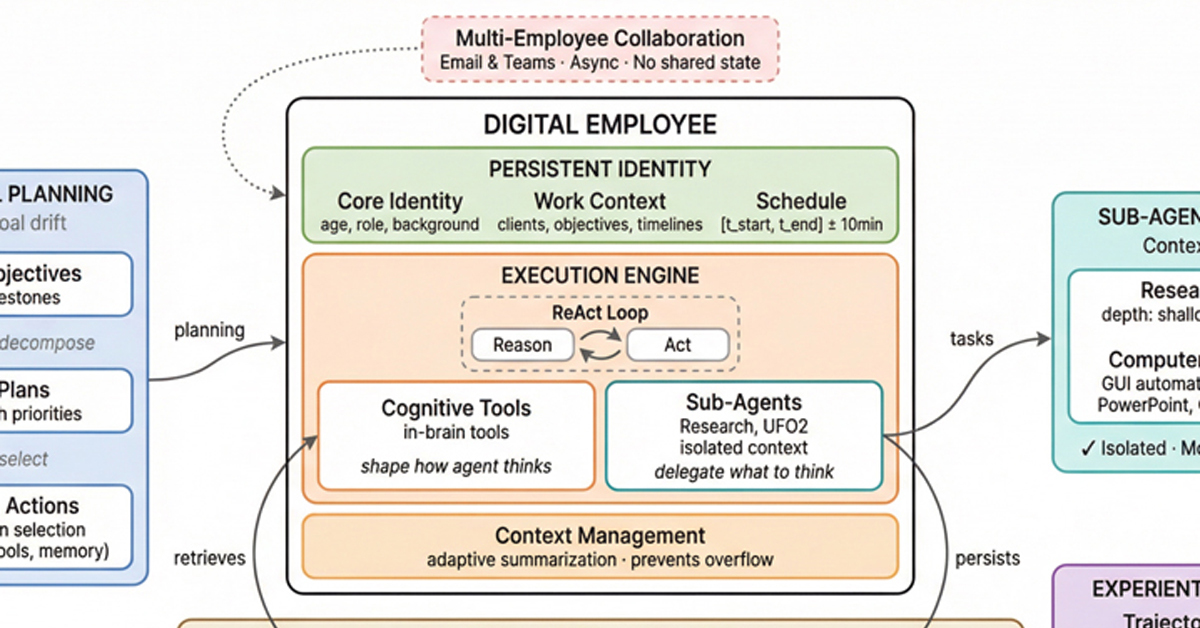
💡Microsoft's CORPGEN fixes AI agent multitasking—3.5x task completion boost for real workloads
⚡ 30-Second TL;DR
What Changed
Identifies 4 key challenges for AI agents in multitasking
Why It Matters
This research highlights limitations in current AI agents, potentially accelerating more robust multi-agent systems for enterprise use. It could shift focus from single-task to realistic workload handling.
What To Do Next
Read the CORPGEN paper to benchmark your AI agents against its 3.5x multitasking gains.
Key Points
- •Identifies 4 key challenges for AI agents in multitasking
- •Proposes CORPGEN framework for digital employees
- •Uses realistic work schedules for deployment
- •Achieves up to 3.5x higher task completion rates
🧠 Deep Insight
AI-generated analysis for this event — not the original article.
🔑 Enhanced Key Takeaways
- •The CORPGEN framework specifically addresses the 'context switching' penalty by utilizing a hierarchical task decomposition approach that mimics human cognitive load management.
- •Microsoft's research highlights that previous agent benchmarks failed to account for 'interruption handling,' a critical failure point where agents lose state when forced to switch between concurrent tasks.
- •The 3.5x performance improvement is primarily attributed to the integration of a 'temporal scheduler' that dynamically prioritizes sub-tasks based on deadline urgency and resource availability.
📊 Competitor Analysis▸ Show
| Feature | Microsoft CORPGEN | Google Agentic Frameworks | Anthropic Claude Computer Use |
|---|---|---|---|
| Primary Focus | Multitasking/Scheduling | Ecosystem Integration | Direct UI Interaction |
| Task Management | Hierarchical/Temporal | Goal-Oriented/Reactive | Sequential/Instructional |
| Benchmark Focus | Completion under load | Task success rate | Tool-use accuracy |
🛠️ Technical Deep Dive
- •Architecture: Employs a dual-layer controller system consisting of a 'Global Scheduler' for task allocation and a 'Local Executor' for specific tool interaction.
- •State Management: Utilizes a persistent 'Context Buffer' that snapshots agent memory states during task suspension to mitigate information loss during context switching.
- •Scheduling Logic: Implements a priority-queue mechanism that treats AI agent actions as non-preemptive processes, reducing the overhead of re-initializing LLM prompts.
- •Training Data: Developed using synthetic datasets simulating high-concurrency office environments, including email, calendar, and project management tool interactions.
🔮 Future ImplicationsAI analysis grounded in cited sources
⏳ Timeline
Weekly AI Recap
Read this week's curated digest of top AI events →
👉Related Updates

AI-curated news aggregator. All content rights belong to original publishers.
Original source: ITmedia AI+ (日本) ↗
This is a summary, not the original. Read the source, or get the weekly briefing.
The weekly digest
One email a week. Unsubscribe anytime.