Microsoft emissions rise 25% due to AI data centers

💡Learn how the massive energy footprint of AI infrastructure is impacting corporate sustainability goals.
⚡ 30-Second TL;DR
What Changed
Microsoft emissions increased by 25% year-over-year
Why It Matters
This highlights the environmental cost of scaling large language models. Expect increased scrutiny on the sustainability of AI infrastructure and potential shifts toward greener compute.
What To Do Next
Audit your model training pipelines for energy efficiency and consider using smaller, specialized models to reduce compute overhead.
Key Points
- •Microsoft emissions increased by 25% year-over-year
- •AI infrastructure expansion is the primary driver of energy consumption
- •The company's 2030 carbon-negative target faces significant implementation challenges
🧠 Deep Insight
AI-generated analysis for this event — not the original article.
🔑 Enhanced Key Takeaways
- •The 25% emissions increase is largely categorized as Scope 3 emissions, which encompass the embodied carbon in building materials and hardware like GPUs rather than just operational electricity usage.
- •Microsoft has begun integrating 'carbon-aware' software scheduling, which shifts non-urgent computing tasks to times when the local power grid has a higher mix of renewable energy.
- •The company is actively investing in direct air capture (DAC) and other carbon removal technologies to offset emissions, though these projects are currently struggling to scale at the pace required to meet the 2030 goal.
- •Regulatory bodies and environmental groups have increased pressure on Microsoft to disclose more granular data regarding the specific energy intensity of its AI training runs versus inference workloads.
- •Microsoft has updated its procurement policies to require key suppliers to match 100% of their electricity usage with zero-carbon energy purchases by 2030 to help mitigate the Scope 3 surge.
📊 Competitor Analysis▸ Show
| Feature | Microsoft (Azure) | Google (GCP) | Amazon (AWS) |
|---|---|---|---|
| Carbon Reporting | High (Scope 1, 2, 3) | High (Scope 1, 2, 3) | Moderate/High |
| AI Energy Strategy | Nuclear/Renewable PPA | Renewable/Geothermal | Renewable/Nuclear |
| 2030 Goal Status | Under Pressure | On Track/Challenged | Challenged |
🛠️ Technical Deep Dive
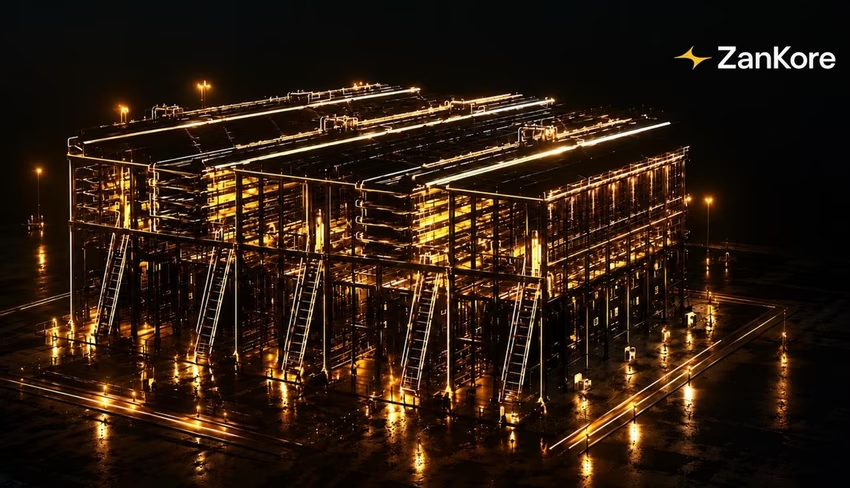
- Data center cooling systems have shifted toward liquid cooling technologies to handle the higher thermal design power (TDP) of AI-specialized hardware like NVIDIA H100 and B200 GPUs.
- Implementation of modular data center designs to reduce the embodied carbon footprint of construction materials such as low-carbon concrete and green steel.
- Utilization of AI-driven telemetry to optimize Power Usage Effectiveness (PUE) by dynamically adjusting server rack airflow and cooling fan speeds based on real-time compute load.
🔮 Future ImplicationsAI analysis grounded in cited sources
⏳ Timeline
Weekly AI Recap
Read this week's curated digest of top AI events →
👉Related Updates

AI-curated news aggregator. All content rights belong to original publishers.
Original source: The Next Web (TNW) ↗
This is a summary, not the original. Read the source, or get the weekly briefing.
The weekly digest
One email a week. Unsubscribe anytime.