Microsoft, Atom Computing, EeroQ Advance Quantum Computing Research
💡Quantum computing is the next frontier for AI compute; track these hardware milestones to prepare for future shifts.
⚡ 30-Second TL;DR
What Changed
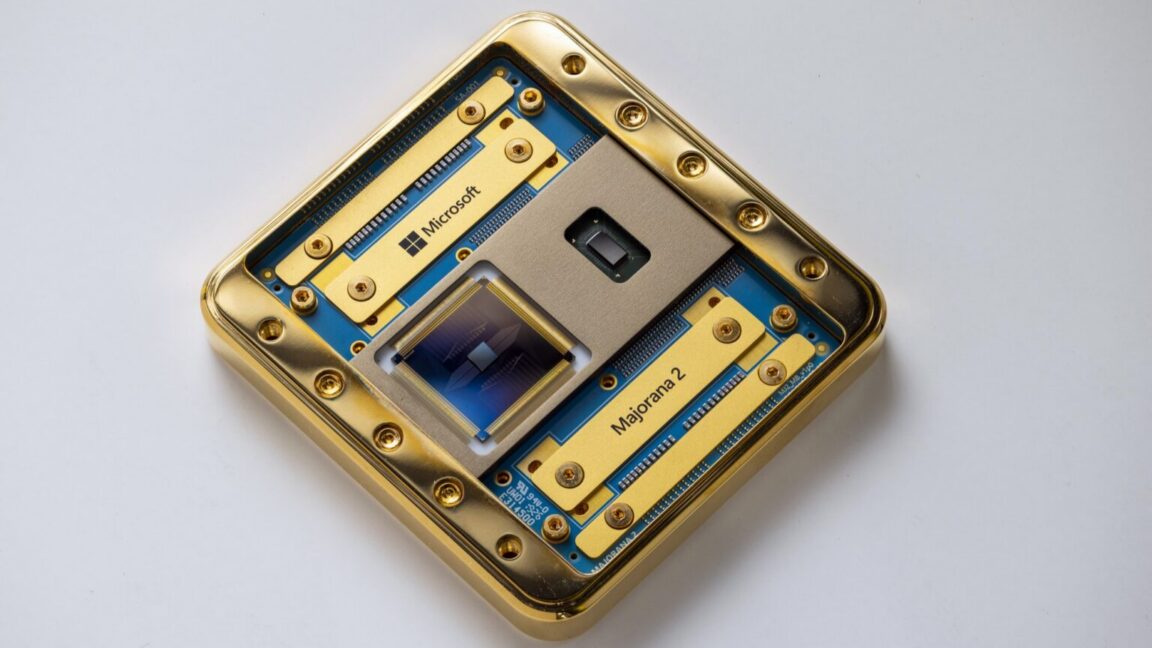
Microsoft continues to refine its topological quantum computing approach.
Why It Matters
These advancements are critical for the long-term future of AI, as quantum computing could eventually solve optimization and simulation problems currently impossible for classical hardware.
What To Do Next
Monitor the documentation for Microsoft Azure Quantum to understand how these hardware advancements will be exposed via cloud APIs.
Key Points
- •Microsoft continues to refine its topological quantum computing approach.
- •Atom Computing is scaling its neutral-atom based quantum processing units.
- •EeroQ is advancing its electron-on-helium quantum chip technology.
- •Industry focus remains on error correction and qubit stability.
🧠 Deep Insight
Background and context from public sources — not the original article. 33 sources cited.
🔑 Enhanced Key Takeaways
- •Microsoft unveiled "Majorana 2," a topological quantum chip with qubits demonstrating a 1,000-fold improvement in reliability over its predecessor, achieving a mean qubit lifetime of 20 seconds, and instances lasting up to one minute.
- •Atom Computing demonstrated the industry's first full quantum error correction using a toric code on its neutral-atom system, showing error reduction as larger numbers of qubits are used in computations.
- •EeroQ has developed a control architecture capable of managing up to one million qubits using fewer than 50 physical control lines, addressing a significant bottleneck in quantum computing known as the "wire problem."
- •Microsoft has accelerated its target for delivering a commercially useful, scalable quantum computer from 2033 to 2029, attributing this acceleration partly to the use of agentic AI in research and development.
- •Atom Computing announced a 1,180-qubit prototype in late 2023, marking the first 1,000+ qubit gate-based quantum computer in the industry, and in collaboration with Microsoft, achieved a record 24 entangled logical qubits in late 2024.
🛠️ Technical Deep Dive
- Microsoft's Topological Qubits:
- Based on Majorana quasiparticles (Majorana zero modes) which act as their own antiparticle and are topologically protected, making them inherently robust against local noise.
- Quantum information is stored non-locally across two or more Majorana particles, providing redundancy and stability.
- The Majorana 2 chip utilizes an improved material stack incorporating Lead (Pb) and Antimony (Sb) to enhance qubit stability and protect quantum states from cosmic disturbances.
- Qubit operations can run on the microsecond scale, and the small qubit size (1/100th of a millimeter) supports scaling.
- Development was accelerated using Microsoft Discovery's agentic AI for tasks such as materials science, fabrication optimization, and measurement automation.
- Atom Computing's Neutral-Atom QPUs:
- Uses individual neutral atoms (e.g., Rubidium, Cesium, Strontium) as qubits, trapped by highly focused laser beams called optical tweezers.
- Qubits are encoded in the nuclear spin states of neutral atoms, yielding long coherence times, with a world-record of approximately 40 seconds demonstrated.
- Two-qubit gates are enabled by temporarily exciting atoms to highly excited Rydberg states, which possess large electric dipole moments for interaction.
- The architecture allows for flexible two-dimensional and three-dimensional arrays with all-to-all connectivity and can be scaled by projecting more optical tweezers.
- Demonstrated quantum error correction using a toric code, involving repeatedly refreshing atoms to preserve logical information.
- EeroQ's Electron-on-Helium Quantum Chips:
- Utilizes individual electrons floating above a surface of superfluid helium in microchannels as qubits.
- The superfluid helium provides an ultraclean surface where electrons can move freely, theoretically leading to long spin coherence times exceeding 100 seconds.
- Qubit control and readout involve coupling the electron's spin state to its charge state, which is then coupled to an LC resonator.
- The technology is CMOS-compatible, potentially allowing for dense qubit alignment and integration with standard semiconductor manufacturing.
- A key innovation is a control architecture that can manage up to one million qubits with fewer than 50 physical control lines, addressing the "wire problem" bottleneck.
🔮 Future ImplicationsAI analysis grounded in cited sources
⏳ Timeline
📎 Sources (33)
Factual claims are grounded in the sources below. Forward-looking analysis is AI-generated interpretation.
- microsoft.com
- benzinga.com
- thenextweb.com
- medium.com
- prnewswire.com
- investing.com
- redmondmag.com
- postquantum.com
- businessmodelcanvastemplate.com
- quantumzeitgeist.com
- atom-computing.com
- microsoft.com
- wikipedia.org
- bluequbit.io
- technologypublisher.com
- qutube.nl
- medium.com
- uwaterloo.ca
- quantumcomputingreport.com
- quera.com
- originqc.com
- atom-computing.com
- giiresearch.com
- atom-computing.com
- moorinsightsstrategy.com
- tracxn.com
- pitchbook.com
- princeton.edu
- arxiv.org
- aip.org
- fsu.edu
- quantumzeitgeist.com
- techtarget.com
Weekly AI Recap
Read this week's curated digest of top AI events →
👉Related Updates
AI-curated news aggregator. All content rights belong to original publishers.
Original source: Ars Technica ↗
This is a summary, not the original. Read the source, or get the weekly briefing.
The weekly digest
One email a week. Unsubscribe anytime.