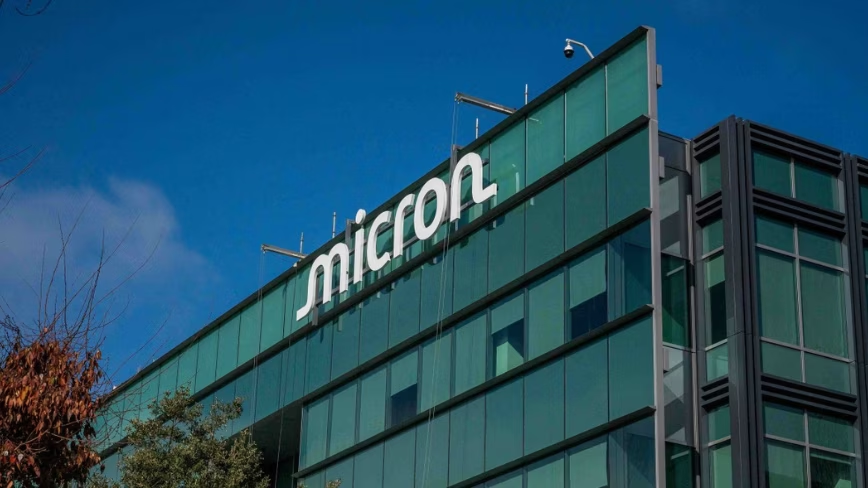
Micron Breaks Ground on $9bn Hiroshima AI Memory Plant
💡Critical infrastructure news: Micron's massive HBM expansion directly impacts the availability of AI compute hardware.
⚡ 30-Second TL;DR
What Changed
Micron invested $9.3 billion in its Hiroshima factory expansion.
Why It Matters
This expansion significantly boosts the supply chain capacity for AI-specific memory, potentially alleviating bottlenecks for high-performance computing hardware.
What To Do Next
Monitor HBM supply availability and lead times when planning your next-generation AI infrastructure or server procurement.
Key Points
- •Micron invested $9.3 billion in its Hiroshima factory expansion.
- •The facility will specialize in high-bandwidth memory (HBM) and stacked DRAM.
- •The expansion is a strategic move to capitalize on the global AI memory boom.
🧠 Deep Insight
AI-generated analysis for this event — not the original article.
🔑 Enhanced Key Takeaways
- •The Hiroshima expansion is supported by significant subsidies from the Japanese government, which views memory chip production as a critical pillar of national economic security.
- •Micron's Hiroshima facility is the former Elpida Memory plant, which Micron acquired in 2013, marking a decade-plus evolution of the site into a global hub for advanced DRAM.
- •This expansion utilizes EUV (Extreme Ultraviolet) lithography technology, marking the first time Micron has deployed this advanced manufacturing process in Japan.
- •The facility is expected to create hundreds of high-skilled engineering jobs in the Hiroshima prefecture, bolstering local semiconductor ecosystem development.
- •The investment aligns with Micron's broader goal to capture a significant percentage of the HBM market share, aiming to compete directly with South Korean giants Samsung and SK Hynix.
📊 Competitor Analysis▸ Show
| Feature | Micron (Hiroshima) | SK Hynix | Samsung |
|---|---|---|---|
| HBM Focus | HBM3E / HBM4 | HBM3E (Market Leader) | HBM3E / HBM4 |
| Primary Strategy | Capacity Expansion | Aggressive R&D / Partnerships | Vertical Integration |
| Manufacturing | EUV-based DRAM | MR-MUF Packaging | TC-NCF / Hybrid Bonding |
🛠️ Technical Deep Dive
- Focus on HBM3E and next-generation HBM4 architectures utilizing 1-gamma (1γ) process node technology.
- Implementation of Through-Silicon Via (TSV) technology to enable high-density vertical stacking of DRAM dies.
- Integration of EUV lithography to improve pattern fidelity and reduce the number of masks required for advanced DRAM nodes.
- Enhanced thermal management designs to support the high power density requirements of AI accelerators and GPUs.
🔮 Future ImplicationsAI analysis grounded in cited sources
⏳ Timeline
📰 Event Coverage
Weekly AI Recap
Read this week's curated digest of top AI events →
👉Related Updates


AI-curated news aggregator. All content rights belong to original publishers.
Original source: The Next Web (TNW) ↗
This is a summary, not the original. Read the source, or get the weekly briefing.
Weekly AI briefing
One email a week. Unsubscribe anytime.