Meta’s Muse Video Enters Closed Beta
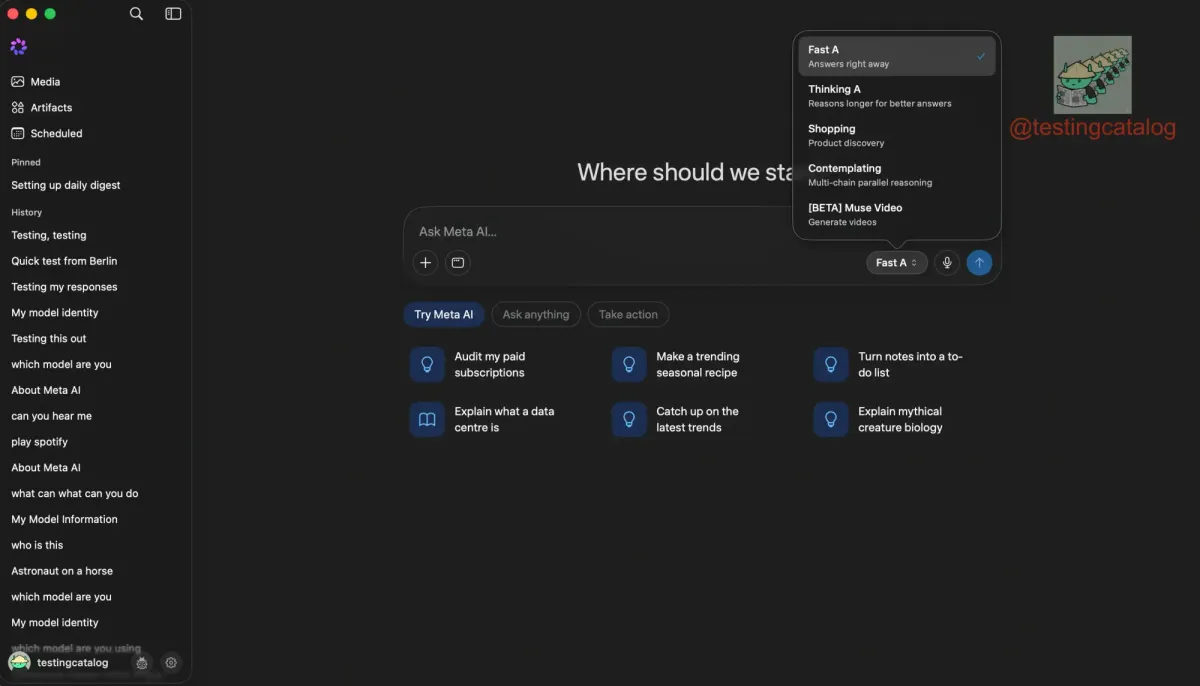
💡See early evidence of Meta’s native-audio video model and its 10-second generation quality.
⚡ 30-Second TL;DR
What Changed
Muse Video has entered a closed beta program.
Why It Matters
If the early results hold up, native audio and consistent motion could make Muse Video more useful for short-form production workflows. The closed beta limits immediate access, but it signals Meta is advancing its competitive position in generative video.
What To Do Next
Monitor Meta’s Muse Video beta access and prepare short, audio-inclusive test prompts to evaluate it against your current video-generation workflow.
Key Points
- •Muse Video has entered a closed beta program.
- •The model supports native audio generation alongside video.
- •Early 10-second generation tests show strong detail and temporal consistency.
🧠 Deep Insight
AI-generated analysis for this event.
🔑 Enhanced Key Takeaways
- •Muse Video utilizes a masked generative transformer architecture, distinguishing it from the diffusion-based models commonly used by competitors.
- •The model is integrated into Meta's broader 'Movie Gen' ecosystem, allowing for seamless transitions between image-to-video and text-to-video workflows.
- •Early beta access is currently restricted to a select group of creators and researchers via the Meta AI Studio platform.
- •The native audio generation feature is powered by a specialized audio-visual alignment layer that synchronizes sound effects with visual motion cues.
- •Meta has implemented new watermarking protocols within Muse Video to comply with the Coalition for Content Provenance and Authenticity (C2PA) standards.
📊 Competitor Analysis▸ Show
| Feature | Meta Muse Video | OpenAI Sora | Runway Gen-3 Alpha |
|---|---|---|---|
| Architecture | Masked Transformer | Diffusion Transformer | Diffusion-based |
| Native Audio | Yes | No (requires external) | Limited/External |
| Max Duration | 10s | 60s | 10s (extensible) |
| Pricing | Closed Beta (Free) | Paid/Enterprise | Subscription |
🛠️ Technical Deep Dive
- Architecture: Employs a non-autoregressive masked transformer approach which allows for parallel decoding, significantly reducing inference latency compared to sequential diffusion models.
- Tokenization: Uses a proprietary VQ-GAN (Vector Quantized Generative Adversarial Network) to compress video frames into discrete latent tokens.
- Audio Integration: Features a cross-modal attention mechanism that aligns audio latent embeddings with video frame tokens during the generation process.
- Temporal Consistency: Achieves stability through a sliding-window attention mechanism that maintains context across the 10-second generation span.
🔮 Future ImplicationsAI analysis grounded in cited sources
⏳ Timeline
Weekly AI Recap
Read this week's curated digest of top AI events →
👉Related Updates
AI-curated news aggregator. All content rights belong to original publishers.
Original source: TestingCatalog ↗