Meta's KernelEvolve Optimizes AI Infra
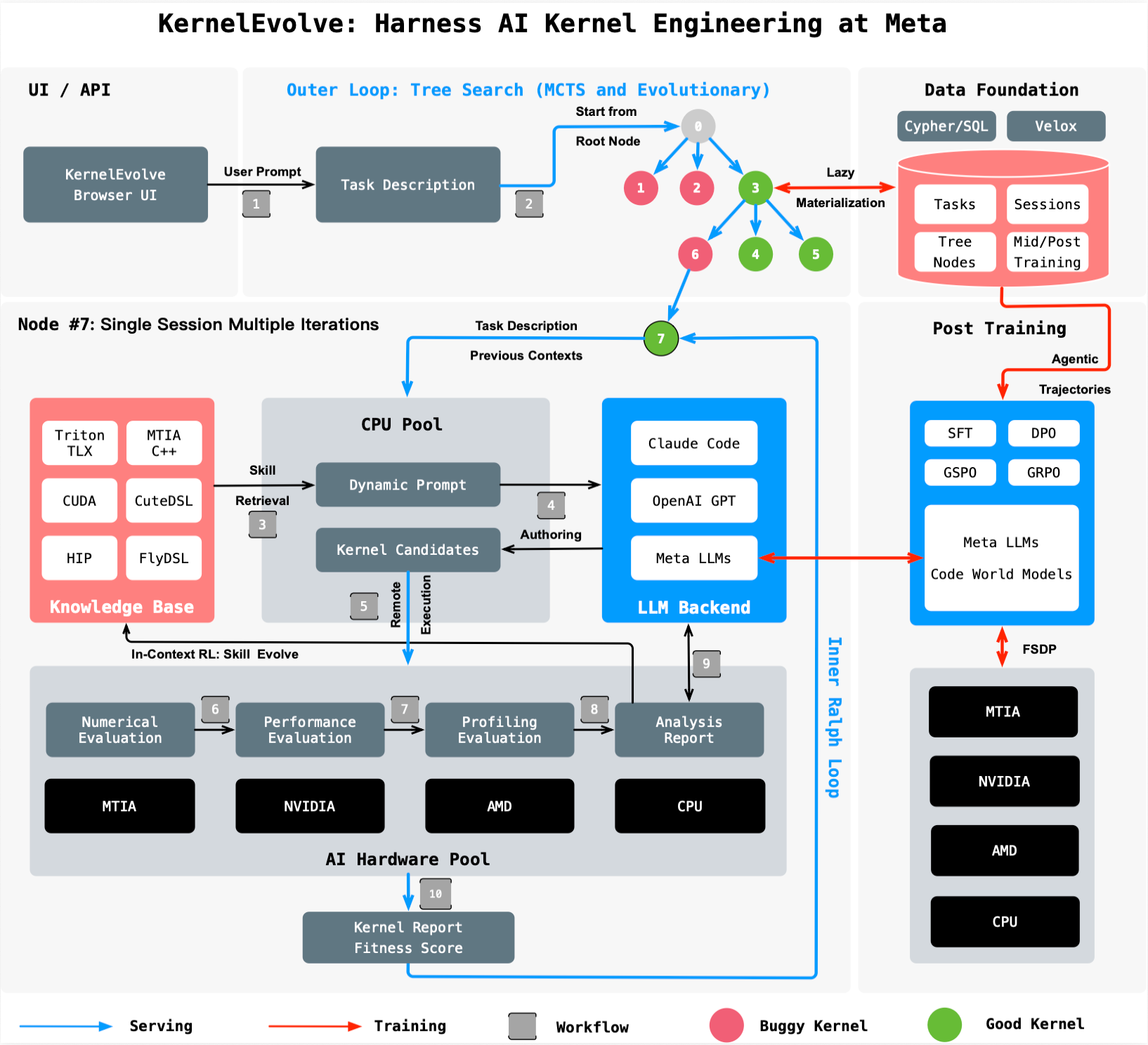
💡Meta AI agent auto-optimizes kernels for ads infra—blueprint for ML ops scaling.
⚡ 30-Second TL;DR
What Changed
KernelEvolve autonomously tunes low-level infrastructure for AI models
Why It Matters
Demonstrates scalable AI agents for infra optimization, reducing manual tuning in production ML systems. Applicable to other large-scale AI deployments beyond ads.
What To Do Next
Read Meta Engineering Blog's KernelEvolve post to prototype agent-based kernel optimizers in your ML pipelines.
Key Points
- •KernelEvolve autonomously tunes low-level infrastructure for AI models
- •Part of Ranking Engineer Agent accelerating Meta ads innovation
- •Follows ML exploration post on experiment automation
- •Focuses on runtime optimization for ranking models
🧠 Deep Insight
AI-generated analysis for this event — not the original article.
🔑 Enhanced Key Takeaways
- •KernelEvolve utilizes a reinforcement learning-based approach to automatically search and select optimal GPU kernel configurations, reducing the need for manual CUDA optimization by human engineers.
- •The system specifically targets the reduction of latency in high-throughput inference pipelines, directly impacting the 'time-to-first-token' and overall throughput for Meta's large-scale recommendation models.
- •Integration with Meta's internal 'Ranking Engineer Agent' framework allows KernelEvolve to operate in a closed-loop system, where performance metrics from production traffic are fed back into the optimization agent to iteratively refine kernel selection.
📊 Competitor Analysis▸ Show
| Feature | KernelEvolve (Meta) | Triton (OpenAI) | TVM (Apache) |
|---|---|---|---|
| Primary Focus | Autonomous infra optimization | Language for writing kernels | End-to-end compiler stack |
| Automation Level | High (Agent-driven) | Low (Manual/Semi-auto) | Medium (Auto-tuning) |
| Target Environment | Meta-specific production | General purpose | General purpose |
| Benchmarking | Ads ranking latency | General GPU performance | Model-agnostic performance |
🛠️ Technical Deep Dive
- Search Space Exploration: Employs a multi-armed bandit or reinforcement learning agent to navigate the vast parameter space of kernel tiling, unrolling, and memory access patterns.
- Hardware Abstraction: Interfaces with Meta's proprietary hardware abstraction layer to deploy optimized kernels across heterogeneous GPU clusters (e.g., H100s, A100s).
- Feedback Loop: Utilizes real-time telemetry from production ranking services to validate performance gains, ensuring that 'optimized' kernels do not introduce regressions in model accuracy or stability.
- Integration: Operates as a plugin within the broader Ranking Engineer Agent ecosystem, leveraging existing CI/CD pipelines for automated deployment of kernel updates.
🔮 Future ImplicationsAI analysis grounded in cited sources
⏳ Timeline
Weekly AI Recap
Read this week's curated digest of top AI events →
👉Related Updates
AI-curated news aggregator. All content rights belong to original publishers.
Original source: Meta Engineering Blog ↗
This is a summary, not the original. Read the source, or get the weekly briefing.
The weekly digest
One email a week. Unsubscribe anytime.