Meta’s AI Second Brain Learns From Experts
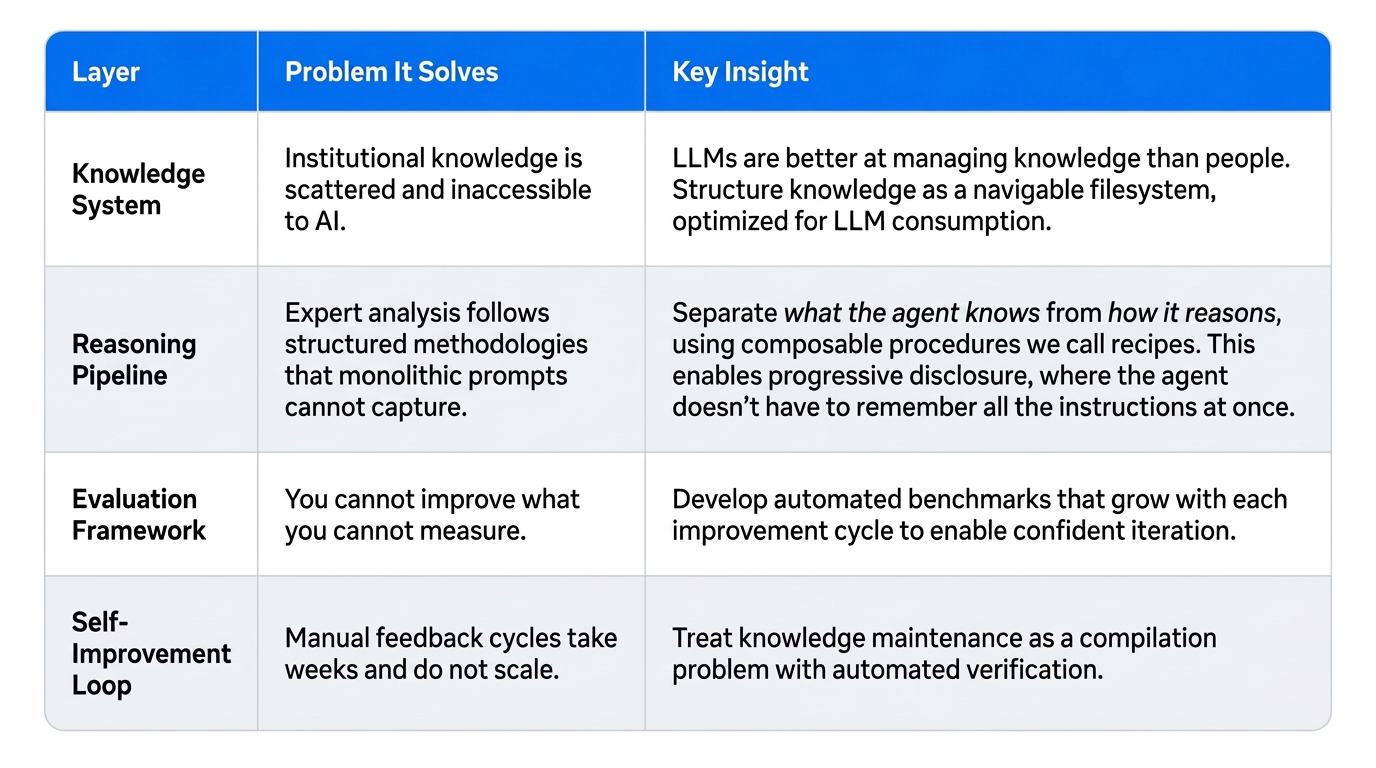
💡See how Meta turns expert knowledge into an auditable organizational AI asset.
⚡ 30-Second TL;DR
What Changed
The agent acts as a secondary expert for a defined organizational domain.
Why It Matters
This approach could help enterprises reduce knowledge silos and make scarce specialist expertise available to broader teams. Its emphasis on auditability may also improve trust and governance compared with opaque domain-specific agents.
What To Do Next
Prototype a domain agent with a structured knowledge layer and add audit logs for every expert-derived answer before expanding its organizational use.
Key Points
- •The agent acts as a secondary expert for a defined organizational domain.
- •A structured, auditable knowledge architecture separates and organizes domain knowledge.
- •The system is designed to preserve, share, and extend specialist expertise across an organization.
🧠 Deep Insight
Background and context from public sources — not the original article. 9 sources cited.
🔑 Enhanced Key Takeaways
- •The system utilizes a self-improvement loop that compiles expert feedback into verified knowledge updates, bypassing the need for full model retraining.
- •Internal adoption has reached over 63,000 employees across all organizational pillars as of mid-2026.
- •The architecture explicitly separates reasoning processes from domain-specific information to ensure auditability and accuracy.
- •The platform includes specialized operational commands such as /start-project, /read-meeting-notes, and /debrief:team to automate routine administrative workflows.
- •Meta is transitioning toward custom silicon, specifically the 'Iris' chip, to support the compute-intensive requirements of its internal AI infrastructure.
📊 Competitor Analysis▸ Show
| Feature | Meta AI Second Brain | Microsoft 365 Copilot | Google Workspace AI Agents |
|---|---|---|---|
| Knowledge Architecture | Structured/Auditable | Graph-based (Graph API) | RAG-based (Vertex AI) |
| Primary Focus | Institutional Memory | Productivity/Office Suite | Search/Data Synthesis |
| Customization | Expert-led feedback loops | Plugin/Graph extensions | Agent Builder/Grounding |
🛠️ Technical Deep Dive
- Architecture: Dual-layer design separating reasoning engines from structured knowledge repositories.
- Model Integration: Powered by Muse Spark 1.3, optimized for long-horizon agentic workflows and multi-thread management.
- Knowledge Management: Implements a feedback-driven update mechanism that allows for real-time institutional memory expansion without retraining.
- Compute Infrastructure: Supported by custom Iris AI silicon and a massive scaling effort targeting 7 gigawatts of capacity in 2026.
🔮 Future ImplicationsAI analysis grounded in cited sources
⏳ Timeline
📎 Sources (9)
Factual claims are grounded in the sources below. Forward-looking analysis is AI-generated interpretation.
Weekly AI Recap
Read this week's curated digest of top AI events →
👉Related Updates
AI-curated news aggregator. All content rights belong to original publishers.
Original source: Meta Engineering Blog ↗
This is a summary, not the original. Read the source, or get the weekly briefing.
Weekly AI briefing
One email a week. Unsubscribe anytime.