Meta Unveils 4 New MTIA AI Chips
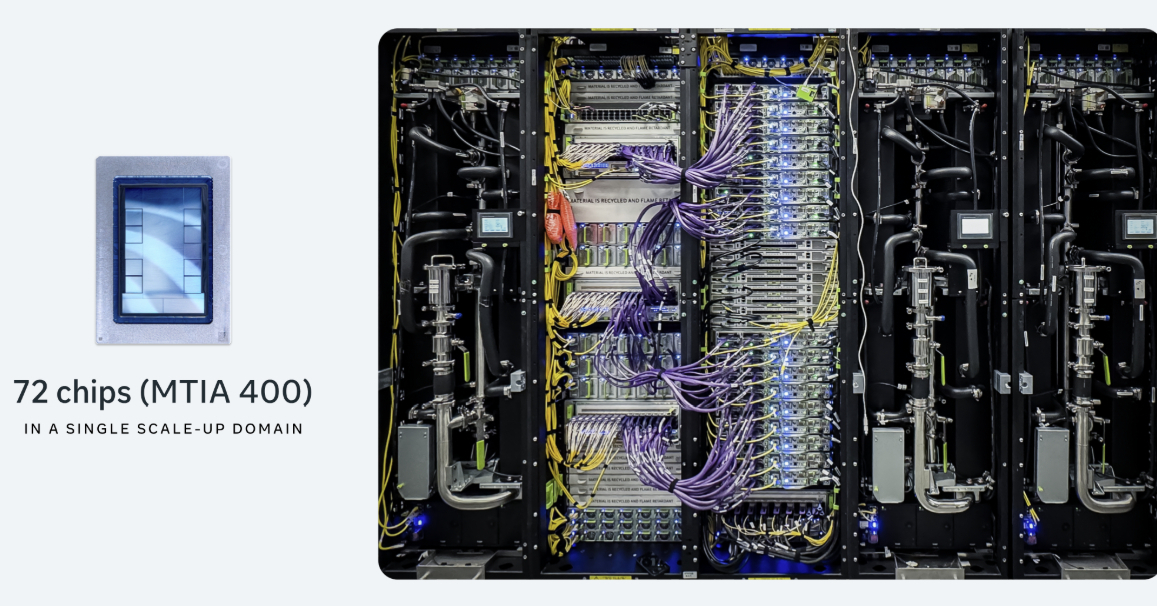
💡Meta's custom AI chips + 5GW data center plan challenge NVIDIA's infra dominance
⚡ 30-Second TL;DR
What Changed
Four new MTIA models specialized for AI inference
Why It Matters
Meta's in-house chips reduce dependency on third-party hardware like NVIDIA, potentially lowering AI training costs industry-wide. This accelerates custom AI infrastructure scaling for hyperscalers.
What To Do Next
Benchmark MTIA inference performance against NVIDIA GPUs for your custom AI workloads.
Key Points
- •Four new MTIA models specialized for AI inference
- •Significant reduction in development cycles
- •Massive NVIDIA GPU cluster deployments underway
- •Future 5GW 'Hyperion' data center plan announced
🧠 Deep Insight
Background and context from public sources — not the original article. 9 sources cited.
🔑 Enhanced Key Takeaways
- •MTIA v1, the first-generation chip designed in 2020, uses TSMC 7nm process, operates at 800 MHz with 102.4 TOPS at INT8 and 25W TDP, featuring 64 PEs in an 8x8 grid and 128 MB on-chip SRAM.[1][3]
- •Meta announced MTIA v2i, the second-generation inference chip, at ISCA'23, which is now deployed at scale for production workloads.[9]
- •In April 2024, Meta unveiled MTIA v2 supporting generative AI inference for recommendation systems on Facebook and Instagram, with plans to ramp adoption throughout 2025.[5]
🛠️ Technical Deep Dive
- •MTIA v1 architecture includes 64 Processing Elements (PEs) in an 8x8 grid connected via mesh network, each with 128 KB local SRAM, supporting thread/data/instruction/memory-level parallelism.[1]
- •Memory subsystem: 128 MB on-chip SRAM shared among PEs, scalable to 128 GB off-chip LPDDR5 DRAM for high bandwidth and low latency.[1]
- •Fabricated on TSMC 7nm, clocked at 800 MHz, delivers 102.4 TOPS (INT8) / 51.2 TFLOPS (FP16), TDP 25W, includes RISC-V cores.[1][6]
🔮 Future ImplicationsAI analysis grounded in cited sources
⏳ Timeline
📎 Sources (9)
Factual claims are grounded in the sources below. Forward-looking analysis is AI-generated interpretation.
- Meta AI — Meta Training Inference Accelerator AI Mtia
- TechCrunch — Meta Bets Big on AI with Custom Chips and a Supercomputer
- encord.com — Meta AI Chip Mtia Explained
- youtube.com — Watch
- mobileworldlive.com — Meta Moves Forward on AI Training Chip
- semiwiki.com — Metas First Bespoke AI Chips
- inspirepreneurmagazine.com — Meta Custom AI Chips Training Models
- Meta AI — Meta AI Infrastructure Overview
- dl.acm.org — 3695053
Weekly AI Recap
Read this week's curated digest of top AI events →
👉Related Updates


AI-curated news aggregator. All content rights belong to original publishers.
Original source: ITmedia AI+ (日本) ↗
This is a summary, not the original. Read the source, or get the weekly briefing.
Weekly AI briefing
One email a week. Unsubscribe anytime.