🌍The Next Web (TNW)•Freshcollected in 21m
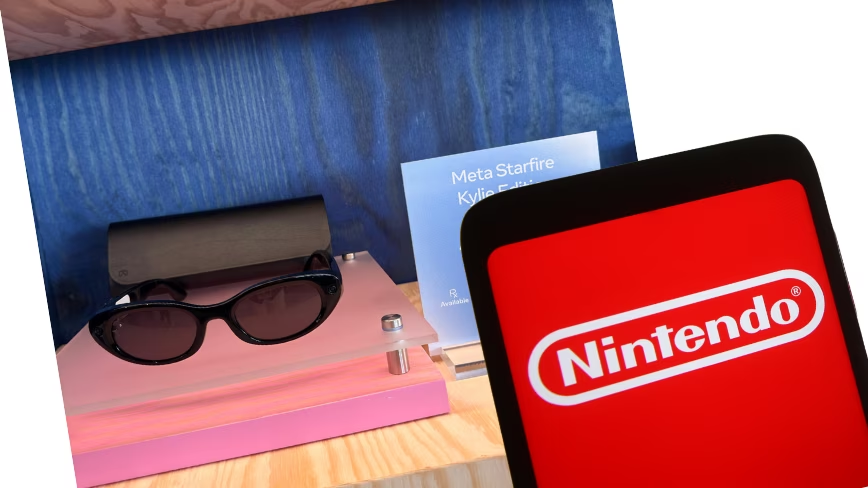
Meta Smart Glasses Exempted from EU Battery Rules
💡Regulatory changes for wearables could impact your hardware roadmap for the EU market.
⚡ 30-Second TL;DR
What Changed
EU delegated act adds six product categories to battery exemption list
Why It Matters
This exemption sets a precedent for how AI-integrated hardware is regulated in the EU, potentially encouraging more investment in compact, sealed wearable AI devices.
What To Do Next
If you are building wearable AI hardware, review the updated EU battery delegated act to see if your form factor qualifies for similar exemptions.
Who should care:Developers & AI Engineers
Key Points
- •EU delegated act adds six product categories to battery exemption list
- •Wearable devices like smartwatches and smart glasses are now excluded from mandatory user-replaceable battery rules
- •Regulatory change clears the path for Meta's latest smart glasses in Europe
🧠 Deep Insight
AI-generated analysis for this event.
🔑 Enhanced Key Takeaways
- •The exemption stems from the EU Battery Regulation (Regulation (EU) 2023/1242), which originally mandated that batteries in portable devices must be removable and replaceable by the end-user by 2027.
- •The European Commission's delegated act specifically targets devices where the battery is essential for water resistance or structural integrity, which is critical for the compact form factor of smart glasses.
- •Industry lobbying groups, including those representing consumer electronics manufacturers, argued that forcing user-replaceable batteries would compromise the IP68/IP69 water and dust resistance ratings required for outdoor wearable use.
- •This regulatory relief is expected to lower manufacturing costs for Meta, as they will not need to redesign the internal chassis of the Ray-Ban Meta smart glasses to accommodate modular battery compartments for the EU market.
- •The exemption includes a 'review clause' requiring the Commission to reassess the technological feasibility of replaceable batteries in wearables by 2030, keeping the door open for future regulatory pressure.
📊 Competitor Analysis▸ Show
| Feature | Meta Ray-Ban Smart Glasses | Apple Vision Pro | XREAL Air 2 Pro |
|---|---|---|---|
| Battery Type | Integrated (Non-removable) | External (Wired) | External (Wired) |
| Primary Use | Casual AR/Audio/Camera | Spatial Computing | Display Mirroring |
| EU Compliance | Exempted (New Ruling) | N/A (External) | N/A (External) |
| Price (USD) | ~$299 | ~$3,499 | ~$449 |
🛠️ Technical Deep Dive
- The Ray-Ban Meta smart glasses utilize a custom-designed lithium-ion battery integrated into the temple arms to maintain a slim profile similar to standard eyewear.
- The device architecture relies on a high-density energy cell that requires specialized adhesive and ultrasonic welding for enclosure, which is incompatible with tool-less user replacement.
- The internal power management system (PMIC) is tightly coupled with the Snapdragon AR1 Gen 1 platform to optimize thermal dissipation, a process that would be disrupted by modular battery connectors.
- The exemption allows Meta to maintain the current IPX4 water resistance rating without the added bulk of battery doors or sealing gaskets required for user access.
🔮 Future ImplicationsAI analysis grounded in cited sources
Meta will accelerate the release of next-generation smart glasses in the EU market.
The removal of the battery redesign requirement eliminates a major engineering bottleneck that previously delayed regional product launches.
The EU will introduce stricter circularity requirements for wearable electronics by 2031.
The inclusion of a 2030 review clause indicates that the current exemption is a temporary bridge rather than a permanent abandonment of repairability goals.
⏳ Timeline
2021-09
Meta and EssilorLuxottica launch the first generation Ray-Ban Stories.
2023-07
EU adopts Regulation (EU) 2023/1242, setting strict battery replaceability standards.
2023-10
Meta releases the second-generation Ray-Ban Meta smart glasses.
2026-07
European Commission grants formal exemption for wearable devices from battery removal rules.
📰
Weekly AI Recap
Read this week's curated digest of top AI events →
👉Related Updates

AI-curated news aggregator. All content rights belong to original publishers.
Original source: The Next Web (TNW) ↗