Meta Scales Ads Ranking with User Sequences
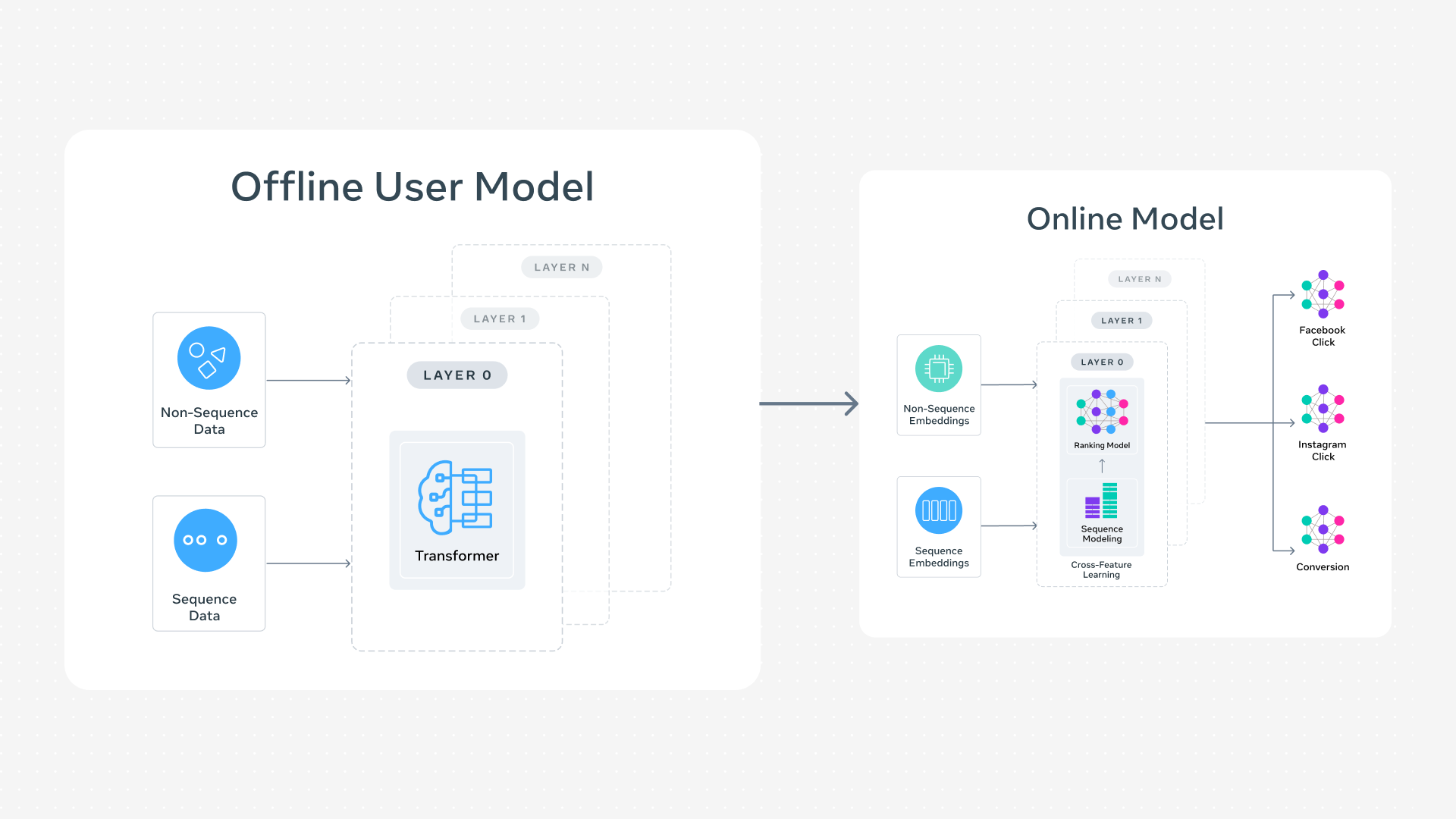
See how Meta turns billions of timed user interactions into scalable ads-ranking signals.
30-Second TL;DR
What Changed
Models temporal user-action sequences instead of relying mainly on static, manually engineered sparse features.
Why It Matters
For recommendation teams, the work suggests that richer temporal signals can improve personalization beyond conventional feature engineering. It may also provide a blueprint for scaling sequence-based ranking while managing production complexity.
What To Do Next
Prototype a sequence-based ranking feature using timestamped user events, then compare it with your current sparse-feature ranker on offline relevance and latency metrics.
Key Points
- •Models temporal user-action sequences instead of relying mainly on static, manually engineered sparse features.
- •Targets recommendation workloads spanning ads, content, and other Meta products.
- •Uses a multi-stage architecture to connect sequence modeling with large-scale ads-ranking deployment.
- •Builds on Meta’s 2024 work on sequence learning for ads recommendations.
Deep Insight
AI-generated analysis for this event — not the original article.
Enhanced Key Takeaways
- •Meta utilizes a Transformer-based architecture specifically optimized for long-range dependency modeling in user behavior sequences, moving beyond traditional RNN or LSTM approaches.
- •The system employs a 'Sequence-Aware Embedding' technique that dynamically updates feature representations based on the recency and context of user interactions.
- •To manage computational overhead, Meta implements a two-tower retrieval and ranking pipeline where sequence features are compressed into dense vectors before the final ranking stage.
- •The architecture integrates 'Time-Interval Encoding' to explicitly model the irregular gaps between user actions, which is critical for distinguishing between impulsive and planned purchase intent.
- •Meta's implementation leverages custom kernels in their inference engine (likely related to TorchRec) to accelerate the processing of sparse sequence data at the scale of billions of daily requests.
Competitor Analysis
- Meta (Sequence Ranking)
- Transformer-based sequence modeling
- Google (Ads/YouTube)
- Deep Retrieval & Multi-task Learning
- ByteDance (TikTok)
- Real-time interest graph modeling
- Meta (Sequence Ranking)
- Multi-stage compression
- Google (Ads/YouTube)
- TPU-optimized serving
- ByteDance (TikTok)
- High-frequency feedback loops
- Meta (Sequence Ranking)
- Cross-platform (FB/IG/Threads)
- Google (Ads/YouTube)
- Search & Video history
- ByteDance (TikTok)
- Short-form video engagement
| Feature | Meta (Sequence Ranking) | Google (Ads/YouTube) | ByteDance (TikTok) |
|---|---|---|---|
| Core Approach | Transformer-based sequence modeling | Deep Retrieval & Multi-task Learning | Real-time interest graph modeling |
| Latency Focus | Multi-stage compression | TPU-optimized serving | High-frequency feedback loops |
| Data Context | Cross-platform (FB/IG/Threads) | Search & Video history | Short-form video engagement |
Technical Deep Dive
- Architecture: Utilizes a multi-stage ranking pipeline consisting of a candidate retrieval stage followed by a deep ranking model (DRM).
- Sequence Modeling: Implements self-attention mechanisms to weigh the importance of past user actions relative to the current ad context.
- Feature Engineering: Replaces static user-profile features with dynamic sequence embeddings generated from event logs (clicks, views, shares).
- Optimization: Uses asynchronous training pipelines to update sequence models in near real-time without blocking the serving path.
- Infrastructure: Built on top of Meta's internal AI infrastructure, utilizing TorchRec for distributed embedding tables and model parallelism.
Future ImplicationsAI analysis grounded in cited sources
Timeline
- 2022-05Meta introduces TorchRec, an open-source library for large-scale recommendation systems.
- 2023-09Meta announces advancements in DLRM (Deep Learning Recommendation Model) architecture.
- 2024-04Meta publishes research on sequence learning for ads, establishing the foundation for current ranking models.
- 2025-02Integration of real-time sequence modeling into production ad-ranking pipelines begins.
- 2026-08Meta scales multi-stage sequence-based ranking across all major ad surfaces.
Weekly AI Recap
Read this week's curated digest of top AI events →
AI-curated news aggregator. All content rights belong to original publishers.
Original source: Meta Engineering Blog ↗
This is a summary, not the original. Read the source, or get the weekly briefing.
The weekly digest
One email a week. Unsubscribe anytime.