Meta Launches Creator Assistant and Expands AI Translation
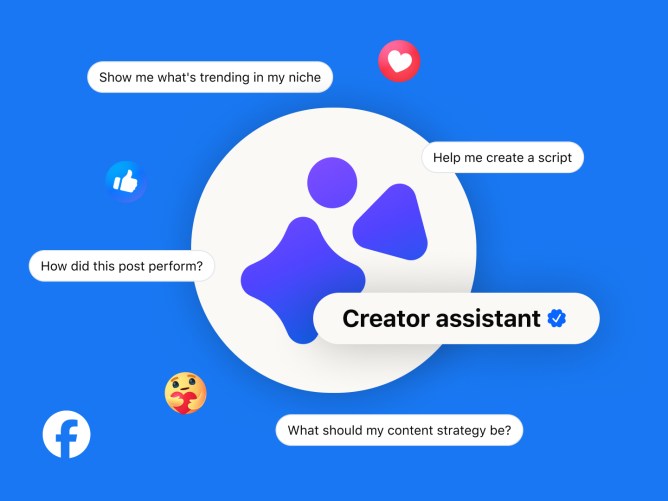
💡Learn how Meta's new AI assistant helps creators scale their presence and reach international markets.
⚡ 30-Second TL;DR
What Changed
Creator Assistant provides personalized guidance to help creators take actionable steps for growth.
Why It Matters
These updates lower the barrier for creators to reach global audiences and optimize their content strategy through automated AI assistance.
What To Do Next
Explore the Meta for Creators portal to see if your account has access to the Creator Assistant beta features.
Key Points
- •Creator Assistant provides personalized guidance to help creators take actionable steps for growth.
- •The tool is designed to understand and adapt to each creator's unique content style and presence.
- •Facebook is increasing the number of supported languages for its AI-driven translation features.
🧠 Deep Insight
Background and context from public sources — not the original article. 12 sources cited.
🔑 Enhanced Key Takeaways
- •Meta's Creator Assistant, integrated into Facebook's creator dashboard, leverages advanced language models such as LLaMA 2 and LLaMA 3 to provide personalized content strategy, performance analysis, and brainstorming capabilities.
- •The expanded AI translation for Reels now includes features like voice characteristic preservation and optional lip-syncing technology, aiming to make translated video content feel more authentic and natural to viewers.
- •Meta's latest Omnilingual Machine Translation (OMT) system, introduced in March 2026, significantly extends AI translation support to over 1,600 languages, a substantial increase from its earlier 200-language NLLB models, with a particular focus on improving reliable translations for low-resource languages.
- •OMT employs a comprehensive data strategy, including synthetic data generation, and utilizes specialized LLM architectures like OMT-LLaMA (based on LLaMA 3) and OMT-NLLB (based on NLLB) to achieve high-quality translation, demonstrating that specialized models can outperform larger general-purpose LLMs for translation tasks.
- •The Creator Assistant is currently rolling out to creators in the United States, Canada, and India, with Meta planning to introduce new capabilities and expand its availability to additional countries in the coming months.
📊 Competitor Analysis▸ Show
| Feature/Metric | Meta AI Translation (OMT) | Google Translate | DeepL |
|---|---|---|---|
| Supported Languages | Over 1,600 | Over 130 | 33 (primarily European, plus Chinese, English, Japanese, Korean) |
| Quality Focus | High quality for low-resource languages; specialization over scale | Broad coverage; quality varies by language pair | High accuracy, especially for European languages |
| Key Features | Voice characteristic preservation, optional lip-syncing for Reels; speech-to-text translation (with Omnilingual ASR) | Text, speech, image, real-time conversation, offline support | Text, documents (PDF, Word, PowerPoint), formal/informal tone options |
| Underlying Models | OMT-LLaMA (based on LLaMA 3), OMT-NLLB (based on NLLB) | Neural Machine Translation (NMT) | Neural Machine Translation (NMT) |
| Pricing | Integrated into Meta platforms (free for users) | Free for personal use; API with usage limits/pricing | Free tier (limited); Pro versions for businesses/API |
🛠️ Technical Deep Dive
- Creator Assistant: Powered by Meta AI, which utilizes Natural Language Processing (NLP) and Machine Learning (ML) technologies, based on advanced language models such as LLaMA 2 and LLaMA 3.
- AI Translation (Omnilingual Machine Translation - OMT):
- Extends translation support to over 1,600 languages, a significant increase from the approximately 200 languages supported by earlier NLLB models.
- Addresses the 'generation bottleneck' to improve reliable translation output, particularly for low-resource languages where understanding is easier than generating fluent text.
- Employs a comprehensive data strategy that integrates large public multilingual corpora with newly created and mined datasets, as well as synthetic data generation.
- Utilizes two distinct architectural approaches for specializing Large Language Models (LLMs) for translation:
- OMT-LLaMA: A decoder-only model built on LLaMA 3, available in multiple sizes (1B, 3B, and 8B parameters).
- OMT-NLLB: An encoder-decoder model built on Meta's multilingual NLLB framework.
- Specialized OMT models in the 1B–8B parameter range achieve translation performance comparable to or exceeding that of a 70B general-purpose LLM, indicating that specialization can be a more reliable path to high-quality multilingual translation than sheer scale.
- Supported by a suite of evaluation tools, including BOUQuET (a benchmark covering 275 languages), Met-BOUQuET (a large-scale human evaluation dataset), MeDLEy (a training dataset focused on extremely low-resource languages), BLASER 3 (a reference-free quality estimation model), and OmniTOX (a multilingual toxicity classifier).
- Designed as a potential foundation for broader multilingual AI, with capabilities that could extend to reasoning, dialogue, and multimodal applications across thousands of languages, and can be combined with large-scale speech recognition systems like Meta's Omnilingual ASR for speech-to-text translation.
🔮 Future ImplicationsAI analysis grounded in cited sources
⏳ Timeline
📎 Sources (12)
Factual claims are grounded in the sources below. Forward-looking analysis is AI-generated interpretation.
Weekly AI Recap
Read this week's curated digest of top AI events →
👉Related Updates
AI-curated news aggregator. All content rights belong to original publishers.
Original source: Meta Newsroom ↗
This is a summary, not the original. Read the source, or get the weekly briefing.
The weekly digest
One email a week. Unsubscribe anytime.