Meta Launches Paid Subscription Tiers for AI Chatbot
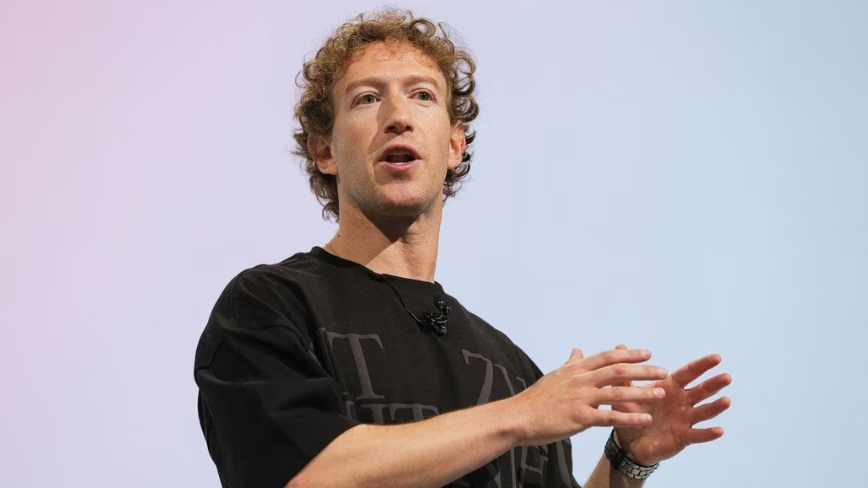
💡Meta enters the consumer AI subscription war; compare their new pricing and features against OpenAI and Google.
⚡ 30-Second TL;DR
What Changed
Meta One Plus priced at $7.99 per month
Why It Matters
Meta's entry into paid consumer AI signals a shift toward monetizing generative models directly. This intensifies the competition for consumer subscription revenue against established players like ChatGPT Plus.
What To Do Next
Compare the output quality and latency of Meta's new premium tiers against GPT-4o and Gemini Advanced to determine the best fit for your creative workflows.
Key Points
- •Meta One Plus priced at $7.99 per month
- •Meta One Premium priced at $19.99 per month
- •Includes expanded access to image and video generation tools
🧠 Deep Insight
Background and context from public sources — not the original article. 27 sources cited.
🔑 Enhanced Key Takeaways
- •The new subscription tiers, Meta One Plus and Meta One Premium, are initially rolling out in Singapore, Guatemala, and Bolivia, with plans for broader international expansion.
- •While Meta AI will continue to offer a free tier for casual use, paid subscribers will gain expanded access to image and video generation, along with enhanced 'extended reasoning capabilities' that will be capped for non-paying users.
- •Meta's pricing strategy includes a $7.99/month Meta One Plus tier, which is designed to undercut existing consumer AI chatbot offerings from competitors like OpenAI and Google, whose premium plans typically start around $19.99/month.
- •These AI chatbot subscriptions are part of a larger 'Meta One' branding initiative, which also encompasses new paid tiers for Meta's other platforms, including Instagram Plus ($3.99/month), Facebook Plus ($3.99/month), and WhatsApp Plus ($2.99/month), as well as business and creator-focused plans (Meta One Essential at $14.99/month and Meta One Advanced at $49.99/month).
- •The introduction of these paid subscriptions represents a strategic shift for Meta to diversify its revenue streams beyond its traditional advertising model and to help recoup its substantial investments in artificial intelligence, especially given its increased capital expenditure guidance for 2026.
📊 Competitor Analysis▸ Show
| Feature/Pricing | Meta One Plus | Meta One Premium | OpenAI ChatGPT Plus | Google Gemini Advanced (Google AI Pro) |
|---|---|---|---|---|
| Price (Monthly) | $7.99 | $19.99 | ~$20 | $19.99 (via Google One AI Premium) |
| Core AI Model | Meta AI (based on Llama family) | Meta AI (based on Llama family) | GPT-5.5 (as of May 2026) | Gemini 2.5 Pro (as of May 2026) |
| Image Generation | Expanded access | Expanded access (more capacity) | Yes (with DALL·E 3) | Yes (multimodal inputs) |
| Video Generation | Expanded access | Expanded access (more capacity) | Limited access to Sora | AI-powered video creation/editing assistant |
| Reasoning Capabilities | Extended reasoning | Deeper reasoning for complex tasks ('thinking mode') | Advanced reasoning models | Enhanced reasoning, complex task handling |
| Context Window | Not specified for consumer tiers | Not specified for consumer tiers | Not specified, but higher message limits | 1,000,000 tokens |
| Other Features | Integrated into Meta apps | Integrated into Meta apps | Faster response times, priority access, custom GPTs, advanced voice mode | 2TB Google One storage, Workspace integration (Gmail, Docs, Sheets), custom AI experts (Gems) |
🛠️ Technical Deep Dive
- Image Generation: Meta AI's image generation is powered by the Emu model, which utilizes advanced diffusion models and the Imagine Flash framework. Imagine Flash accelerates image generation, enabling high-fidelity results in fewer steps by employing techniques like Backward Distillation, Shifted Reconstruction Loss, and Noise Correction. It supports an extended context from 8K to 128K and can generate images at over 800 tokens per second.
- Video Generation: Meta's video generation tool, "Meta Movie Gen," allows users to create 16-second videos at 16 frames per second from text prompts. It incorporates elements like object motion, subject-object interactions, and camera movements for precise control. Movie Gen can also edit existing videos and generate synchronized audio up to 45 seconds. The system comprises models such as Movie Gen Video (30 billion parameters) and Movie Gen Audio (13 billion parameters).
- Underlying LLM Architecture: Meta's AI chatbot is built upon the Llama family of large language models. Llama 3.2 (MLLaMA) is a multimodal model that integrates vision and language capabilities through a two-stage vision encoder and a language model based on the LLaMA 3.1 architecture, using strategically placed cross-attention layers for integration.
- Llama 4 Models: The more recent Llama 4 series (e.g., Scout, Maverick) introduces a Mixture-of-Experts (MoE) architecture, which enhances compute efficiency and quality by activating only a fraction of the model's expert sub-networks per input token. Llama 4 Maverick is highlighted as a best-in-class multimodal model.
- Llama 3.1: The Llama 3.1 405B model, a decoder-only transformer, was trained on over 15 trillion tokens and features a 128K context length.
🔮 Future ImplicationsAI analysis grounded in cited sources
⏳ Timeline
📎 Sources (27)
Factual claims are grounded in the sources below. Forward-looking analysis is AI-generated interpretation.
- thenextweb.com
- gurufocus.com
- gurufocus.com
- mlq.ai
- reddit.com
- pymnts.com
- macrumors.com
- intuitionlabs.ai
- cloudeagle.ai
- openai.com
- cloudeagle.ai
- nexos.ai
- wikipedia.org
- spyglass.org
- tomsguide.com
- reddit.com
- google.com
- encord.com
- morphed.app
- medium.com
- ultralytics.com
- medium.com
- meta.com
- meta.com
- wikipedia.org
- github.io
- serendipity35.net
Weekly AI Recap
Read this week's curated digest of top AI events →
👉Related Updates


AI-curated news aggregator. All content rights belong to original publishers.
Original source: The Next Web (TNW) ↗
This is a summary, not the original. Read the source, or get the weekly briefing.
The weekly digest
One email a week. Unsubscribe anytime.