🐯虎嗅•Stalecollected in 19m
Meta Hikes AI Capex to $145B
💡Meta's $145B AI Capex raise lacks ROI clarity, unlike Google—earnings lesson
⚡ 30-Second TL;DR
What Changed
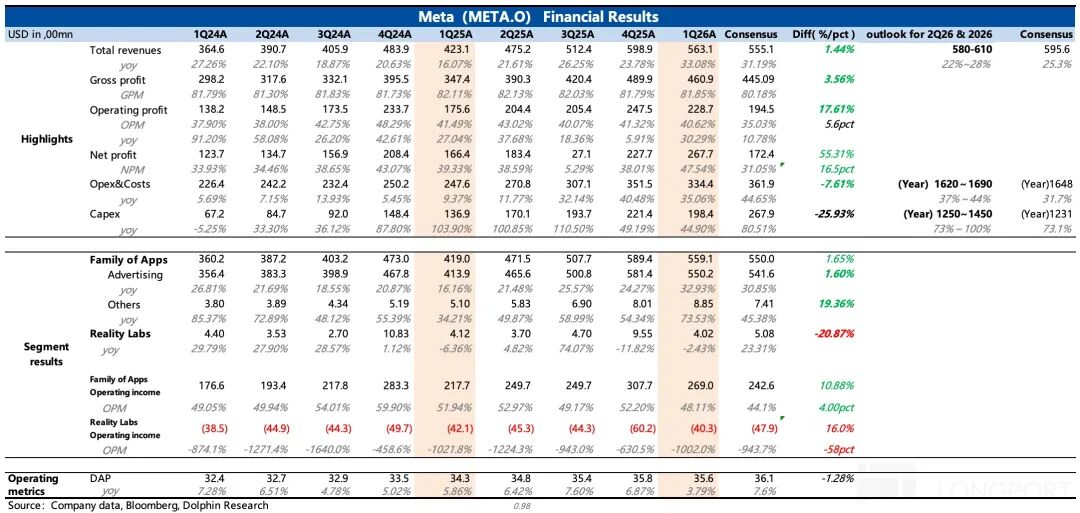
Capex upped to $1250-1450B due to memory price hikes, no Opex cuts.
Why It Matters
Investors question Meta's AI spend without clear returns, capping valuation at ~20x PE vs Google's cloud-driven optimism. Signals need for ToB AI tools to justify infra bets.
What To Do Next
Analyze Meta's Capex breakdown in Q1 10-Q for benchmarking your AI infra costs.
Who should care:Founders & Product Leaders
Key Points
- •Capex upped to $1250-1450B due to memory price hikes, no Opex cuts.
- •Q2 revenue guide at 22-28% growth, with DAU seasonal decline signaling pressures.
- •Strong ads (33% growth) but no pure AI monetization beyond Reels/Threads.
- •No buybacks despite cash pile, prioritizing AI over shareholder returns.
🧠 Deep Insight
AI-generated analysis for this event.
🔑 Enhanced Key Takeaways
- •Meta's aggressive capital expenditure is heavily concentrated on the deployment of 'Llama 4' training clusters, which require significantly higher power density and cooling infrastructure than previous generations.
- •The company is shifting its data center architecture toward a modular design to accommodate the rapid obsolescence cycles of high-end AI accelerators, aiming to reduce long-term facility retrofitting costs.
- •Internal reports indicate that Meta is prioritizing the integration of generative AI agents into its WhatsApp Business API to create a direct enterprise-grade monetization channel, attempting to diversify revenue beyond traditional display advertising.
📊 Competitor Analysis▸ Show
| Feature | Meta (Llama) | Google (Gemini) | Microsoft (Azure/OpenAI) |
|---|---|---|---|
| Primary Monetization | Ad-driven / Open Weights | Cloud API / SaaS | Cloud API / Enterprise SaaS |
| Hardware Strategy | Custom Silicon/H100/B200 | TPU v5p/v6 | Custom Silicon/H100/B200 |
| Ecosystem Focus | Social/Creator Economy | Search/Productivity | Enterprise/Developer Tools |
🛠️ Technical Deep Dive
- •Transition to 'Grand Teton' server architecture, optimized for high-bandwidth memory (HBM3e) requirements of large-scale transformer models.
- •Implementation of Disaggregated Rack architecture to decouple compute and storage, allowing for independent scaling of GPU clusters.
- •Utilization of custom-designed 'MTIA' (Meta Training and Inference Accelerator) chips to supplement NVIDIA GPU deployments and reduce dependency on external supply chains.
- •Deployment of advanced liquid cooling solutions to support the thermal design power (TDP) of next-generation AI accelerators exceeding 700W per chip.
🔮 Future ImplicationsAI analysis grounded in cited sources
Meta will face significant operating margin compression through 2027.
The massive depreciation costs associated with the $145B Capex cycle will begin to hit the income statement as new clusters come online.
Meta will pivot toward a 'Cloud-like' enterprise subscription model.
The lack of non-ad revenue growth will force the company to monetize its Llama model ecosystem through enterprise API access to satisfy investor demands for ROI.
⏳ Timeline
2023-02
Meta releases LLaMA, marking the start of its aggressive open-weights AI strategy.
2024-04
Meta announces Llama 3 and significantly increases 2024 Capex guidance for AI infrastructure.
2025-03
Meta begins large-scale deployment of custom MTIA v2 chips in production data centers.
2026-02
Meta reports record-breaking training cluster size, signaling the start of Llama 4 pre-training.
📰
Weekly AI Recap
Read this week's curated digest of top AI events →
👉Related Updates



AI-curated news aggregator. All content rights belong to original publishers.
Original source: 虎嗅 ↗