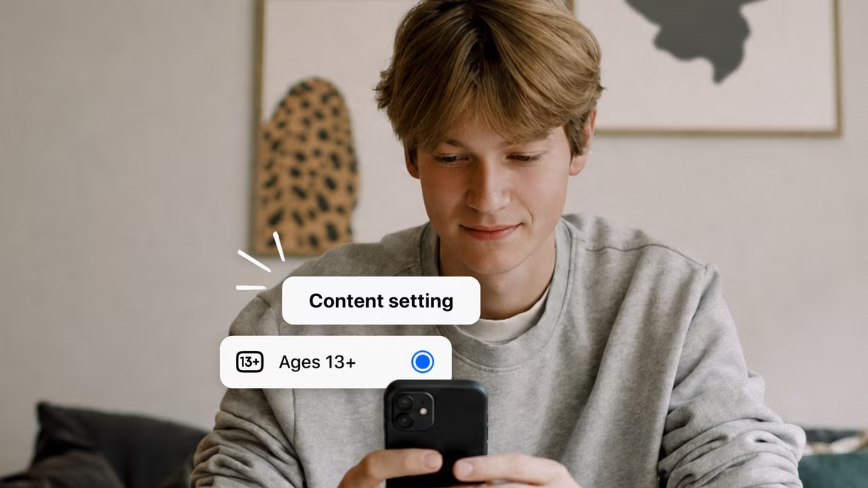
Meta expands 13+ teen content settings globally
💡Understand how Meta is scaling automated content safety guardrails for minors across its global social ecosystem.
⚡ 30-Second TL;DR
What Changed
Content settings now apply by default to all teen accounts worldwide.
Why It Matters
This update signals Meta's increasing reliance on automated content classification and safety guardrails to comply with global regulatory pressures regarding teen safety.
What To Do Next
Review your content moderation pipeline to ensure it supports automated age-gating and classification metadata for compliance with safety standards.
Key Points
- •Content settings now apply by default to all teen accounts worldwide.
- •The system acts as a content filter similar to movie rating classifications.
- •Expansion covers Instagram, Facebook, and Messenger platforms.
🧠 Deep Insight
Background and context from public sources — not the original article. 26 sources cited.
🔑 Enhanced Key Takeaways
- •The global rollout of Meta's 13+ content settings extends a system initially launched in October in the US, UK, Australia, and Canada.
- •Meta is actively testing a new feature on Instagram designed to prevent teens from repeatedly encountering the same type of content, aiming to diversify feeds and mitigate 'algorithmic rabbit holes' for topics such as nutrition, weightlifting, or anxiety.
- •An even stricter 'Limited Content' option, already available on Instagram, is slated for introduction on Facebook and Messenger later in 2026.
- •Independent adversarial testing by Alice (formerly ActiveFence) indicated that Instagram Teen Accounts with the default 13+ setting were exposed to 68% less mature content compared to an unnamed competitor's teen experience.
- •The content restrictions also apply to interactions teenagers have with Meta's AI chatbot, ensuring age-appropriate responses and topics.
📊 Competitor Analysis▸ Show
| Feature/Platform | Meta (Instagram, Facebook, Messenger) | TikTok | YouTube (Supervised Accounts/Kids) |
|---|---|---|---|
| Content Filtering | Default 13+ content settings globally; 'Limited Content' option for stricter filtering; AI-driven moderation; filters for AI chatbot interactions. | Restricted Mode; content moderation system (AI + human); smart keyword filtering; manage topics to tailor 'For You' feed. | YouTube Kids (curated content, no comments); Supervised Accounts with 'Explore' (9+), 'Explore More' (13+), 'Most of YouTube' (some restrictions); Restricted Mode. |
| Parental Controls | Parental supervision tools (time limits, insights into AI chat topics, blocking AI characters); notifications for setting changes; combined block/report option. | Family Pairing (screen-time limits, content restrictions, block accounts, control discoverability/recommendations, report alerts); notifications for public uploads/setting changes. | Google Family Link integration; set daily limits on Shorts; full Shorts block; custom 'Take a Break' and bedtime reminders; pause watch/search history; block specific channels/videos. |
| Default Privacy | Teen accounts default to private; default 13+ content settings cannot be opted out of by teens under 18 without parental permission. | Accounts for ages 13-15 are private by default; certain posting/download permissions restricted unless changed. | Teen uploads set to most private option by default; age-based content levels for YouTube Kids; supervised accounts have some protections around ads and data collection. |
| Age Verification | Relies on AI analysis and secure video selfie verification partnerships. | Officially 13+ but does not reliably verify age at account creation. | Estimates user ages and automatically applies teen protections; Google Family Link for supervised accounts. |
🛠️ Technical Deep Dive
- The content filtering system is described as 'movie-ratings-inspired' and aims to hide content deemed inappropriate for teens in Feed and Reels.
- It also limits teens' interactions with Profiles, Pages, Groups, and Events that primarily post such material.
- For Messenger, the system restricts teens from opening links to inappropriate content or chatting with accounts that predominantly share it on Facebook.
- Meta utilizes AI analysis and partnerships for secure video selfie verification as methods for age verification.
- A new feature being tested on Instagram aims to diversify content by trialing limits on how many similar posts (e.g., about nutrition, weightlifting, anxiety) appear consecutively in Explore, Feed, and Reels to prevent 'algorithmic rabbit holes.'
- Meta commissioned Alice (formerly ActiveFence), a trust and safety firm, to perform adversarial stress-testing against the content settings to evaluate their effectiveness.
🔮 Future ImplicationsAI analysis grounded in cited sources
⏳ Timeline
📎 Sources (26)
Factual claims are grounded in the sources below. Forward-looking analysis is AI-generated interpretation.
- thenextweb.com
- news.az
- qz.com
- mashable.com
- cybernews.com
- helpnetsecurity.com
- fb.com
- wasabisys.com
- gigabitiq.com
- kidmatterscounseling.com
- tiktok.com
- screenwiseapp.com
- bitdefender.com
- globaldayofunplugging.org
- understandtech.co.uk
- kids360.app
- mashable.com
- cnet.com
- engadget.com
- socialmediatoday.com
- fb.com
- cybersmile.org
- myfirst.tech
- meta.com
- popsci.com
- fb.com
Weekly AI Recap
Read this week's curated digest of top AI events →
👉Related Updates


AI-curated news aggregator. All content rights belong to original publishers.
Original source: The Next Web (TNW) ↗
This is a summary, not the original. Read the source, or get the weekly briefing.
The weekly digest
One email a week. Unsubscribe anytime.