Meta Doubles GEM Training Efficiency
See how Meta reached 20–25% MFU while scaling an ads model to thousands of GPUs.
30-Second TL;DR
What Changed
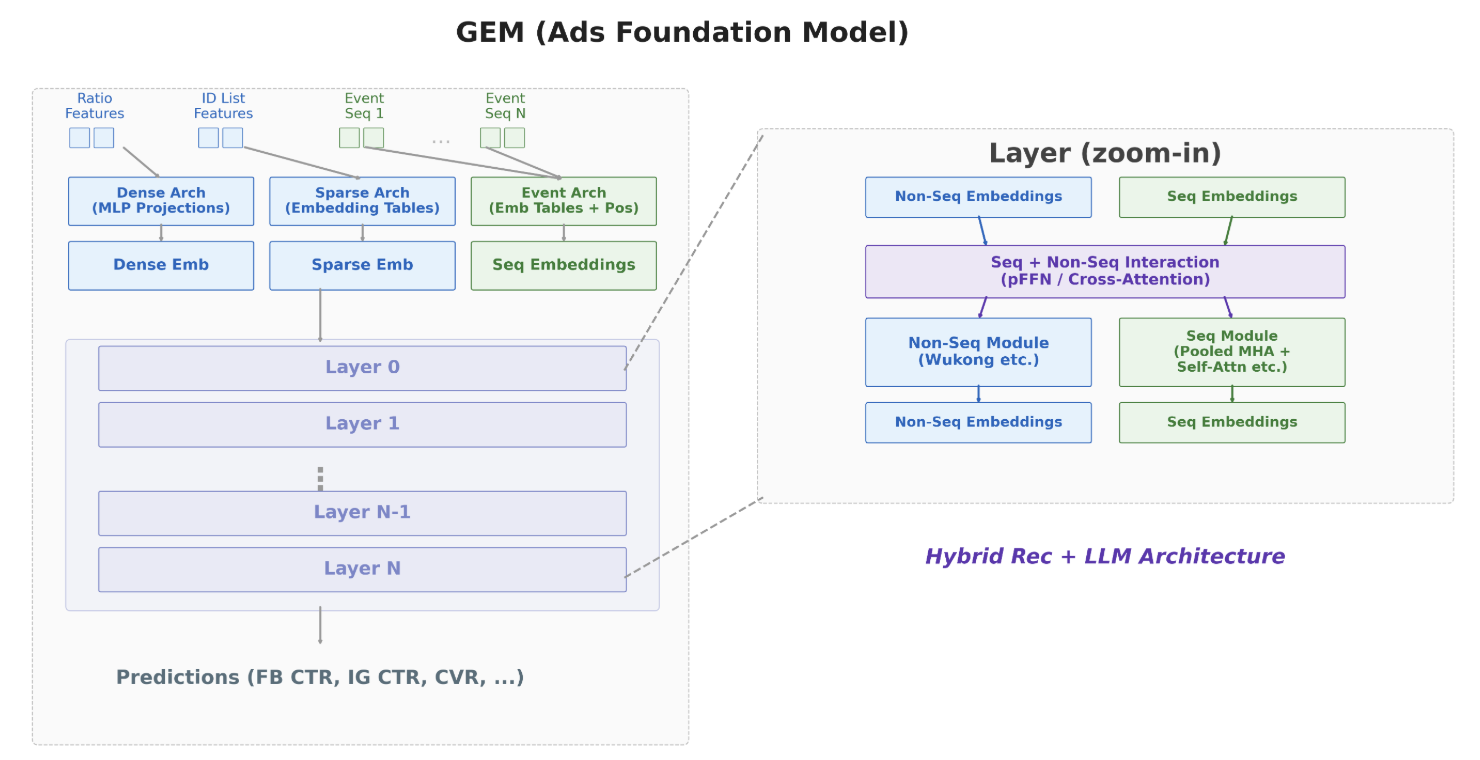
GEM is Meta’s foundation model for ad recommendations across Instagram and Facebook.
Why It Matters
The results show that large recommendation models can benefit substantially from infrastructure and systems optimization, not only from larger models or datasets. Meta’s approach may offer useful efficiency benchmarks for companies training large-scale production models.
What To Do Next
Profile your next distributed training run with NVIDIA Nsight Systems and use 20–25% MFU as an initial efficiency benchmark.
Key Points
- •GEM is Meta’s foundation model for ad recommendations across Instagram and Facebook.
- •The training system now operates at LLM scale across several thousand latest-generation GPUs.
- •Meta doubled end-to-end training efficiency to 20–25% Model FLOPs Utilization.
- •Training FLOPs increased fourfold while maintaining higher computational efficiency.
Deep Insight
AI-generated analysis for this event — not the original article.
Enhanced Key Takeaways
- •Meta utilized a custom-built distributed training framework, likely an evolution of PyTorch FSDP (Fully Sharded Data Parallel), to manage the massive communication overhead across thousands of GPUs.
- •The efficiency gains were largely driven by optimizing the 'all-to-all' communication patterns inherent in large-scale embedding table lookups, which are critical for ad recommendation models.
- •GEM leverages a hybrid parallelism strategy that combines tensor parallelism for dense layers and pipeline parallelism for the massive embedding tables required for user-item interactions.
- •The transition to 'latest-generation GPUs' implies the integration of high-bandwidth memory (HBM3e) and specialized transformer engines that accelerate FP8 training precision without sacrificing model convergence.
- •Meta's optimization efforts included custom kernel fusion for the recommendation-specific operators, reducing the memory footprint and latency bottlenecks typically found in standard deep learning frameworks.
Competitor Analysis
- Meta (GEM)
- Foundation Model / Transformer
- Google (Ads AI)
- Transformer / Mixture-of-Experts
- ByteDance (Monolith)
- Real-time Streaming / Embedding-heavy
- Meta (GEM)
- Thousands of GPUs
- Google (Ads AI)
- Massive TPU Clusters
- ByteDance (Monolith)
- Distributed CPU/GPU Hybrid
- Meta (GEM)
- Model FLOPs Utilization (MFU)
- Google (Ads AI)
- Latency & Throughput
- ByteDance (Monolith)
- Real-time Update Frequency
| Feature | Meta (GEM) | Google (Ads AI) | ByteDance (Monolith) |
|---|---|---|---|
| Architecture | Foundation Model / Transformer | Transformer / Mixture-of-Experts | Real-time Streaming / Embedding-heavy |
| Training Scale | Thousands of GPUs | Massive TPU Clusters | Distributed CPU/GPU Hybrid |
| Efficiency Focus | Model FLOPs Utilization (MFU) | Latency & Throughput | Real-time Update Frequency |
Technical Deep Dive
- Implementation of 2D/3D parallelism to shard massive embedding tables that exceed the memory capacity of a single GPU node.
- Utilization of asynchronous gradient updates to hide communication latency during the backward pass of the training loop.
- Adoption of FP8 mixed-precision training to double throughput while maintaining the numerical stability required for sparse recommendation tasks.
- Optimization of collective communication primitives (NCCL) specifically tuned for the high-radix network topologies of Meta's latest data center clusters.
- Integration of custom memory allocators to reduce fragmentation during the training of models with billions of parameters.
Future ImplicationsAI analysis grounded in cited sources
Timeline
- 2022-05Meta announces the consolidation of its AI infrastructure to support large-scale recommendation models.
- 2023-03Meta releases PyTorch 2.0 with improved support for distributed training and compiler optimizations.
- 2024-06Meta begins large-scale deployment of its latest-generation GPU clusters for generative AI workloads.
- 2025-11Meta reports initial successful scaling of foundation models for recommendation tasks.
- 2026-08Meta achieves 20-25% Model FLOPs Utilization for GEM training.
Weekly AI Recap
Read this week's curated digest of top AI events →
AI-curated news aggregator. All content rights belong to original publishers.
Original source: Meta Engineering Blog ↗
This is a summary, not the original. Read the source, or get the weekly briefing.
The weekly digest
One email a week. Unsubscribe anytime.