Meta AI Testing New Deep Research and Presentation Modes
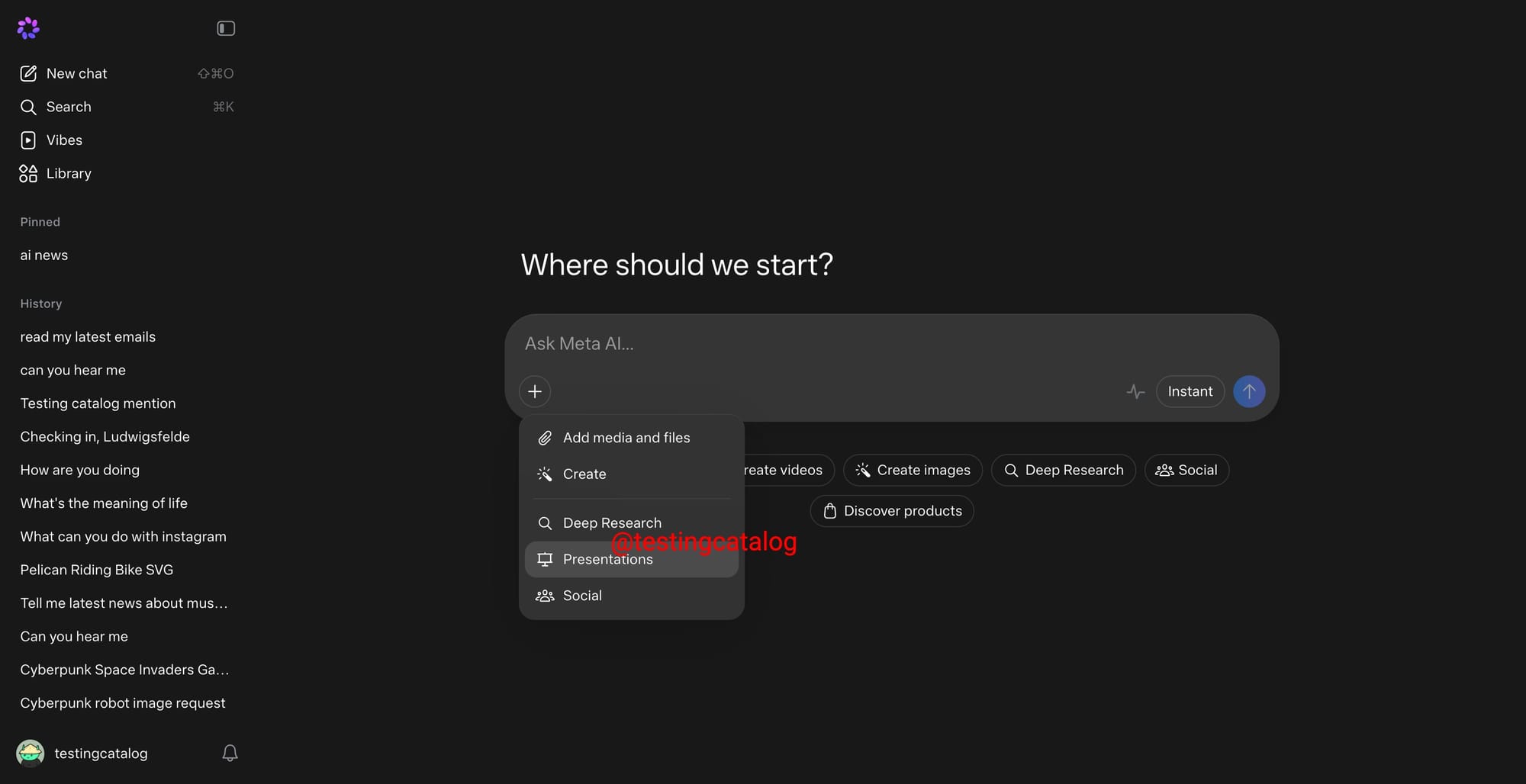
💡Meta is expanding its AI agent capabilities to compete with specialized research and presentation tools.
⚡ 30-Second TL;DR
What Changed
Introduction of a dedicated 'Deep Research' mode for complex information gathering.
Why It Matters
These features signal Meta's intent to compete directly with specialized AI research and productivity tools, potentially reducing the need for third-party plugins. It marks a shift toward an 'all-in-one' agentic workflow within the Meta ecosystem.
What To Do Next
Monitor the Meta AI web interface for the rollout of these modes to evaluate if they can replace your current research or slide-generation workflows.
Key Points
- •Introduction of a dedicated 'Deep Research' mode for complex information gathering.
- •New 'Presentation' mode to automate the creation of slide decks.
- •Addition of 'Social' mode to enhance interactive capabilities on the web interface.
🧠 Deep Insight
Background and context from public sources — not the original article. 23 sources cited.
🔑 Enhanced Key Takeaways
- •Meta AI's new modes are powered by its Llama family of large language models, with Llama 3, released in April 2024, demonstrating competitive performance against other leading AI models.
- •The AI assistant is deeply integrated across Meta's social platforms, including Facebook, Instagram, WhatsApp, and Messenger, and is also available as a standalone app, offering features like real-time conversational AI and image generation.
- •Beyond software, Meta AI extends its functionality to hardware such as Ray-Ban Meta smartglasses, enabling hands-free interaction, live AI views, real-time translation, and the ability to control devices or ask questions about the surroundings.
- •The 'Social' mode is expected to leverage Meta AI's capability to cite public posts from Instagram, Facebook, and Threads, providing richer, context-aware responses and local recommendations tailored to a user's personal style.
- •The 'Deep Research' mode will enter a competitive landscape with existing AI research assistants like Google Gemini, ChatGPT, Perplexity AI, and specialized tools such as Elicit and Consensus, which offer features like structured data extraction and evidence-grounded answers.
📊 Competitor Analysis▸ Show
| Feature/Category | Meta AI (Deep Research/Presentation Modes) | Google Gemini (Deep Research/Slides) | ChatGPT (Deep Research) | Gamma (Presentation Maker) | Plus AI (Presentation Maker) |
|---|---|---|---|---|---|
| Primary Use Case | Complex info gathering, automated slide creation, social interaction | Research, summarization, content generation, slide drafting | In-depth research reports, content generation | Versatile presentation creation, web-native design | Professional presentations, native integration with MS/Google Slides |
| Underlying Models | Llama family (e.g., Llama 3) | Gemini models | GPT-4, GPT-5.5 | AI models (unspecified, but includes web search) | AI models (unspecified) |
| Integration | Deeply integrated into Meta apps (Facebook, Instagram, WhatsApp, Messenger), standalone app, Ray-Ban Meta glasses | Google Workspace (Slides, Docs), standalone app | Standalone app, desktop/mobile apps | Standalone web platform | Google Slides, PowerPoint add-on |
| Research Capabilities | Aims for complex information gathering, deep dives | Speed, clarity, high source counts (18-28 per task), smart summarization | Full (30 min) and lightweight (few min) reports, reasoning depth, detailed sourcing (7-27 sources) | Agent can search the web, pull live data, generate fact-based slides | N/A (focused on presentations) |
| Presentation Capabilities | Automates slide deck creation | Drafts slide text, summarizes docs, generates visuals in Slides editor | Can generate basic slides (via chatbot) | AI image generation, restyle decks, real-time collaboration | Generates full presentations/single slides, rewrites/reformats, creates charts/images |
| Pricing (Approx. Monthly) | Free within Meta apps, standalone app (details for new modes not specified) | Free plan (standard limits), AI Plus (2x limits), AI Pro (4x limits) | Free (limited lightweight), Plus ($20), Team/Edu (10 full/15 lightweight), Pro (125 full/125 lightweight) | Free (400 credits), Plus ($8-10), Pro ($15-20) | Varies (often subscription-based, e.g., Plus AI for Google Slides) |
🛠️ Technical Deep Dive
- Llama (Large Language Model Meta AI): A family of large language models, with Llama 3 (released April 2024) featuring 8B and 70B parameters, trained on approximately 15 trillion tokens of text from publicly available sources. It includes instruction fine-tuned models and plans for multilingual and multimodal capabilities.
- MEGABYTE: A multiscale decoder architecture designed to model sequences exceeding one million bytes by dividing them into fixed-sized patches, addressing challenges in long sequence processing and scalability for content generation.
- ImageBIND: A multimodal AI architecture that processes and analyzes data from six different modalities (image, video, audio, text, depth, thermal, IMU) by creating a joint embedding space, leading to a more comprehensive understanding of information.
- MTIA (Meta Training and Inference Accelerator): An Application-Specific Integrated Circuit (ASIC) chip developed by Meta AI to efficiently handle its AI workloads, particularly for recommendation systems, as part of a full-stack solution including silicon, PyTorch, and models.
- V-JEPA 2 (Video Joint Embedding Predictive Architecture 2): A self-supervised world model trained on video data to achieve state-of-the-art visual understanding and prediction, enabling zero-shot robot control in new environments through a two-phase training approach.
- Large Concept Models: A new architectural approach that operates on higher-level semantic representations, referred to as 'concepts' (e.g., sentences), rather than individual tokens, utilizing the SONAR sentence embedding space which supports over 200 languages.
- PyTorch: An open-source deep learning framework widely used by Meta AI for its flexibility and modularity, facilitating rapid experimentation and production deployment.
🔮 Future ImplicationsAI analysis grounded in cited sources
⏳ Timeline
📎 Sources (23)
Factual claims are grounded in the sources below. Forward-looking analysis is AI-generated interpretation.
Weekly AI Recap
Read this week's curated digest of top AI events →
👉Related Updates
AI-curated news aggregator. All content rights belong to original publishers.
Original source: TestingCatalog ↗
This is a summary, not the original. Read the source, or get the weekly briefing.
The weekly digest
One email a week. Unsubscribe anytime.