Matrix Super Intelligence Unveils MATRIX-3 Humanoid Robot
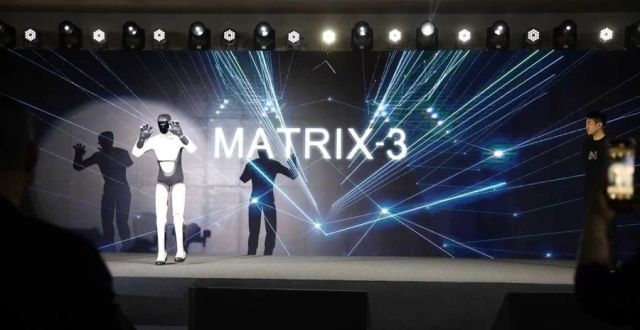
Aggressive 100k unit production target for humanoid robots suggests a major scale-up in embodied AI hardware.
30-Second TL;DR
What Changed
MATRIX-3 stands 170cm tall and weighs 65kg
Why It Matters
This aggressive production target signals a rapid shift toward commercializing humanoid robots for industrial or service applications.
What To Do Next
Monitor the supply chain and hardware specifications of MATRIX-3 to evaluate its potential for integration into automated workflows.
Key Points
- •MATRIX-3 stands 170cm tall and weighs 65kg
- •Company targets 100,000 units in mass production by 2027
- •Represents a significant scaling effort in embodied AI hardware
Deep Insight
Background and context from public sources — not the original article. 10 sources cited.
Enhanced Key Takeaways
- •The MATRIX-3 is positioned as a 'China's Optimus,' aiming for general-purpose physical intelligence in unstructured, real-world environments, moving beyond pre-programmed industrial tasks.
- •Its biomimetic design incorporates a flexible, 3D-woven skin with embedded high-dimensional tactile sensing, capable of detecting pressure as low as 0.1 N for nuanced physical interactions.
- •The robot's cognitive core is powered by a proprietary neural network architecture that enables zero-shot generalization, allowing it to adapt to unfamiliar tasks and complex environments using natural language instructions without prior specific training.
- •Matrix Super Intelligence (also known as Matrix Robotics) was established in Shanghai in 2024, with initial pilot deployments for the MATRIX-3 planned for mid-2026.
- •The company's ambitious target of mass producing 100,000 units by 2027 signifies a significant push towards commoditizing humanoid hardware, contrasting with many competitors still in prototype or small-batch pilot phases.
Competitor Analysis
- Matrix Super Intelligence (MATRIX-3)
- 170cm
- Tesla (Optimus)
- ~1.73m
- Agility Robotics (Digit)
- N/A (focus on torso/legs)
- Unitree Robotics (G1)
- N/A (focus on torso/legs)
- Sanctuary AI (Phoenix)
- N/A
- Matrix Super Intelligence (MATRIX-3)
- 65kg
- Tesla (Optimus)
- ~20kg payload
- Agility Robotics (Digit)
- N/A
- Unitree Robotics (G1)
- N/A
- Sanctuary AI (Phoenix)
- N/A
- Matrix Super Intelligence (MATRIX-3)
- Zero-shot generalization via proprietary neural network, spatial perception foundation model
- Tesla (Optimus)
- Utilizes Full Self-Driving (FSD) stack for real-world navigation and object identification
- Agility Robotics (Digit)
- Focus on reliable material handling, autonomous operation
- Unitree Robotics (G1)
- N/A (focus on hardware commoditization)
- Sanctuary AI (Phoenix)
- Carbon™ AI system for precise manipulation from natural language
- Matrix Super Intelligence (MATRIX-3)
- 27 DoF dexterous hand
- Tesla (Optimus)
- 28 DoF
- Agility Robotics (Digit)
- N/A
- Unitree Robotics (G1)
- N/A
- Sanctuary AI (Phoenix)
- N/A
- Matrix Super Intelligence (MATRIX-3)
- Target 100,000 units by 2027, pilot deployments mid-2026
- Tesla (Optimus)
- Target 50,000 units annually by end of 2026
- Agility Robotics (Digit)
- Over 100,000 successful warehouse cycles by early 2026
- Unitree Robotics (G1)
- Commercially available, rapid iteration cycles
- Sanctuary AI (Phoenix)
- Performs tricky jobs, aims for human-like brain control
- Matrix Super Intelligence (MATRIX-3)
- N/A (early access program for partners)
- Tesla (Optimus)
- N/A
- Agility Robotics (Digit)
- RaaS model
- Unitree Robotics (G1)
- ~$16,000+
- Sanctuary AI (Phoenix)
- N/A
| Feature / Company | Matrix Super Intelligence (MATRIX-3) | Tesla (Optimus) | Agility Robotics (Digit) | Unitree Robotics (G1) | Sanctuary AI (Phoenix) |
|---|---|---|---|---|---|
| Height | 170cm | ~1.73m | N/A (focus on torso/legs) | N/A (focus on torso/legs) | N/A |
| Weight | 65kg | ~20kg payload | N/A | N/A | N/A |
| Key AI Feature | Zero-shot generalization via proprietary neural network, spatial perception foundation model | Utilizes Full Self-Driving (FSD) stack for real-world navigation and object identification | Focus on reliable material handling, autonomous operation | N/A (focus on hardware commoditization) | Carbon™ AI system for precise manipulation from natural language |
| Degrees of Freedom (DoF) | 27 DoF dexterous hand | 28 DoF | N/A | N/A | N/A |
| Production Target/Status | Target 100,000 units by 2027, pilot deployments mid-2026 | Target 50,000 units annually by end of 2026 | Over 100,000 successful warehouse cycles by early 2026 | Commercially available, rapid iteration cycles | Performs tricky jobs, aims for human-like brain control |
| Approx. Price | N/A (early access program for partners) | N/A | RaaS model | ~$16,000+ | N/A |
Technical Deep Dive
- Cognitive Core: Powered by a proprietary neural network architecture that enables advanced reasoning, adaptability, and zero-shot generalization, allowing the robot to understand basic physical laws and execute novel tasks from natural language instructions without prior training.
- Biomimetic Design & Sensing: Features a flexible, 3D-woven skin that wraps the robot, embedding high-dimensional tactile sensing across its contact surfaces. High-sensitivity tactile sensor arrays in the fingertips can detect pressure as low as 0.1 N, enabling nuanced physical interactions.
- Dexterous Manipulation: Equipped with a dexterous hand featuring 27 degrees of freedom (DoF), utilizing cable-driven technology for lightweight configuration, high-speed precision, and the ability to operate standard tools or manipulate delicate objects.
- Vision System: Incorporates an upgraded vision system powered by a large-scale spatial perception foundation model, facilitating precise object handling and environmental mapping through a visual-tactile feedback loop.
- Locomotion: Achieves a natural humanoid gait through a general motion control model trained on extensive human motion-capture datasets, resulting in fluid and human-like walking, turning, and overall movement.
- Actuators: Uses proprietary integrated linear actuators that combine high power density with low-noise operation, providing a stable and agile foundation for full-body coordination.
- Processing Hardware: Features an 8-core high-performance ARM-based processor and an integrated high-density GPU specifically optimized for spatial reasoning.
Future ImplicationsAI analysis grounded in cited sources
Timeline
- 2024Matrix Robotics (Matrix Super Intelligence) established in Shanghai.
- 2024-12Release of MATRIX-1, the company's first-generation humanoid robot.
- 2026-01-10Official unveiling of the third-generation flagship humanoid robot, MATRIX-3.
- 2026-05-19Pandaily reports on the MATRIX-3 unveiling and the company's mass production target.
Sources (10)
Factual claims are grounded in the sources below. Forward-looking analysis is AI-generated interpretation.
Weekly AI Recap
Read this week's curated digest of top AI events →
Related Updates



AI-curated news aggregator. All content rights belong to original publishers.
Original source: Pandaily ↗
This is a summary, not the original. Read the source, or get the weekly briefing.
The weekly digest
One email a week. Unsubscribe anytime.