☁️AWS Machine Learning Blog•Freshcollected in 28m
Master Bedrock Model Lifecycle Management
💡New Bedrock feature prevents app crashes from model changes—essential for prod AI.
⚡ 30-Second TL;DR
What Changed
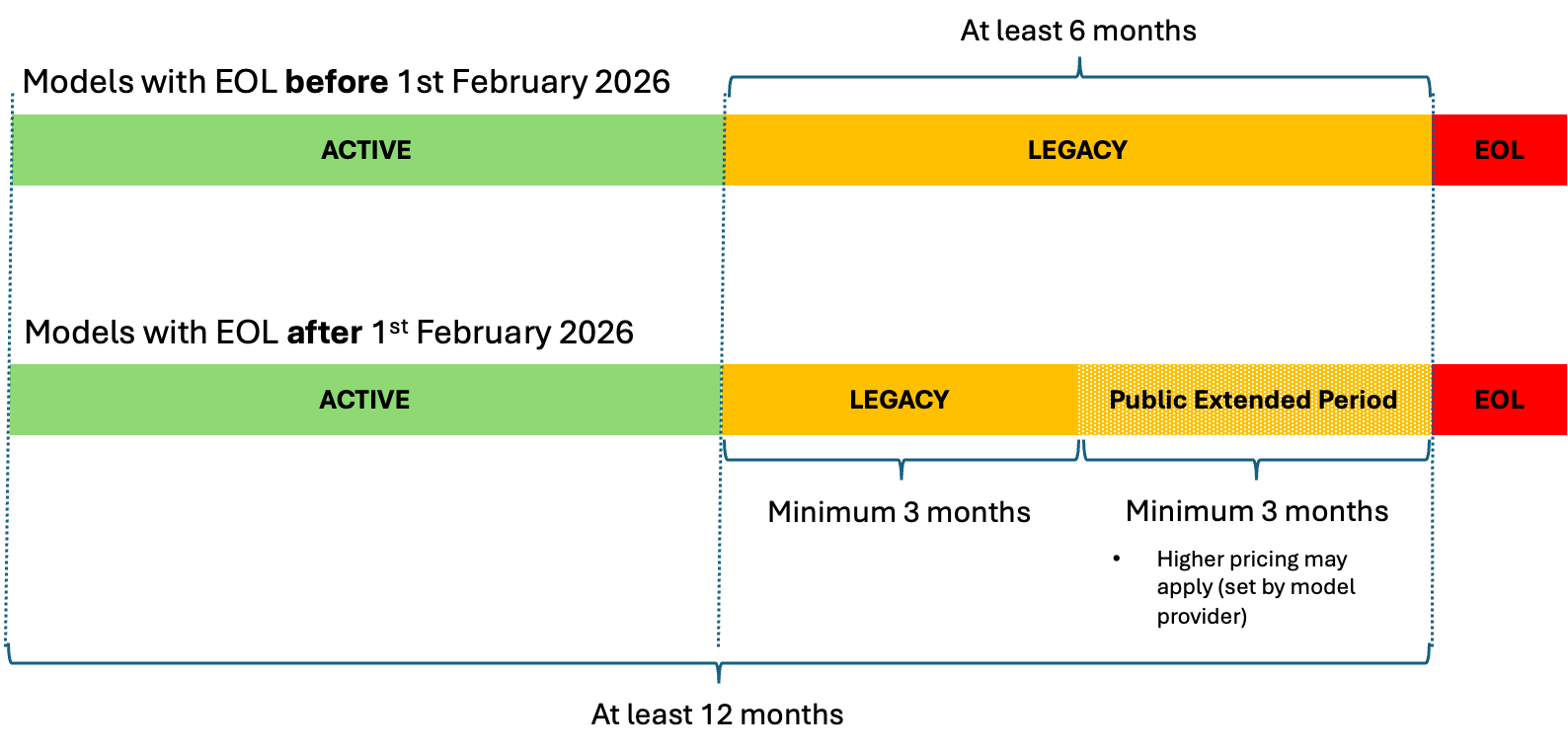
Three lifecycle states for Bedrock foundation models.
Why It Matters
Empowers developers to maintain production AI reliability by smoothly handling model deprecations, reducing unexpected downtime.
What To Do Next
Review Bedrock console for your models' lifecycle states and enable extended access for migrations.
Who should care:Developers & AI Engineers
🧠 Deep Insight
AI-generated analysis for this event.
🔑 Enhanced Key Takeaways
- •The lifecycle management framework introduces specific deprecation timelines, typically providing customers with a minimum of 6 months of notice before a model version is retired, ensuring enterprise-grade stability.
- •Extended access allows developers to maintain API compatibility with older model versions beyond their standard retirement date for a premium cost, facilitating phased migration for complex, high-stakes production workloads.
- •The transition strategy emphasizes 'Model Aliasing' and version-specific ARN pinning, which allows developers to decouple application code from specific model versions, enabling seamless updates without requiring full redeployments.
📊 Competitor Analysis▸ Show
| Feature | Amazon Bedrock (Lifecycle Mgmt) | Google Vertex AI (Model Garden) | Azure OpenAI Service |
|---|---|---|---|
| Lifecycle Control | Explicit state tracking & extended access | Versioning & lifecycle labels | Model versioning & retirement policies |
| Migration Support | Automated transition tools & aliasing | Managed model updates | Version-specific API endpoints |
| Pricing Model | Pay-as-you-go + Extended access fees | Pay-as-you-go | Pay-as-you-go |
🛠️ Technical Deep Dive
- Model Versioning Architecture: Bedrock utilizes immutable ARNs (Amazon Resource Names) for every model version, ensuring that once a model is deployed, its behavior remains deterministic regardless of global updates.
- Extended Access Implementation: This feature leverages a side-car control plane that maintains the inference environment for deprecated models, isolated from the primary model serving fleet to prevent performance degradation.
- Lifecycle States: The three states are defined as 'Active' (fully supported), 'Deprecated' (no new features, security patches only), and 'Retired' (inaccessible via standard APIs).
- API Compatibility: The system supports header-based versioning, allowing clients to specify the desired model version in the request metadata, which the Bedrock routing layer uses to direct traffic to the appropriate cluster.
🔮 Future ImplicationsAI analysis grounded in cited sources
Enterprise adoption of generative AI will shift from experimental to long-term maintenance focus.
Standardized lifecycle management reduces the operational risk of model obsolescence, a primary barrier for large-scale enterprise AI deployment.
Model-as-a-Service (MaaS) providers will increasingly monetize 'legacy support' as a standard enterprise feature.
The introduction of extended access fees creates a new recurring revenue stream for cloud providers by catering to risk-averse organizations.
⏳ Timeline
2023-04
Amazon Bedrock announced in preview to provide managed foundation models.
2023-09
Amazon Bedrock becomes generally available with support for multiple model providers.
2024-05
Introduction of Provisioned Throughput for consistent performance on specific model versions.
2025-02
Expansion of model evaluation and lifecycle management tools within the Bedrock console.
📰
Weekly AI Recap
Read this week's curated digest of top AI events →
👉Related Updates
AI-curated news aggregator. All content rights belong to original publishers.
Original source: AWS Machine Learning Blog ↗

