Embed Live AI Browser Agent in React Apps
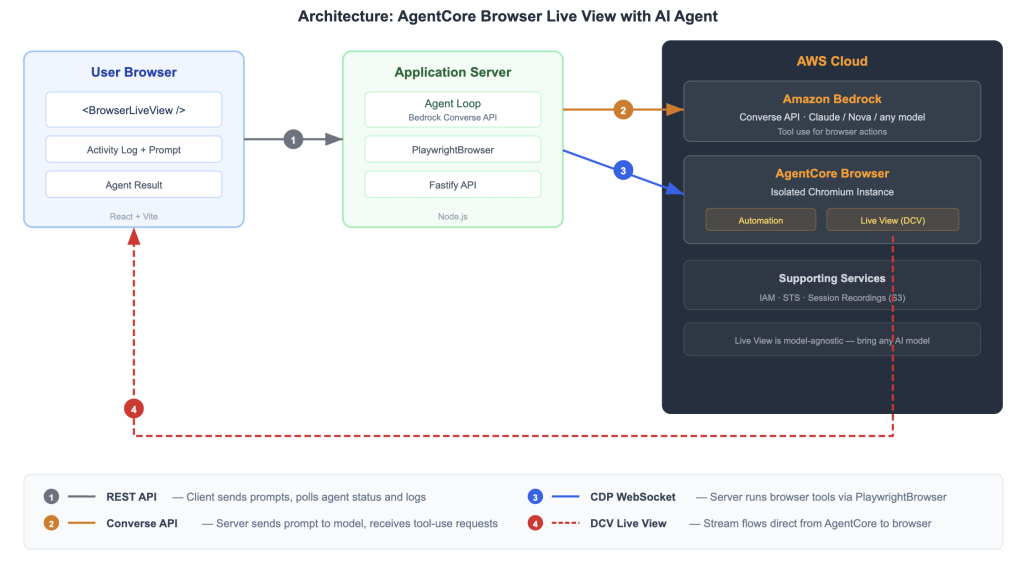
💡Build watchable AI browser agents in React with Bedrock's 3-step tutorial.
⚡ 30-Second TL;DR
What Changed
Start session and generate Live View URL for browser agent
Why It Matters
Empowers developers to build interactive AI-driven web experiences easily. Lowers barrier for integrating observable AI agents into front-end apps.
What To Do Next
Clone the sample React app from the AWS blog and run the live AI browser demo.
Key Points
- •Start session and generate Live View URL for browser agent
- •Render real-time stream directly in React application
- •Wire AI agent to autonomously drive the browser
- •Provides cloneable sample app for immediate testing
🧠 Deep Insight
AI-generated analysis for this event — not the original article.
🔑 Enhanced Key Takeaways
- •Amazon Bedrock AgentCore utilizes a specialized WebRTC-based streaming protocol to minimize latency between the headless browser environment and the React frontend, ensuring sub-100ms interaction feedback.
- •The architecture leverages a 'Human-in-the-Loop' (HITL) override mechanism, allowing developers to inject manual DOM events into the agent's execution stream without terminating the active session.
- •Security is managed through ephemeral, scoped IAM roles generated per session, which restrict the browser agent's access to specific URL domains and prevent unauthorized data exfiltration during autonomous tasks.
📊 Competitor Analysis▸ Show
| Feature | Amazon Bedrock AgentCore | MultiOn | Browserbase |
|---|---|---|---|
| Integration | Native AWS ecosystem | API-first / SDK | API-first / SDK |
| Pricing | Consumption-based (Bedrock) | Tiered Subscription | Usage-based |
| Latency | Low (WebRTC optimized) | Moderate | Low |
| Primary Focus | Enterprise/AWS Native | Consumer/General Agent | Developer/Infrastructure |
🛠️ Technical Deep Dive
- Session Orchestration: Uses a WebSocket-based signaling server to negotiate WebRTC peer connections between the AWS-managed headless browser container and the client-side React component.
- Agent Architecture: Built on a ReAct (Reasoning + Acting) pattern, utilizing Claude 3.5 Sonnet or Haiku models to parse DOM snapshots and generate actionable browser commands (e.g., click, type, scroll).
- DOM Serialization: Employs a lightweight accessibility tree representation rather than raw HTML to reduce token consumption and improve agent reasoning accuracy.
- React Integration: Provides a custom
useAgentSessionhook that handles state synchronization, stream cleanup, and event proxying between the React synthetic event system and the remote browser.
🔮 Future ImplicationsAI analysis grounded in cited sources
⏳ Timeline
Weekly AI Recap
Read this week's curated digest of top AI events →
👉Related Updates
AI-curated news aggregator. All content rights belong to original publishers.
Original source: AWS Machine Learning Blog ↗
This is a summary, not the original. Read the source, or get the weekly briefing.
The weekly digest
One email a week. Unsubscribe anytime.